Showing posts with label Mexico City. Show all posts

Saturday, October 30, 2021

Day of the Dead Transformed by Commercialization Over the Centuries

The Conversation, October 27, 2021 | By Mathew Sandoval*

As a Mexican-American who celebrates Día de los Muertos, or the Day of the Dead, at the end of October and beginning of November, I’ve noted an increasing concern the past several years that the holiday is becoming more commercialized

The mass-marketing of the Day of the Dead is evident in the costumes that people buy for the day. Credit: Man Hon Lam / EyeEm Getty Images

Indeed, for those who hold the holiday sacred, it’s jarring to see the extent to which it’s now mass-marketed. The evidence is everywhere. The holiday aisles of Target are stuffed with cheap Day of the Dead crafts during October. Halloween stores sell Day of the Dead costumes. Nike makes Day of the Dead shoes. California and Arizona sell Day of the Dead lottery tickets. Disney famously tried to trademark “Día de los Muertos” before its 2017 film “Coco.” The examples go on and on.

The bottom line is that Día de los Muertos and its associated imagery, skulls and skeletons have become trendy and a prime opportunity for companies to make a profit.

But as a researcher of culture and performance, I know only too well that the truth is Day of the Dead has always been commodified.

The Roots of Commercialization

Day of the Dead is what anthropologist Hugo Nutini calls a syncretic holiday, meaning it’s a cultural product of two different religious traditions that hybridized during the European colonization of the Americas.

Day of the Dead brings together the annual feasts for the dead celebrated by pre-Hispanic Indigenous cultures such as the Aztec, Maya, Zapotec and Mixtec peoples. During Mexico’s 300-year-long colonial period, which started in 1521, these Indigenous rituals were merged with the Spanish Catholic holy days for the dead known as All Saints, celebrated on Nov. 1, and All Souls on Nov. 2.

Early Spanish chroniclers in Mesoamerica such as Diego Duran and Bernardino Sahagún documented the Aztec feasts for the dead known as Miccailhuitontli and Huey Miccailhuitl. Duran wrote in the 1570s that he was astounded to see how lavishly the Aztecs spent on supplies for their offerings to the dead.

Sahagún noted the overwhelming bustle and financial activity that took place at the market in the capital city of Tenochtitlán, modern-day Mexico City, during the Aztec ritual feasts.

All manner of foods and goods were sold to citizens to celebrate the Aztec feasts of the dead. In this respect, there wasn’t much distinction between commercial and religious activity. The religious feasts supported the market and vice versa.

The Catholic religion also emphasized commercial activity in relation to All Saints and All Souls Day. According to 16th- and 17th-century Catholic belief, the majority of souls landed in purgatory after death, rather than heaven or hell. It was the responsibility of the living to help alleviate the suffering of souls in purgatory and assist them in getting to heaven. This could be done through prayer or by making offerings to the souls.

In Mexico that meant Spanish colonizers and newly converted Indigenous Catholics were tasked with purchasing directly from the church candles and other religious items that could be used in offerings to those souls in purgatory. Additionally, they could pay their local priest to say special prayers for the souls during Día de los Muertos, a practice that remained in effect through the 20th century.

The Colonial Era

As Day of the Dead became a more popular and elaborate festival in Mexico, the associated commercial activity grew in size. According to anthropologist Claudio Lomnitz, in the 1700s, Day of the Dead generated the largest annual market in Mexico City.

In fact, the plazas and streets were so overwhelmed during the holiday with vendors, carts, booths and makeshift markets that the local government deemed it a “public disorder.” Mexico City’s mayor and city council eventually had to control Day of the Dead’s economic frenzy by enacting laws and issuing vendor permits. In other words, the holiday had become so commodified in Mexico City that it required government regulation.

By and large the markets and vendors in Mexico sold items related to the holiday – food, candy, bread, alcohol, candles, toys and religious items. However, according to Lomnitz, by the 1800s, the Day of the Dead markets in Mexico City were also selling clothing, shoes, furniture, tools, home decor and many other things.

The swell of commercial activity on Day of the Dead also presented an opportunity for musicians, dancers and other entertainers to perform on the streets for money. In short, Day of the Dead in Mexico City and other urban areas carried both religious and economic significance.

Modern-Day Commercialization

Day of the Dead’s commercialization was also quite pronounced in rural Mexico. A number of anthropologists in Mexico and the U.S. writing about Day of the Dead in the early and mid-20th century make special note of the sizable holiday markets. They write that villages are transformed into commercial fairs where people gather from communities many miles away to buy and sell foods, goods and services during the festival.

The scholarship of anthropologists Stanley Brandes and Ruth Hellier-Tinoco has been influential for understanding how Mexico began “selling” Day of the Dead to the outside world in the mid-20th century. Mexico’s tourism industry started promoting the holiday to U.S. and European travelers as an “authentic” Mexican experience.

Many guidebooks and travel brochures highlighted Day of the Dead as a cultural event for tourists to attend and buy folk art related to the holiday. Additionally, Mexico’s tourism industry positioned certain regional celebrations as the most “traditional” Day of the Dead festivals for tourists to explore.

Mexican candy in the shape of sugar skulls being sold on the occasion of the Day of the Dead in Michoacan, in the western part of Mexico. Source: ©fitopardo/Moment via Getty images

Hellier-Tinoco has shown how Mexico’s “selling” of the Day of the Dead on the rustic island of Janitzio in the state of Michoacán transformed the small community ceremony into a spectacle attended by more than 100,000 tourists a year.

Given all this evidence, there doesn’t appear to be an era when Day of the Dead wasn’t intimately tied to financial activities and profiteering. But the holiday’s commercialization has also ensured its survival.

In 2019, I talked to a grandmother building a Day of the Dead ofrenda, an altar with offerings for her family’s dearly departed that included candles, food, flowers, and festive decorations. For years she’d tried to get her grandchildren to help her erect the altar for their ancestors, to no avail. It wasn’t until they watched Disney’s “Coco” and saw sugar skulls at Target that they took interest in the holiday. Now they eagerly help their grandmother build the altar.

Commercialization is and has been transforming Day of the Dead. But, from what I’ve seen, it’s also giving a new generation a chance to be proud of their culture.

+   +   +

*Mathew Sandoval, is a Senior Lecturer at Barrett the Honors College at ASU's Downtown Phoenix campus. He holds a PhD in Culture & Performance from UCLA, an MA in Individualized Study with a focus on Performance Studies from NYU, and a BA in English with a focus on Performance at the University of Nevada Las Vegas. Dr. Sandoval is also a member of ASU's Chicano /Latino Faculty & Staff Association.

Dr. Sandoval is currently researching the transborder holiday Dia de los Muertos (Day of the Dead). He focuses on the large-scale public celebrations of the holiday in Los Angeles and the US Southwest in order to examine the ways the holiday has developed from ancient MesoAmerican ritual to American popular culture. His research analyzes issues of performance, interculturalism, race, hybridity, indigeneity, spirituality, and cultural appropriation & commodification. Furthermore, he writes about the way Day of the Dead intersects with his experiences coming of age as a working-class mixed-race Chicano.


Disclosure Statement.

Mathew Sandoval is affiliated with the Mesa Arts Center, an arts nonprofit that stages an annual Day of the Dead celebration. He serves on its annual Day of the Dead organizing committee. Dr. Sandoval is also affiliated with the Hollywood Forever Cemetery's Dia de los Muertos festival, serving as a judge for its altar competition.

Partners.

Arizona State University provides funding as a member of The Conversation US.

View All Partners.


We believe in the free flow of information

This article is republished from The Conversation under a Creative Commons license.

Friday, September 21, 2018

Cohetes, Giant Firecrackers | Indigenous Traditions Alive in Modern Mexico City

Today our neighborhood parish church begins its week-long Fiesta Patronal in honor of the church's Patron Saint, San Mateo (Matthew). The festivities are accompanied by much fanfare, including processions and regular barrages of cohetes — giant firecrackers, rockets.

San Mateo Church Portada,
decoration of archway over main door

The story of how cohetes arrived in Mexico and our reflections about their contemporary cultural significance offers a rare glimpse into the complex, multi-dimensionality of Mexico's culture.

The celebrations of Mexico's indigenous peoples prior to the arrival of the Spanish were noisy affairs involving drums, rattles and war cries.

Meanwhile, in Europe, both gunpowder and the recipe for making it had arrived in Europe from China via The Silk Road sometime in the thirteenth century. Hence, Spanish soldiers were armed with muskets during their conquest of Mexico's original peoples.

Then in 1520, just one year after Cortés landed on Mexico's shores, two of his soldiers brought back from the crater of the volcano Popocatépetl the sulfur needed to make gunpowder.

Meanwhile, Franciscan Friars — brought to Nueva España, New Spain, to evangelize the indigenous peoples —  banned percussion instruments for being elements of pagan rituals. To take their place, the Friars introduced stringed instruments. But cohetes also made their way into the mix.

Reed's hunch is that the cohetes replaced the enormous drums employed by the Aztecs in their religious ceremonies to ensure that the gods were paying attention. So when the Spaniards introduced gunpowder, the original people immediately adopted it to their own customs —  to non-Mexicans, sometimes to startling effect.

Several years ago, during the fiesta of the Holy Spirit in Pátzcuaro, Michoacán, we attended a High Mass celebrated outdoors in a traditional Purhépecha community near Pátzcuaro. We noticed the cohetero, man who sets off cohetes, standing no more than twenty feet from the priest. At the Elevation of the Host, the cohetero set off a barrage of cohetes.

Startled, we jumped, but neither the priest officiating at the Mass nor the congregants seemed fazed. We were later told that cohetes are set off to get God's attention — almost certainly a legacy of pre-Spanish ritual beliefs.

Thus is the stage set for an article by Francisco Ortiz Pinchetti, a journalist who founded Proceso magazine, a widely read Mexican weekly.

A forty-year veteran observer and reporter of Mexican society, Pinchetti is also the author of De pueblo en pueblo: crónicas del pequeño México (2000). In Spanish the word pueblo refers both to the people (el pueblo) and the place (pueblo or village) where the people live. Hence, the title might be translated as "From People to Village: Chronicles from Little Mexico."

Here's my translation of part of the article:
"Many residents in the upper middle class neighborhoods of such Mexico City boroughs as Coyoacán, Benito Juárez, Álvaro Obregón and Miguel Hidalgo get all stirred up by the barrages of cohetes that go off each time there's a fiesta in a church in these districts. This is particularly true where there are indigenous enclaves whose elderly inhabitants and their descendants preserve the tradition. The newcomers say they don't support the tradition, complain they cannot sleep and claim it's illegal to set off cohetes. 
"Last weekend was an ordeal for them, since few fiestas are like that of the Holy Cross celebrated with a scenario comprised of a fireworks display. Moreover, [on International Worker's Day] the noisy celebrations of construction workers at their work sites (which always involve cohetes y cuetes [a play on words: rockets and 'loaded' (drunk) men]), coincides with the religious festivals in many churches dedicated to devotion of the Holy Cross on May 3. 
"In neighborhoods like Santa Cruz Atoyac, for example, the barrages begin the preceding night, go throughout the night into the pre-dawn hours, persist throughout the day and finish up the next day. The newcomers say, 'What a horror!' Social networks are, of course, deluged with complaints.
"I must confess that I am addicted to pyrotechnics (not as a pyromaniac, mind you). I enjoy fireworks as few other things in life. It fascinates me to watch the night sky fill with bright, multicolored spangles. Sure, I love the now-computerized September 15 [Grito or Shout of Dolores at midnight before Independence Day, September 16] spectacular displays in the Zócalo, but I have a special fondness for — let's call them —  'artesanal' pyrotechnics set off by means of traditional "castillos" [castles], the "toritos" [little bulls] and "bombas" [bombs] in small-town fiestas and in our urban neighborhoods that still hold onto that enchantment.
"An inevitable part of all this are the barrages of the loud cohetes that are a completely indispensable part of any popular celebration in our country. Without them, a celebration just wouldn't be the same. 
"In the neighborhood where I live, the feast of St. Lawrence the Martyr is celebrated each August 10 in the sixteenth century Franciscan chapel that still stands in the Saint's namesake park. And I must say that it thrills me to hear the first battery of cohetes announcing the celebration, even if they do waken me at five o'clock in the morning.
"Be that as it may, everyone can put up many reasons for or against this practice, which is as traditional as the questions raised about it. Personally, it seems to me that the matter has an irretrievable class bias that was, I believe, summed up, perhaps unwittingly, by one Karen (surely she lives in a luxury condominium) on her Twitter account. 
"Last Sunday between barrages, Karen tweeted:
'Unfortunately, we are mixed in with closed-minded pueblo (village) and neighborhood people. It's all a matter of education.'
"God help us!"  
 Some Personal Reflections

Time to 'fess up. Reed and I live in a condominium in Coyoacán two blocks from the original pueblo of San Mateo. We enjoy the cohetes, which is a good thing because we are treated fairly regularly to their barrages. Not only is the parish church just three blocks away, but we seem to be centrally located to hear the thunder from several other churches as well. We've come to accept the cohetes announcing five o'clock Mass and heaven only knows what else as yet another part of Mexico.

As a practical matter, Mexico's indigenous and Spanish heritage peoples have struggled to find ways to live together. Through conversion and education the Franciscan Friars hoped to acculturate the indigenous peoples to Spanish ways, which involved learning to speak Spanish and follow la cortesía ("the courtesy") — the elaborate code of manners governing personal behavior. Those who made the transition were called ladinos.

One of our only reservations about moving to Mexico City was that we would lose touch with indigenous elements of Mexican culture. We've been surprised and delighted to discover that we needn't have been concerned — as Ortiz Pinchetti makes clear in his description of the Fiesta de la Santa Cruz [Feast of the Holy Cross] celebrated in the neighborhood of Santa Cruz Atoyac. The convention for naming neighborhoods illustrates the Spanish-Indigenous synchronicity:
Santa Cruz [Holy Cross] is the parish's Catholic patron saint; Atoyac is the indigenous place name.
The article's concluding paragraph is so loaded with cultural references that it almost deserves its own post, but for the sake of convenience, if not brevity, let me take a shot at it.

As former twenty-year residents of New York City, Reed and I are unrepentant urbanites. We thrive on the energy and cultural diversity of city life, but we're also very comfortable in rural settings. We've lived not just in New York City, but in rural and semi-rural communities as well. Maybe our experience has made us more aware of regional differences:
Northern California (where I grew up) versus Southern California; New York City versus Upstate New York (where Reed grew up); Fairfield County versus the rest of Connecticut.
It's very similar here. People outside Mexico City speak of "México," when they refer to their country's capital. People born in Mexico City call themselves capitalinos, people of the capital.

Like city people the world over, they tend to speak with a certain condescension about las provincias, the provinces, by which they mean anywhere outside Mexico City.

Many in Mexico's middle and professional classes are not in touch with the indigenous elements of their culture. Almost like foreign tourists, they visit places like Pátzcuaro, Michoacán, to gain experience with this 'exotic' way of life.

Still yet another layer of cultural complication:
Mexico today faces the increasing Americanization of its culture, a phenomenon accelerated and strengthened by the Internet with its social media.
So here we find ourselves in a cultural tangle between modern Mexico and traditional, indigenous Mexico. Fortunately, we are not alone.

After the Mexican Revolution (1910-1920), Secretary of Public Education José Vasconcelos (1921-1924) espoused a new, "modern" mestizo (mixed blood, Spanish-Indigenous) and called for the cultural assimilation of all ethnic groups. In recent times, this philosophy has been attacked by Native North, Central and South Americans because of its negative implications for native peoples throughout the Americas.

In Mexico, the Zapatista movement in Chiapas and the defense of natural resources (minerals, oil, wind, corn, timber — all sought by transnational companies) on the ancestral lands of indigenous peoples across Mexico has stoked a fierce pride in indigenous culture. Part of the bitter conflict over the so-called Reform of Public Education enacted during the administration of Enrique Peña Nieto, 2012-2018, hinges on this very issue:
acculturation to modernity versus adherence to indigenous culture and values.
With this context firmly in mind, we now return to the concluding lines of Ortiz Pinchetti's article, where he cites the "irretrievable class bias" epitomized in "Karen's" tweet:
'Unfortunately, we are mixed in with closed-minded pueblo (village) and neighborhood people. It's all a matter of education.'
Ortiz Pinchetti concludes his article with a heartfelt plea, "God help us!"

Karen's tweet has all the elements:
this thoroughly modern Mexican woman finds herself and her friends "mixed in with close-minded pueblo [indigenous] and neighborhood peoples"; that is, with those who insist on maintaining the original, indigenous traditions of their people and their pueblo, or more stridently, those who refuse to accept 'modern' culture.
But most poignant of all is the last line of Karen's tweet:
"It's all a matter of education."
The educator José Vasconcelos would be proud.

But not so Francisco Ortiz Pinchetti, who in concluding "God help us!" gives us outsiders a brief peek into the depths of a profound split in Mexican society and culture.

Saturday, July 7, 2018

The Activists Using Embroidery to Protest Mexico's Murder Epidemic

Broadly.VICE, July 3, 2018 | Lauren Cocking

For Fuentes Rojas, a collective that reclaims public space through peaceful protest, stitching is one way to remember those who have been disappeared or killed in their country.

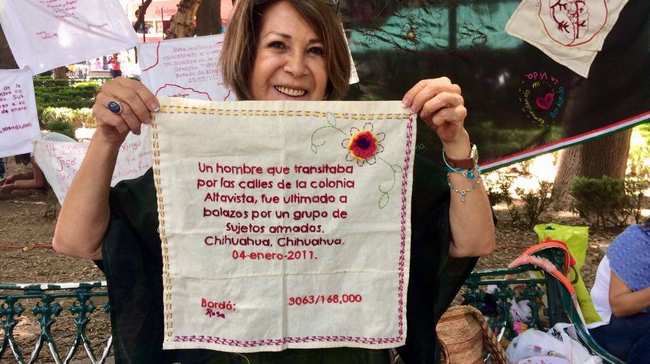
A member of the Fuentes Rojas collective holds up a handkerchief stitched in memory of an anonymous victim from Chihuahua, murdered in 2011. Photo courtesy of the Fuentes Rojas Archives

Jenny's translation of bordado text displayed in above photo: 
A man traveling through the streets of the Colonia Altavista, 
was killed by bullets fired by a group of armed subjects. 
Chihuahua, Chihuahua. 04 January 2011. 
[His Death is Number] 3063 / 168,000 [Total Violent Deaths up to 2011]


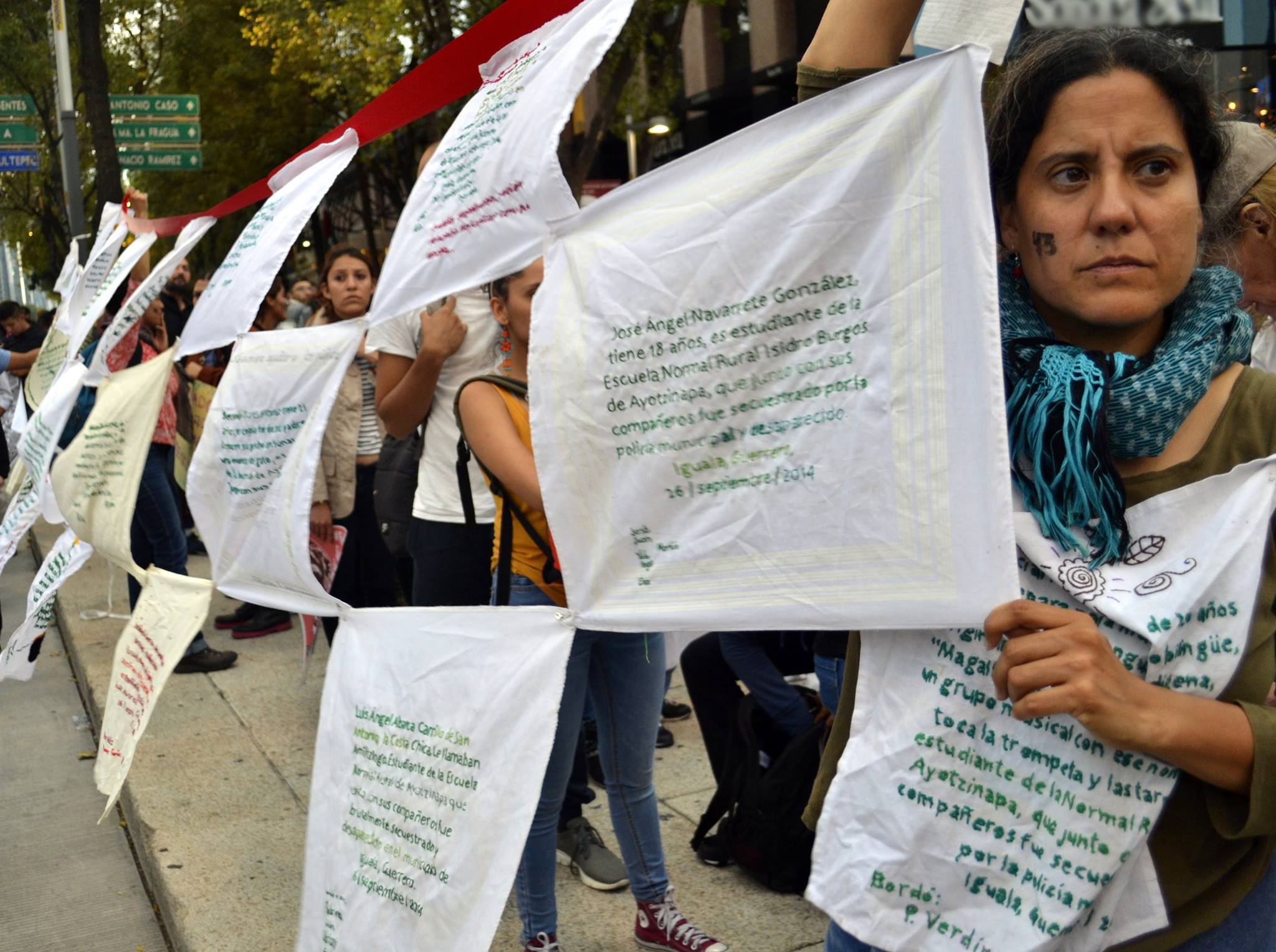
Rows of handkerchiefs are strung between the trees, fluttering in the early Sunday afternoon breeze. Some are simple, threaded with stark block black letters, while others bear an elaborate, blood-red outline of Mexico. Each one carefully spells out a name and tells a story.  One reads:


“Anabel Flores Salazar, a reporter for the
crime beat of the Sol de Orizaba, was
taken from her home by a group of armed
men on February 8th. The victim’s body was
found with the head covered by a bag,
handcuffed and with the feet tied.”


Referencing the 2015 forced disappearance of 43 students in Guerrero, another reads:


“Mauricio Ortega Valerio, 18 years.
Ayotzinapa, Mexico.
Alive they were taken,
alive we want them back.
Never again.”


I’m in Coyoacán, Mexico City and in front of this patchworked web of handkerchiefs, some black, some white, some pink, sit a group of women — Elia Andrade, her sister Tania Andrade and Regina Méndez (plus her tiny xoloitzcuintle dog, Tonalli) — who together make up the founding members of the Fuentes Rojas collective, a group dedicated to reclaiming public space through peaceful protest.

Their method of choice? Embroidery.
“Sometimes [the sewing sessions are] really peaceful, sometimes we stitch alone”, Elia Andrade tells me. 
“The minute people come closer to read the handkerchiefs, and they realize what they say, there are many people that reject it [and then] there are people that start talking to us.”
Originally, the Fuentes Rojas focus was on homicide victims, of which there were roughly 70 per day in Mexico in 2017. They’d stitch the names and stories in vibrant red thread—naming the dead is a technique also employed by Chiapas’ radical resistance movement, the Zapatistas, Andrade told me. 

Creating a captivating, tangible memorial that was hard to ignore was just the point, especially in a country with such a high track record of impunity.
“Many people wander through Coyoacán and many people, many families, try not to hear about these things, or they don’t want to open their eyes to the true situation in which the country finds itself; so it seems to us very important that we disrupt these spaces and not in a violent way, but a peaceful way… because we must find other ways to relate to one another that go beyond violence,” Andrade notes.
As time went by, the group broadened their focus:
“more people joined and there were many who’d experienced the disappearance of children or parents.”
In response, and although color codes aren’t always rigidly adhered to, Fuentes Rojas introduced green thread (“for hope”, explains Andrade), pinks for femicide victims—in 2016, at least seven women a day were murdered in gender-based killings—and black for deceased journalists (six reporters have died in 2018 alone).

And while the occupation of public space was always high on the agenda for Fuentes Rojas (“Public space only exists when one inhabits and occupies it, no?” Andrade points out), embroidery wasn’t always their calling, something at which their name—literally ‘Red Fountains’ in Spanish—suggests. 

Inaugurated in 2011, the collective first grew out of a Mexico City march held by the poet Javier Sicilia in memory of his murdered son, Juan Francisco. (This march in itself would flourish into the Movement for Peace with Justice and Dignity [MPJD], a.k.a. the Mexican Indignados Movement.) The Andrade sisters and Méndez were invited to participate in peaceful but public protests, during which they would dye the fountains red; however, after several meetings they found themselves warming to the idea of needlework instead.

Tania Andrade carries some of Fuentes Rojas' handkerchiefs on a 2017 march in protest of the 2015 Ayotzinapa student disappearances. The green thread signifies hope for their safe return. Photo courtesy of Fuentes Rojas Archives

Turning craft into a political statement might be nothing new—the Suffragettes could tell you that—but in Mexico, Fuentes Rojas gave rise to a new wave of craftivism. Much like the stories woven into each handkerchief, the word about Fuentes Rojas’ project spun a web across the country, beginning in Guadalajara, then Puebla, and making its way into other towns and cities from there.

Andrade notes that “the initiative comes from us, from this collective,” but some of the contacts they’d invited to stitch with them formed “break-off cells and collectives, dubbing themselves ‘Bordando por la Paz’ (‘Stitching for Peace’).”

I spoke via email with Teresa Sordo, the coordinator of one of these groups, Bordamos por la Paz Guadalajara. The
“intention from the beginning was to denounce [the killings and disappearances], go out into parks to find people that needed to talk about the topic that until now had been silenced by the government with the help of the media.”
Meanwhile, Hazel Dávalos of the similarly aligned Bordeamos por la Paz [Let's Embroider for Peace] in Ciudad Juárez, adds that the handkerchiefs work to remind the viewer that victims
“are people, not numbers.”

It’s clear that their craft is political, but is it ‘art?’

No, came the resounding answer, from Dávalos at least:
“Our work is a political statement. We prefer not to call it art,” before elaborating that “by calling it art, we’d be closing off our protest to elitist spaces.”
Other public protest movements in Mexico do consider their work ‘art.’ Take the yarn bombing collective Lana Desastre, pioneers of the phenomenon in Mexico. They’ve embroidered everything from Mexico City metro cars to Day of the Dead altars, and even displayed 52 giant woolen breasts (under the Spanish pun ‘Lactejiendo’; ‘Lac-knitting’ which, unfortunately, doesn’t have quite the same ring to it in English) in the garden of Mexico City’s Vasconcelos Library. Their work is both to “protest and beautify public spaces” Miriam Mabel Martínez, a member of Lana Desastre, writes to me.

Art or not then, all of these collectives, by weaponizing and politicizing a medium so typically associated with the ‘feminine,’ one that is in and of itself intricately linked to the storied Mexican textile tradition of elaborate embroidery and needlework, potently condemn Mexican impunity while lending a voice to the silenced.

As Andrade puts it,
“every stitch, every breath, every emotion, every chat; what we’re interested in is empathy. We appeal to the emotions, completely different from those of power or violence. Yes, it’s a peaceful protest, but it’s also hard-hitting.”

Monday, March 26, 2018

My Great-Grandfather Found Buried in U.S. Military Cemetery in Mexico City!

Last fall, our seven-year-old grandson in Chicago brought home a school assignment to construct a Family Tree, which prompted his maternal grandmother (maiden name, Kingman; born in Chicago, raised in California) to dig out the Kingman Geneology prepared decades ago by my aunt (father's sister).

I read with interest of the arrival of Henry Kingman and his family, listed as members of the 'Hull Party' that landed in Massachusetts in 1635. Setting aside for the moment the displacement of Native Americans, I noted their settlement of land in what is today the town of Weymouth—after Plymouth, the oldest town in Massachusetts. I read of the successive generations of Kingmans living and farming in Massachusetts and of their eventual relocation to Clifton, a farming community in southern Illinois.

But the next entry simply stopped me in my tracks:
In the 1890's, Charles Henry Kingman worked for Lewis Co., mine operators, in Mexico City; died of pneumonia and buried in Mexico City. Died March 19, 1900. A gentle and good-natured man. 
It is hard enough to take in that I wasn't aware that my great-grandfather is buried in Mexico City, but it turns out that there's more:
Barry Kingman [my grandfather] born March 19, 1875, went to Mexico with his father and worked for Lewis Co. at Zacatecas [famous for its mines of silver, lead, gold, copper, zinc and cadmium]; when he heard of his father's illness, Barry went down to Mexico City to be with him; Charles died on Barry's twenty-fifth birthday.
I wonder what father and son might think of the fact that 118 years later their great-granddaughter and granddaughter would be about to complete ten years of living in Mexico. What greater testimony could be offered of the many links between our two countries than this—the internment in Mexico of a U.S. citizen coupled with the long-term Mexican residency of his great-granddaughter?

Quite naturally, the first question that popped into my head was:
What on earth was great-grandfather Charles Henry doing in Mexico? 
We are familiar with mining's difficult, painful history in Mexico—a business practice still carried on by today's transnational mining companies. But it began five hundred years ago with the Spanish subjugation of the land's indigenous peoples, pressing the men into forced labor in the gold and silver mines. The extracted wealth was sent back to Spain, where the monarchy used it to finance their imperial exploits. It is understandable, then, my first thought was, 'Oh, no—not mining!'

Fortunately, I am married to a real history buff. When I gave Reed the date of Charles Henry's death, he was quick to pinpoint it as taking place during the 35-year dictatorship of Porfirio Díaz—the period known as the 'Porfiriato'. [For more information, see post in Reed's Mexico Ambles blog.]
Díaz got himself "re-elected" president of Mexico over a thirty-five year period (1877-1911). For the upper-class, it was an era of political stability, industrialization and economic growth. For the lower classes, it was a time of exclusion and suppression of protests.
Díaz maintained control through "Pan o palo", "bread or stick", an informal system based on personal loyalty using patronage and repression. His motto was "little politics and plenty of administration."
The epoch was suddenly brought to an end with the outbreak of the Mexican Revolution in November 1910, when various forces of social, political and economic opposition exploded. [Emphasis added.]
So it seems that the business activity of the Lewis Mining Co. took place at the invitation of Porfirio Díaz, part of his strategy to bring in foreign expertise to assist in industrializing Mexico for the purpose of promoting economic growth. In yet another historical twist, twenty years ago (1992-1994), I had a two-year consulting project with the Subdirectorate of Natural Gas at Pemex (Mexican Oil Company) that focused on improving work efficiency.

It seems that the more this story unfolds, the more layers are uncovered—even including a certain ironic twist. To wit, I discovered a newspaper article titled 'Ruined by a Wicked Partner', dated November 25, 1889, reporting the filing of a legal action by Charles Henry Kingman in Chicago Superior Court against his business partner. The article gives Charles Henry's account of how the partner defrauded and bankrupted the Kingmans' thriving wholesale grocery business.

Hence, in an ironic reversal of today's dominant reality, it seems that in the wake of the devastating business loss, Charles Henry and his elder son came to Mexico to recoup the family's finances.

A little more digging, and I quickly discovered that great-grandfather is buried in the Mexico City National Cemetery. It should be quickly noted that 'National' is from a U.S. perspective. In Spanish, its name is the Panteón Norteamericano, North American [i.e., U.S.] Cemetery. It is maintained by the American Battle Monuments Commission, ABMC, under the Department of Defense of the U.S. government.

A recent visit by our elder daughter, who lives in Chicago, seemed like a perfect time to make a visit.  So on a sunny Sunday morning, we all headed to the cemetery in the San Rafael neighborhood, which is one of the upscale neighborhoods created just west of Mexico City's Historic Center toward the end of the Porfiriato to provide housing for the Mexican and foreign business class. 

Stepping through the gate, visitors are greeted by plants trimmed to spell out the acronym: ABMC.

ABMC
American Battle Monuments Commission
The rectangular one-acre space that makes up the cemetery is beautifully landscaped and meticulously maintained.


The white stone monument at the south end is flanked by two flagpoles, each flying the U.S. flag.

It is forbidden to walk on the grass, so any capture of the monument
flanked by U.S. flags, of necessity, includes the gardener's lawnmower. 

It seems somehow fitting for the lawnmower to be part of the photo. The gardener, a kindly man, turned off the sprinklers so we could walk along the sidewalk, looking for my great-grandfather's crypt. He also tried to help us locate the crypt, but, in the end, it was our elder daughter who found it.

Charles Henry Kingman
Born, January 8, 1845; he spent his childhood on a farm in Southern Illinois.
He served in the Civil War (Illinois Regiment, Union Army),
which made him eligible to be buried in the U.S. military cemetery.
He died on March 19, 1900.

Monument to unidentified U.S. Soldiers killed
During Mexican-American War (1846-1848),
known in Mexico as the American Intervention. 
From the ABMC website:
"The Mexico City National Cemetery was established in 1851 by the U.S. Congress to gather the dead of the Mexican-American War (1846-1848) that lay in the nearby fields and to provide burial space for Americans that died in the vicinity. In 1851, the remains of 750 U.S. dead were gathered and buried in a common grave at this cemetery.
Buried at the Mexico City National Cemetery are American servicemen who served either during the Mexican-American War (1846-1848), Civil War or Spanish American War [Cuba]. 
The remains of 813 Americans are bruied in wall crypts lining two sides of the cemetery. The cemetery was closed to further burials in 1923."

East Crypt Wall viewed from West Crypt Wall.

The sidewalks around the park are lined by park benches which invite quiet reflection.

Mexican couple walking slowly along the West Wall,
reading the markers as they go.

Toward the end of our visit, a middle-aged, probably professional Mexican couple arrived and began walking slowly along the sidewalks, taking time to read names on the crypts. After I took this photo, I approached the couple and asked whether they had a relative buried in the cemetery.  When they answered in the negative, I couldn't help blurting out, "My great-grandfather is buried here. He worked in Mexico City near the end of the Porfiriato and died here of pneumonia."

Their gentle acceptance of my information was yet one more reminder of the tremendous amabilidad, kindness the vast majority of Mexicans accord to USians who show respect and demonstrate interest in Mexico's culture, history, and people.

On this note, we concluded our visit to the final resting place of my great-grandfather, our two daughters' great-great-grandfather, and our grandchildren's great-great-great-grandfather. 

We leave the cemetery carrying with us all that the cycle in our family history connotes—a kind of ironic turning of the tables that upends many of the assumptions about the relations between people in the country of our birth and those of our host country.

Related posts in our family of blogs:

Thursday, October 26, 2017

Mexico's Public Markets: World of Colors, Aromas, Sounds, Tastes — and Community!

La Jornada: Ángeles González Gamio

Walking through a Mexican market is one of the richest cultural and sensual experiences you can have. Dating back to pre-Hispanic times, they persist even today, despite the onslaught of supermarkets. There is a marked difference in the quality and offering between public markets and the supermarkets.

Mercado San Juan Pugibet
Centro West
Supermarkets offer only one quality of pumpkin, onion, apples, peppers, tomatoes and other products of the earth. If they are ugly, you put up with it, since that's all there is. But the supers make up for it by offering 20 different types of deodorant and, if they are lucky, even some gringo brands, which are the same as the ones here but cost twice as much—and, yes!—the labels are in English.

Supermarkets never offer the rich variety of products found only in the markets. Besides fruits, vegetables and all kinds of food, there are piñatas, crafts, flowers, medicinal herbs, clothing and pretty much anything else that comes to mind. Eating in one of the fonditas [lunch counters] guarantees tasty, economical dishes with the freshest ingredients.


Markets have been an essential part of life in Mexico City, although the growth of markets hasn't kept pace with the capital's steady growth. In recent decades, they stopped building public markets even as a thousand facilities for large supermarket chains were constructed.

The disappearance of public markets has resulted not only in the loss of many job opportunities but of the warm, personal treatment provided by the sellers—not to mention the richness of having several options of the same produce! The markets are places of community, of socialization—where networks are woven of kinship and cronyism that create a strong communal solidarity.

"Fondita" 

Fresh chicken breasts
Now we are seeing emergence of a hope that the market decline might be reversed. A few days ago [August 2016], a declaration was signed naming as an intangible cultural heritage these traditional expressions that take place in Mexico City's public markets.

One important aspect is that the markets are recognized not only as supply centers, but as custodians of traditions. Suffice it to recall Christmas. Where would we buy everything needed for that celebration? Figurines for the Nativity scene, hay, moss, poinsettias, corn husks for tamales, brown sugar and fruit for the punch served at the posadas and, of course, the piñatas, to mention just a few of the many products not found in the supermarkets.
See: Mexican Traditions: Las Posadas
It was announced that in 2017 the budget will be tripled in order to rescue the 329 traditional and specialized public markets found in Mexico City's 16 boroughs. The public markets employ 280,000 people, who annually hold more than 1,300 romerías [open-air festivities celebrating a religious event]. This means that every day there are at least three anniversary festivities in the markets of Mexico's capital city.

The declaration regards these public spaces as living and dynamic entities, with an ancient tradition fostering the development of Mexican culture by being the supply channel for 46 percent of Mexico City households.

Eduardo Vázquez, Mexico City's Secretary of Culture, explained that the declaration basically grants to the public markets an active role in the development of the social fabric by integrating and reflecting the ethnic, social and cultural diversity that has built Mexico City.

They are going to dedicate 200 million pesos [11 million USD] for the preservation of public markets; however, given the [deteriorated] state of many markets, a much larger amount is surely going to be needed in the near future.

Take the Merced Market, which some time ago suffered a fire that affected part of the nave, which measures the impressive length of 400 meters [437 yards] with 3,205 puestos [sellers' stalls]. Then there is the smaller nave, which sells meat and poultry and has an annex for meals. Around the outside is the pavilion for popular toys and such typical items as clothing, flowers and candy ...

A world of colors, aromas, sounds and tastes that awaken all the senses. In his memoirs, Chilean poet Pablo Neruda declared:
"Mexico is in the markets."
Spanish original

Related articles:

Thursday, June 26, 2014

Indigenous Wisdom and Clouds in Mexico ... and Alaska!

Today's weather forecast for Mexico is:
"Heavy rains are predicted across the entire country, including the Valley of Mexico" — Translation: Mexico City. 
For all the clouds we've seen in the last six weeks, we could have moved to Seattle!

Neither Reed nor I do very well with gray skies, but yesterday the air was clear, so I leaned out the bedroom window to check on Ajusco Volcano to the southwest. Here's what greeted my astonished eyes!

Cloud Formation on Ajusco Volcano - Click to Enlarge!
(Photo: Reed with my little Canon)

I have been on the lookout for this effect for at least five years. Why? An anthropologist studying the indigenous people of Mexico was told by his informants that clouds rise up from the mountains. Without success, he tried explaining scientifically how clouds are formed.

Then one day, he saw a formation like this one, and he had to admit that the traditional version was based on an understandable interpretation of their observation.

But believe it or not, la naturaleza, Natural World, wasn't quite done with me yet. On the same day, I opened up Facebook only to discover this photo taken by a friend who lives 25 miles north of the Arctic Circle in Kobuk, Alaska:

Camp Taiga, Kobuk, Alaska - Click to Enlarge!
(Photo: Gregory Jurisch)
Never mind the incredible cloud formation, I can't get over the flecks of white flowers, which seem to reflect the spots of snow remaining on the mountains.

Here's another of Greg's photos taken June 20 and captioned:
"Today's Weather Report, 'Hot Air Rising'."
"Hot Air Rising" at Camp Taiga, Kobuk, Alaska
(Photo: Gregory Jurisch)

Is that what's happening? Hot air rising off the mountains? Yet again, America's original peoples have it right. By America, I mean in its true sense of all residents of North, Central and South America.
Note: I just googled the phenomenon and found this wonderful diagram and explanation at Windows to the Universe:
When wind blows across a mountain range, air rises and cools, 
and clouds can form.
"Some clouds form when air encounters a mountain range or other types of terrain. When this happens, the air will rise and cool, but this cooler air is no longer able to hold all of the water vapor it was able to hold when it was warm, so the extra water vapor begins to condense out of the air parcel in the form of liquid water droplets that form a cloud."
Thus confirming what the indigenous people told the skeptical anthropologist:
"The clouds rise up from the mountain."
And, of course, the mountains are sacred not just to Mexico's indigenous peoples, but to indigenous people all over the world.

It's also important to remember that Mexico City is at 7,000 feet [2,133.6 meters]; Ajusco Volcano is 12,893 feet [3,930 meters], with a prominance of 1,217 3992.782 which means that warm air is rising 3,992 feet [1,217 meters] along the volcano's flanks. Hence, it makes sense that warm air would condense as it rises along the flanks of high altitude mountains whereas it condenses at the top of mountains rising from sea level.

Then this morning, I wakened to the first sighting in two weeks of our volcanoes to the East: Iztaccíhuatl and Popocatéptl.

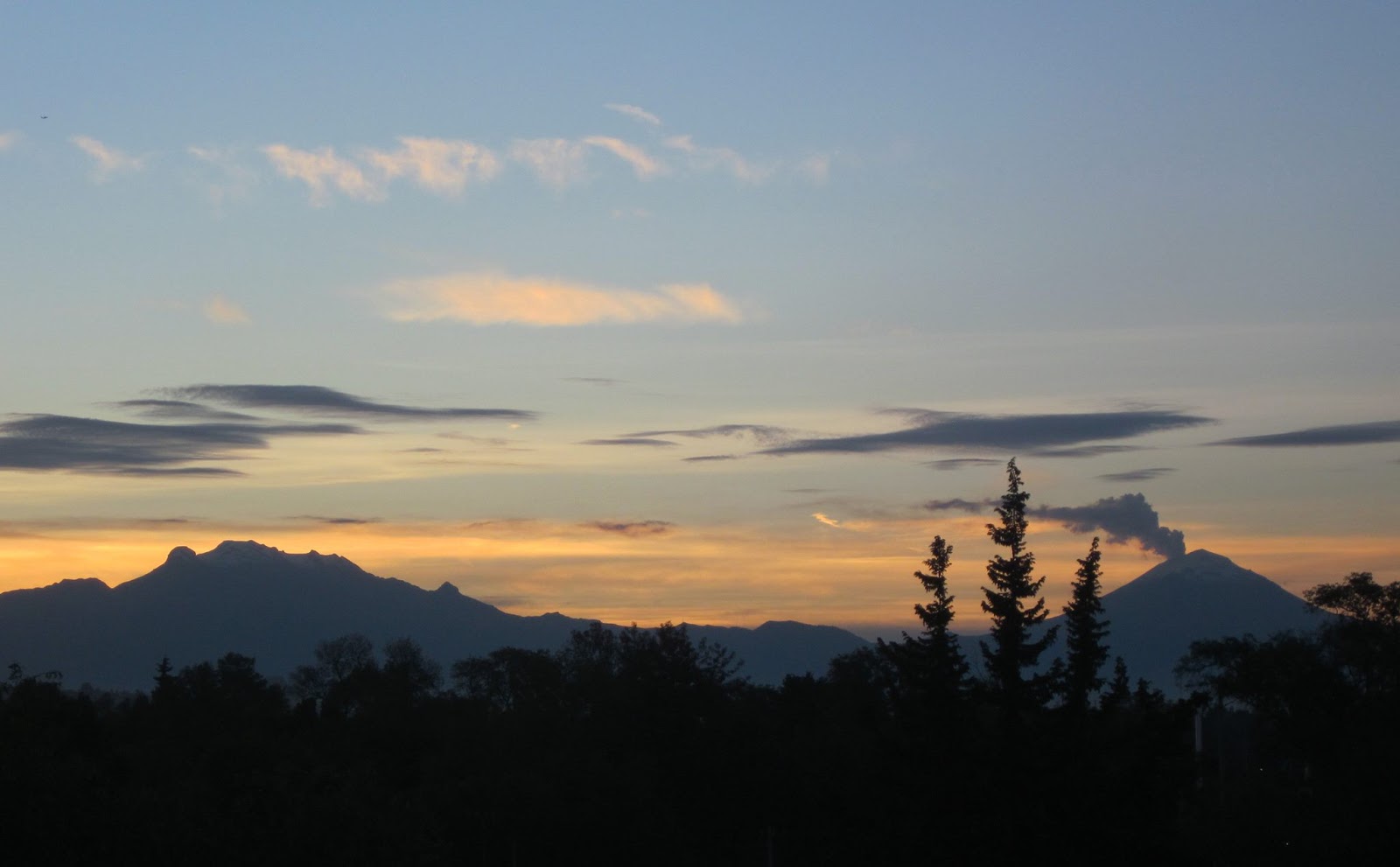
Iztaccíhuatl (left) and Popocatépetl Volcanoes
Bathed in Shades of Gray
(Photo: Jenny)

Ending on an upbeat for me means Mexico full of color. So here's the image of Iztacc and Popo I captured on a clear, clear morning:

Dawn's Early Light on Iztaccíhuatl and Popocatéptl Volcanos
(Photo: Jenny)

And another of Ajusco Volcano I captured on an exceptionally clear day during the dry season.

Ajusco Volcano Captured on a Rare Clear Day
(Photo: Jenny)

Over the last twenty-four hours, the natural world has treated me to quite an adventure!

P.S. More confirmation of the phenomenon comes by way of the photo I took today at sunset of a cloud 'rising up from' the flank of Iztaccíhuatl Volcano. Mother Nature never ceases to amaze and delight!

Cloud Rising From 
Iztaccíhuatl Volcano, 7/21/2014
Photo: Jenny
Still Curious?

Wednesday, May 28, 2014

Mexico City: Between Cohetes and Barking Dogs

Reed spotted it first:
"Between Cohetes and Barking Dogs."
The title calls up multiple layers of urban Mexican culture. In reading the article, I found myself caught up in a tangle of cultural associations best summed up as simply:
¡Bienvenido a México!
Let me invite you to take a trip into a multi-dimensional snapshot of Mexican society, one that juxtaposes traditional and modern Mexico.

Getting started, cohetes are rockets, giant firecrackers. Sometime in the thirteenth century, both gunpowder and the recipe for making it arrived in Europe from China via The Silk Road. During their conquest of Mexico's original peoples, Spanish soldiers were armed with muskets. In 1520, one year after Cortés landed on Mexico's shores, two of his soldiers brought back from the crater of Popocatépetl Volcano the sulfur needed to make gunpowder.

The celebrations of Mexico's indigenous peoples were noisy affairs with drums, rattles and war cries, so when the Spanish brought gunpowder, the original people immediately adopted it as their own. Reed's hunch is that cohetes replaced the enormous drums employed by the Aztecs in their religious ceremonies to assure that the gods were paying attention.

Lending credence to Reed's theory is that the Franciscan Friars, brought to Nueva España to evangelize the indigenous peoples, banned percussion instruments for being elements of pagan rituals. To take their place, the Friars introduced stringed instruments, but cohetes also made their way into the mix.

Several years ago, during the fiesta of the Holy Spirit in Pátzcuaro, Michoacán, we attended a High Mass celebrated outdoors in a traditional Purhépecha community near Pátzcuaro. We noticed the cohetero, man who sets off cohetes, standing no more than twenty feet from the priest. At the Elevation of the Host, the cohetero set off a barrage of cohetes.

Startled, we jumped, but neither the priest officiating at the Mass nor the congregants seemed fazed. We were later told that cohetes are set off to get God's attention—almost certainly a legacy of pre-Spanish ritual beliefs.

Cohetero goes in front of the procession, 
stopping to set off cohetes every half block 
or so to announce its arrival.
 (Photo: Reed)

As for barking dogs . . . Before the Spanish arrived, the only domesticated animals in Mexico were dogs, turkeys and the Muscovy duck. Believed to be the guides and companions of souls making their journey through the Underworld, the Xoloitzuintle ("Xolo," Mexican Hairless) breed of dogs was sacred to the Aztec, Toltec, Maya and some other Mesoamerican peoples. The Aztecs also raised Xolos for their meat. Sixteenth-century Spanish accounts tell of large numbers of dogs served at a banquet.


Xoloitzuintles, Xolos or Mexican Hairless Hunting Dog

Keeping dogs as pets is definitely a mark of modern culture. In Pátzcuaro, Michoacán, dogs are used primarily as guard dogs; probably for that reason, they tend to be feared. We got a first-hand glimpse of dogs in modern Mexico when we visited Parque México in the Condesa neighborhood.


Sunday Mobile Dog Grooming Van in Parque México
(Photo: Reed)

So that's the context for Francisco Ortiz Pinchetti's article "Between Cohetes and Barking Dogs." Ortiz Pinchetti is a journalist who founded Proceso magazine, a widely read Mexican weekly.

A forty-year veteran observer and reporter of Mexican society, Pinchetti is also the author of De pueblo en pueblo: crónicas del pequeño México (2000). In Spanish the word pueblo refers both to the people (el pueblo) and the place (pueblo or village) where the people live. Hence, the title might be translated as "From People to Village: Chronicles from Little Mexico."

Here's the article. All emphasis has been added.
SinEmbargo: Francisco Ortiz Pinchetti 
"Many residents in the upper middle class neighborhoods of such Mexico City boroughs as Coyoacán, Benito Juárez, Álvaro Obregón and Miguel Hidalgo get all stirred up by the barrages of cohetes that go off each time there's a fiesta in a church in these districts. This is particularly true where there are indigenous enclaves whose elderly inhabitants and their descendants preserve the tradition. The newcomers say they don't support the tradition, complain they cannot sleep and claim it's illegal to set off cohetes. 
"Last weekend was an ordeal for them, since few fiestas are like that of the Holy Cross celebrated with a scenario comprised of a fireworks display. Moreover, [on International Worker's Day] the noisy celebrations of construction workers at their work sites (which always involve cohetes y cuetes [a play on words: rockets and 'loaded' (drunk) men]), coincides with the religious festivals in many churches dedicated to devotion of the Holy Cross on May 3. 
"In neighborhoods like Santa Cruz Atoyac, for example, the barrages begin the preceding night, go throughout the night into the pre-dawn hours, persist throughout the day and finish up the next day. The newcomers say, 'What a horror!' Social networks are, of course, deluged with complaints.
"I must confess that I am addicted to pyrotechnics (not as a pyromaniac, mind you). I enjoy fireworks as few other things in life. It fascinates me to watch the night sky fill with bright, multicolored spangles. Sure, I love the now-computerized September 15 [Grito or Shout of Dolores at midnight before Independence Day, September 16] spectacular displays in the Zócalo, but I have a special fondness for 'artesanal' pyrotechnics — let's call them — expressed by means of the traditional "castillos" [castles], the "toritos" [little bulls] and "bombas" [bombs] in small-town fiestas and in our urban neighborhoods that still hold onto that enchantment. 
"An inevitable part of all this are the barrages of the loud cohetes that are a completely indispensable part of any popular celebration in our country. Without them, a celebration just wouldn't be the same. In the neighborhood where I live, the feast of St. Lawrence Martyr is celebrated each August 10 in the sixteenth century Franciscan chapel that still stands in the Saint's namesake park. And I must say that it thrills me to hear the first battery of cohetes announcing the celebration, even if they do waken me at five o'clock in the morning.
"That said, I believe that those protesting the cohetes are acting within their rights. It is valid to complain about the noise and ask that it not be permitted. Ultimately, the newcomers don't have to know, or care, that this is a five hundred year old tradition brought by the Spanish conquistadores along with their muskets, or that it is profoundly, absolutely, rooted in the religious and pagan celebrations of our people. In small rural communities, cohetes are used to sound alarms, send messages, bring rain and announce Mass or a death. 
"It seems fair that the neighbors may ask that their quiet be respected, especially when it comes to babies, the elderly and the infirm. What I find incomprehensible is that in almost all cases, complaints disseminated through social networks about the thunder of the cohetes cite as the main reason for their dissatisfaction the fact that their dogs are scared and stressed! 
"Carlos Olmedo, who lives in the San Ángel Inn section of Álvaro Obregón neighborhood, offers this reflection:
'The problem occurs when one day you return home from work, and it turns out that there were three hours of cohetes being launched every 15 minutes. You have no idea how bad it was, because you weren't there. It turns out that your neighbor has spent that time listening to your frightened dog barking, and he lays into you for disrespecting him. 
'Please note that it isn't the cohetes that bother me very much. What bothers me more is my own dog's frightened barking, and my neighbor recriminating me for the situation. It isn't easy.'
"It happens that almost all who complain about setting off cohetes live in condominium apartments located near churches belonging to communities hundreds of years old. Just in the Borough of Coyoacán, for example, there are eight officially recognized original peoples. There are seven in the Borough of Benito Juárez , and there are also seven in the Borough of Álvaro Obregón. Each one has its own little church and, as the saying goes, every church [has its own saint, and every saint has a day, and on that saint's day that little church] has its little fiesta.
"Interestingly, many of those calling for enforcement of a law they know nothing about, are at one and the same time violators of that very same law. Article 21 Section IX of the Condominium Property Act of the Federal District expressly prohibits:
'owning animals that by their number, size or nature affect conditions of safety, health or comfort of the condo or condominium, in accordance stipulated in the regulations.'
"They are also often the same people who break the Law of Civic Culture of the Federal District daily by walking their pets in the parks without the legally required leash. They do not pick up their pets' feces, and they allow them to destroy plants and take a dip in the fountains, which occurs frequently in the Sunken Park. Of course, it is not the animals who are at fault, but their owners and trainers. 
"For the rest, it must be made clear to the complaining neighbors that although in the Federal District the manufacture and sale of cohetes is prohibited, setting them off is not. The Civic Culture Act itself clearly allows it; Article 25 specifies:
'These are offenses against public safety: (... ) VII. Detonating or igniting cohetes, fireworks, campfires or hoisting balloons without permission of the appropriate authority.'
"Currently, the Secretariat of National Defense (SEDENA) is responsible for issuing permits for the manufacture of products using gunpowder. This manufacture takes place in Tultitlán and Tultepec, towns in the State of Mexico dedicated to this purpose; they are, in fact, the leading suppliers of cohetes across the Valley of Mexico [Mexico City]. Sale there is unrestricted; but in order to get permission to detonate cohetes in the Federal District, one must go to Civil Protection of the appropriate borough. In the case of a religious festival, there are virtually no restrictions, and the process is quite simple. 
"Be that as it may, everyone can put up many reasons for or against this practice, which is as traditional as the questions raised about it. Personally, it seems to me that the matter has an irretrievable class bias that was, I believe, summed up, perhaps unwittingly, by one Karen (surely she lives in a luxury condominium) on her Twitter account. Last Sunday between barrages, Karen tweeted:
'Unfortunately, we are mixed in with closed-minded pueblo (village) and neighborhood people. It's all a matter of education.'
"God help us!" Spanish original
Some Reflections

Time to 'fess up. Reed and I live in a condominium in Coyoacán two blocks from the original pueblo of San Mateo. We enjoy the cohetes, which is a good thing because we are treated fairly regularly to their barrages. Not only is the parish church just three blocks away, but we seem to be centrally located to hear the thunder from several other churches as well. We've come to accept the cohetes announcing Mass and heaven only knows what else as yet another part of Mexico.

As a practical matter, Mexico's indigenous and Spanish heritage peoples have struggled to find ways to live together. Through conversion and education the Franciscan Friars hoped to acculturate the indigenous peoples to Spanish ways, which involved learning to speak Spanish and follow la cortesía ("the courtesy")—the elaborate code of manners governing personal behavior. Those who made the transition were called ladinos.

One of our only reservations about moving to Mexico City was that we would lose touch with indigenous elements of Mexican culture. We've been surprised to discover that we needn't have been concerned—as Ortiz Pinchetti makes clear in his description of the Fiesta de la Santa Cruz held in the neighborhood of Santa Cruz Atoyac. The convention for naming neighborhoods illustrates the Spanish-Indigenous synchronicity: Santa Cruz [Holy Cross] is the parish's Catholic patron saint; Atoyac is the indigenous place name.

The last paragraph of the article is so loaded with cultural references that it almost deserves its own post, but for the sake of convenience, if not brevity, let me take a shot at it. Residents of New York City for twenty years, Reed and I are urbanites. We thrive on the energy and cultural diversity of city life, but we're also very comfortable in rural settings. We've lived not just in New York City, but in rural and semi-rural communities as well. Maybe our experience has made us more aware of regional differences: Northern California (where I grew up) versus Southern California; New York City versus Upstate New York (where Reed grew up); Fairfield County versus the rest of Connecticut, etc.

It's very similar here. People outside Mexico City speak of "México," when they refer to their country's capital. People born in Mexico City call themselves capitalinos [people of the capital]. Like city people the world over, they tend to speak with a certain condescension about las provincias, the provinces, by which they mean everywhere outside Mexico City.

Many in Mexico's middle and professional classes have lost touch with the indigenous elements of their culture. Almost like foreign tourists, they visit places like Pátzcuaro, Michoacán, to gain experience with this unfamiliar way of life.

Like peoples the world over, Mexico today faces the increasing Americanization of its culture, a phenomenon accelerated and strengthened by the Internet with its social media. A vivid example is provided in the evolving role of dogs in traditional culture (first sacred, later protective) and today in modern Mexico (as pampered pets).

So here we are:
modern Mexico versus traditional, indigenous Mexico.
After the Mexican Revolution (1910-1920), Secretary of Public Education José Vasconcelos (1921-1924) espoused a new, "modern" mestizo (mixed blood, Spanish-Indigenous) and called for the cultural assimilation of all ethnic groups. In recent times, this philosophy has been attacked by Native (North, Central, South) Americans because of its negative implications for indigenous peoples.

In Mexico, the Zapatista movement in Chiapas and the defense of natural resources (minerals, oil, wind, corn, timber—all sought by transnational companies) on the ancestral lands of indigenous peoples across Mexico has stoked a fierce pride in indigenous culture. Part of the battle over the so-called Reform of Public Education [undertaken during the administration of Enrique Peña Nieto, 2012-2018] hinges on this very issue:
acculturation to modernity versus adherence to indigenous culture and values.
With this context firmly in mind, we now return to the concluding lines of Ortiz Pinchetti's article, where he cites the "irretrievable class bias" epitomized in "Karen's" Tweet:
'Unfortunately, we are mixed in with closed-minded pueblo (village) and neighborhood people. It's all a matter of education.'
Ortiz Pinchetti concludes his article, "God help us!"

Karen's Tweet has all the elements:
this thoroughly modern Mexican woman finds herself and her friends "mixed in with close-minded pueblo [indigenous] and neighborhood peoples"; that is, with those who insist on maintaining the original, indigenous traditions of their people and their pueblo or more stridently, refuse to accept 'modern' culture.
The last line of Karen's Tweet is the most poignant of all:
"It's all a matter of education."
José Vasconcelos would be proud.

But not so Francisco Ortiz Pinchetti, who in concluding "God help us!" permits us outsiders to peek into the depths of a profound split in Mexican society and culture.

Still Curious?