Showing posts with label Michoacán. Show all posts

Saturday, October 30, 2021

Day of the Dead Transformed by Commercialization Over the Centuries

The Conversation, October 27, 2021 | By Mathew Sandoval*

As a Mexican-American who celebrates Día de los Muertos, or the Day of the Dead, at the end of October and beginning of November, I’ve noted an increasing concern the past several years that the holiday is becoming more commercialized

The mass-marketing of the Day of the Dead is evident in the costumes that people buy for the day. Credit: Man Hon Lam / EyeEm Getty Images

Indeed, for those who hold the holiday sacred, it’s jarring to see the extent to which it’s now mass-marketed. The evidence is everywhere. The holiday aisles of Target are stuffed with cheap Day of the Dead crafts during October. Halloween stores sell Day of the Dead costumes. Nike makes Day of the Dead shoes. California and Arizona sell Day of the Dead lottery tickets. Disney famously tried to trademark “Día de los Muertos” before its 2017 film “Coco.” The examples go on and on.

The bottom line is that Día de los Muertos and its associated imagery, skulls and skeletons have become trendy and a prime opportunity for companies to make a profit.

But as a researcher of culture and performance, I know only too well that the truth is Day of the Dead has always been commodified.

The Roots of Commercialization

Day of the Dead is what anthropologist Hugo Nutini calls a syncretic holiday, meaning it’s a cultural product of two different religious traditions that hybridized during the European colonization of the Americas.

Day of the Dead brings together the annual feasts for the dead celebrated by pre-Hispanic Indigenous cultures such as the Aztec, Maya, Zapotec and Mixtec peoples. During Mexico’s 300-year-long colonial period, which started in 1521, these Indigenous rituals were merged with the Spanish Catholic holy days for the dead known as All Saints, celebrated on Nov. 1, and All Souls on Nov. 2.

Early Spanish chroniclers in Mesoamerica such as Diego Duran and Bernardino Sahagún documented the Aztec feasts for the dead known as Miccailhuitontli and Huey Miccailhuitl. Duran wrote in the 1570s that he was astounded to see how lavishly the Aztecs spent on supplies for their offerings to the dead.

Sahagún noted the overwhelming bustle and financial activity that took place at the market in the capital city of Tenochtitlán, modern-day Mexico City, during the Aztec ritual feasts.

All manner of foods and goods were sold to citizens to celebrate the Aztec feasts of the dead. In this respect, there wasn’t much distinction between commercial and religious activity. The religious feasts supported the market and vice versa.

The Catholic religion also emphasized commercial activity in relation to All Saints and All Souls Day. According to 16th- and 17th-century Catholic belief, the majority of souls landed in purgatory after death, rather than heaven or hell. It was the responsibility of the living to help alleviate the suffering of souls in purgatory and assist them in getting to heaven. This could be done through prayer or by making offerings to the souls.

In Mexico that meant Spanish colonizers and newly converted Indigenous Catholics were tasked with purchasing directly from the church candles and other religious items that could be used in offerings to those souls in purgatory. Additionally, they could pay their local priest to say special prayers for the souls during Día de los Muertos, a practice that remained in effect through the 20th century.

The Colonial Era

As Day of the Dead became a more popular and elaborate festival in Mexico, the associated commercial activity grew in size. According to anthropologist Claudio Lomnitz, in the 1700s, Day of the Dead generated the largest annual market in Mexico City.

In fact, the plazas and streets were so overwhelmed during the holiday with vendors, carts, booths and makeshift markets that the local government deemed it a “public disorder.” Mexico City’s mayor and city council eventually had to control Day of the Dead’s economic frenzy by enacting laws and issuing vendor permits. In other words, the holiday had become so commodified in Mexico City that it required government regulation.

By and large the markets and vendors in Mexico sold items related to the holiday – food, candy, bread, alcohol, candles, toys and religious items. However, according to Lomnitz, by the 1800s, the Day of the Dead markets in Mexico City were also selling clothing, shoes, furniture, tools, home decor and many other things.

The swell of commercial activity on Day of the Dead also presented an opportunity for musicians, dancers and other entertainers to perform on the streets for money. In short, Day of the Dead in Mexico City and other urban areas carried both religious and economic significance.

Modern-Day Commercialization

Day of the Dead’s commercialization was also quite pronounced in rural Mexico. A number of anthropologists in Mexico and the U.S. writing about Day of the Dead in the early and mid-20th century make special note of the sizable holiday markets. They write that villages are transformed into commercial fairs where people gather from communities many miles away to buy and sell foods, goods and services during the festival.

The scholarship of anthropologists Stanley Brandes and Ruth Hellier-Tinoco has been influential for understanding how Mexico began “selling” Day of the Dead to the outside world in the mid-20th century. Mexico’s tourism industry started promoting the holiday to U.S. and European travelers as an “authentic” Mexican experience.

Many guidebooks and travel brochures highlighted Day of the Dead as a cultural event for tourists to attend and buy folk art related to the holiday. Additionally, Mexico’s tourism industry positioned certain regional celebrations as the most “traditional” Day of the Dead festivals for tourists to explore.

Mexican candy in the shape of sugar skulls being sold on the occasion of the Day of the Dead in Michoacan, in the western part of Mexico. Source: ©fitopardo/Moment via Getty images

Hellier-Tinoco has shown how Mexico’s “selling” of the Day of the Dead on the rustic island of Janitzio in the state of Michoacán transformed the small community ceremony into a spectacle attended by more than 100,000 tourists a year.

Given all this evidence, there doesn’t appear to be an era when Day of the Dead wasn’t intimately tied to financial activities and profiteering. But the holiday’s commercialization has also ensured its survival.

In 2019, I talked to a grandmother building a Day of the Dead ofrenda, an altar with offerings for her family’s dearly departed that included candles, food, flowers, and festive decorations. For years she’d tried to get her grandchildren to help her erect the altar for their ancestors, to no avail. It wasn’t until they watched Disney’s “Coco” and saw sugar skulls at Target that they took interest in the holiday. Now they eagerly help their grandmother build the altar.

Commercialization is and has been transforming Day of the Dead. But, from what I’ve seen, it’s also giving a new generation a chance to be proud of their culture.

+   +   +

*Mathew Sandoval, is a Senior Lecturer at Barrett the Honors College at ASU's Downtown Phoenix campus. He holds a PhD in Culture & Performance from UCLA, an MA in Individualized Study with a focus on Performance Studies from NYU, and a BA in English with a focus on Performance at the University of Nevada Las Vegas. Dr. Sandoval is also a member of ASU's Chicano /Latino Faculty & Staff Association.

Dr. Sandoval is currently researching the transborder holiday Dia de los Muertos (Day of the Dead). He focuses on the large-scale public celebrations of the holiday in Los Angeles and the US Southwest in order to examine the ways the holiday has developed from ancient MesoAmerican ritual to American popular culture. His research analyzes issues of performance, interculturalism, race, hybridity, indigeneity, spirituality, and cultural appropriation & commodification. Furthermore, he writes about the way Day of the Dead intersects with his experiences coming of age as a working-class mixed-race Chicano.


Disclosure Statement.

Mathew Sandoval is affiliated with the Mesa Arts Center, an arts nonprofit that stages an annual Day of the Dead celebration. He serves on its annual Day of the Dead organizing committee. Dr. Sandoval is also affiliated with the Hollywood Forever Cemetery's Dia de los Muertos festival, serving as a judge for its altar competition.

Partners.

Arizona State University provides funding as a member of The Conversation US.

View All Partners.


We believe in the free flow of information

This article is republished from The Conversation under a Creative Commons license.

Friday, October 30, 2015

Halloween and Day of the Dead: Same? Different? Little of Each?

This question doesn't even come up in Mexico's traditional, rural regions, but it's increasingly relevant in Mexico's urban settings, where television and the supermarkets have introduced the trappings of Halloween into Mexican culture.  Along the culturally porous frontier region between Mexico and its northern neighbor, of course, this is indeed an intriguing question.

Halloween: Western European Tradition

Halloween, or Hallowe'en — a contraction of "All Hallows’ Evening" — is also known as Allhalloween, All Hallows' Eve, or All Saints' Eve. Regardless of what it's called, it is a yearly celebration observed in a number of countries on October 31, eve of the Western Christian feast of All Hallows' (Saints') Day that begins the three-day observance of Allhallowtide — the season in the liturgical year dedicated to remembering the dead, including saints (hallows), martyrs, and all the faithful departed believers.

Pre-Christian Roots

All Hallows' Eve is influenced by Celtic harvest festivals, particularly the Gaelic festival Samhain (pronounced / sah-win or sow-in), which marks the end of the harvest season and the beginning of winter or the year's "darker half". Traditionally, Samhain is celebrated from sunset on October 31 to sunset on November 1, which puts it about halfway between the Autumn Equinox (September 21) and the Winter Solstice (December 21).

Evidence exists that Samhain has been an important date since ancient times. It is mentioned in some of the earliest Irish literature, and many important events in Irish mythology take place or begin on Samhain. It was the time when cattle were brought back down from the summer pastures, and livestock were slaughtered for the winter.

Special bonfires were ritually lit. The bonfires' flames, smoke and ashes were deemed to have protective and cleansing powers and were also used for divination, especially regarding death and marriage. Some suggest the fires were a kind of imitative or sympathetic magic — they mimicked the Sun, helping the "powers of growth" and holding back the decay and darkness of the coming winter.

Samhain was seen as a liminal time; that is, when the boundary between this world and the Otherworld thinned and hence could more easily be crossed. This meant the 'spirits' or 'fairies' — Aos Sí (pronounced / ees shee) — could come into our world. At Samhain it was believed that the Aos Sí — gods and nature spirits — needed to be propitiated to ensure that the people and their livestock would survive the harsh winter. Offerings of food and drink were left outside for them.

The souls of the dead were thought to revisit their homes seeking hospitality. Feasts were held, and souls of dead kin were beckoned to attend. A place was set for them at the table and a spot was reserved for them by the bonfire.

Mumming (seasonal folk plays performed by troupes of actors) was part of the festival, as was guising, when people went door-to-door in costume (disguise), often reciting verses in exchange for food. The costumes may have been a way of imitating, and disguising oneself from, the Aos Sí. Impersonating these beings, or wearing a disguise, was believed to protect oneself from them. It is suggested that the mummers and guisers
"personify the old spirits of the winter, who demanded reward in exchange for good fortune."
On the custom of wearing costumes, Christian minister Prince Sorie Conteh wrote (2009):
"It was traditionally believed that the souls of the departed wandered the earth until All Saints' Day, and All Hallows' Eve provided one last chance for the dead to gain vengeance on their enemies before moving to the next world. In order to avoid being recognized by any soul that might be seeking such vengeance, people would don masks or costumes to disguise their identities."
From at least the 18th century, "imitating malignant spirits" led to playing pranks in Ireland and the Scottish Highlands. In the 20th century, wearing costumes and playing pranks at Halloween spread to England.

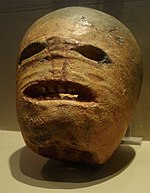
photograph
Traditional Irish Halloween turnip (rutabaga) lantern on display,
 Museum of Country Life, Ireland
The
"traditional illumination for guisers or pranksters abroad on the night in some places was provided by turnips, hollowed out to act as lanterns and often carved with grotesque faces."
Those who made them said the lanterns were to represent the spirits or, alternatively, to ward off evil spirits. They were common in parts of Ireland and the Scottish Highlands in the 19th century. In the 20th century they spread to other parts of England and became generally known as Jack-o'-Lanterns, which in North America are carved from pumpkins.

Christian Influences

Today's Halloween customs are also thought to have been influenced by Christian dogma and practices derived from it. Since the time of the early Church, major feasts in the Christian Church (such as Christmas, Easter and Pentecost) had vigils that began the night before, as did the feast of All Hallows'. Collectively referred to as Allhallowtide, these three days — eve of October 31 to sunset on November 2 — are a time for honoring the saints and praying for the recently departed souls who have yet to reach Heaven.

Introduced in the year 609, All Saints was originally celebrated on May 13, the same date as Lemuria, an ancient Roman festival of the dead. In 835, at the behest of Pope Gregory IV, All Saints was officially switched to November 1, the same date as Samhain. Some suggest this was due to Celtic influence; others suggest it was a Germanic idea. It is claimed that both Germanic and Celtic-speaking peoples commemorated the dead at the beginning of winter, which may have been seen as the most fitting time to do so, since that was when the plants themselves were 'dying'.

By the end of the 12th century the three days of Allhallowtide had become holy days of obligation across Europe and involved such traditions as ringing church bells for the souls in purgatory. In addition,
"it was customary for criers dressed in black to parade the streets, ringing a bell of mournful sound and calling on all good Christians to remember the poor souls."
In medieval Europe at Halloween,
"fires [were] lit to guide these souls on their way and deflect them from haunting honest Christian folk." 
Households in Austria, England and Ireland often had
"candles burning in every room to guide the souls back to visit their earthly homes."
'Souling', the custom of baking and sharing soul cakes (a small, round traditional cake) for all christened souls, has been suggested as the origin of Trick-or-Treating. The custom dates at least as far back as the 15th century and was found in parts of England, Flanders, Germany and Austria. Groups of poor people, often children, would go door-to-door during Allhallowtide, collecting soul cakes in exchange for praying for the dead, especially the souls of the givers' friends and relatives. Soul cakes would also be offered for the souls themselves to eat, or the 'soulers' would act as their representatives.

Halloween Customs in North America

The practice of guising at Halloween in North America doesn't appear until 1911, when a Kingston, Ontario, newspaper reported children going "guising" around the neighborhood. Another reference to ritual begging on Halloween appears, place unknown, in 1915, and a third shows up in Chicago in 1920. 

Trick-or-Treat is a customary Halloween celebration for children, who go house to house in costume, asking for treats such as candy or sometimes money, with the question, "Trick or Treat?" The word "trick" refers to "threat" to perform mischief on the homeowners or their property if no treat is given. But it turns out that Trick-or-Treat may be a 20th century invention. The earliest known use in print of the term "Trick or Treat" appears in 1927, in the Blackie Herald of Alberta, Canada.

American historian Ruth Edna Kelley of Massachusetts wrote the first history of Halloween in the U.S., The Book of Hallowe'en (1919). In the chapter "Hallowe'en in America", Kelley describes souling and has this to say on customs that arrived from across the Atlantic:
"Americans have fostered them, and are making this an occasion something like what it must have been in its best days overseas. All Halloween customs in the United States are borrowed directly or adapted from those of other countries."
Between the turn of the 20th century and the 1920s, thousands of Halloween postcards were produced showing children, but not Trick-or-Treating, which doesn't seem to have become a widespread practice until the 1930s. The term first appeared in the U.S. in 1934, and its first use in a national publication occurred in 1939.

Día de los Muertos / Day of the Dead: Mesoamerican Roots

Original peoples in South Central Mexico and North Central America (Mesoamerica) are known for having "very elaborate forms of spirituality" linked to the annual agricultural cycle grounded in the sun's annual passage across the heavens.

Mexico's geography, climate and natural forces, are very different from Europe's. The vulnerability of this land's early inhabitants to the vicissitudes of natural phenomena — volcanic eruptions, earthquakes, cyclones from the Pacific, hurricanes from the Caribbean and Atlantic, landslides, floods, and drought — honed in them a keen awareness that they were indeed not in charge; in fact, they were at the mercy of la naturaleza (forces of nature). The Mesoamerican worldview has been described like this:
"Rather than imagining a god separate from his creation, the thinkers of Mesoamerica conceived of the divine as the Life-Force itself, constantly creating, ordering, sustaining, destroying and recreating the world."
The Mesoamerican peoples perceived the cosmos as centered on the human world at the earthly level, around which the sun revolved in its daily cycle, rising to the zenith of Heaven, then descending into night and the Underworld. These themes appear in the design of the altars or ofrendas, offerings, that reproduce the Mesoamerican cosmovisión ("worldview"). The altars represent the
  • Underworld [ground level], where incensarios (censers burning copal) are placed; the 
  • Earthly level [midpoint], where offerings [bread, fruit, water, salt, tequila, cerveza] are placed; and the 
  • Heavens [upper level], with images and photographs of the dead.
Ofrenda, Offering, in private home;
a neighbor is placing her gift of fruit

The altars, characterized in most cases by their bright colors, are complete with copal incense and sweet drinks fermented from corn, chocolate, typical dishes like pumpkin or sweet tamales. It is customary to place the names of the deceased with their photographs.
"Here, what appears is a celebration of Life, there is a joy in being connected with the dead. (...) I believe that it is the end of a human cycle that is lived with great joy," observed Andrés Merino, a member of the Institute of Anthropological Research at the National Autonomous University of Mexico (UNAM) .
During this celebration, in addition to going to the cemeteries, children often go out on the streets to sing praises and ask offerings on behalf of the dead, with a chilacayote (a fruit similar to pumpkin) with a candle inside. Dr. Merino believes this custom leads to confusing Día de los Muertos with Halloween.

Spanish Catholic Influences

The Catholic Hispanic legacy is seen, for example, in the pan de muerto [bread of the dead], made with wheat flour [introduced by the Spanish], eggs, sugar and anise; in the placement of fruits and flowers not native to the region [also brought by the Spanish] on altars, and in the use of candles and such Christian concepts as "souls" in referring to the dead who return this one night in the year.

Same, Different, Little of Each?

At first glance, Halloween and Día de los Muertos are similar. Both relate to the agricultural cycle, itself linked to the sun's annual journey, and both occur at the midpoint between the Autumnal Solstice and the Winter Equinox. The belief that the souls of the dead return home on one night of the year seems to have ancient origins; it is found in many cultures throughout the world but, as the saying goes, 'the devil is in the details'.

The European harvest festival was motivated by anticipation of the "dark part" of the year and the fervant desire to gain protection against it. However, Mexico's unique geography and the Mesoamerican cosmovisión that grew up in response to the natural challenges faced by Mexico's early peoples gave rise to both a form and meaning of Día de los Muertos that is quite distinct from the symbolism of Halloween.

Nonetheless, the medieval Spanish Catholic legacy that is part of Mexican culture in general and Día de los Muertos in particular does share common elements with the tradition of Halloween. This becomes more understandable when we realize that the region inhabited by the Celts included a large part of the Iberian Peninsula (Spain).

The pan de muerto, for example, is similar to the soul cakes that are part of Halloween, as is the use of candles and reference to such Christian concepts as "souls" for referring to the dead who return on this one night.

Pan de Muerto / Bread of Death in shape of human with crossed arms
Photo: Reed
As as it did in Europe, human welfare in Mexico depended on the agricultural cycle for producing successful corn crops, which culminated with the "harvest festival" or "festival of the dead" presided over by the goddess Mictecacíhuatl, known as Lady Death, and her husband Mictlantecuhtli, Lord of the Land of the Dead. Today, Lady Death is represented as La Catrina, the character created by graphic artist José Guadalupe Posada and made popular by his disciple and friend, Mexican muralist Diego Rivera.

La Catrina is in center in this detail from Diego Rivera's
 Sueño de la tarde dominical en la Alameda Central /
Dream of a Sunday Afternoon in Alameda Central 
(1947)


Mexico / United States

Mexico and the United States are a single geological region, increasingly linked economically, socially and culturally. What better way, then, to introduce the cross-border cultural influence — which today pretty much runs in both directions — than by presenting Tucson Artist Hank Tusinski's ~:BANDA CALACA:~ now at the Tucson Museum of Art until January 3, 2016.

The work features a nearly life-size, 15-piece free-standing papier mâche skeleton mariachi band with musical instruments on an installation about 12 feet high, 25 feet long, and 6 feet wide. The work is unusual given that Tusinski is a devout Zen Buddhist:
"Tusinski’s work focuses on integrating the beliefs of Mesoamerica, Mexican contemporary indigenous communities, and contemporary Buddhists about death as a transformational process to be celebrated. A journey to Michoacán, Mexico, introduced Tusinski to the indigenous P΄urhépecha peoples’ use of music in their Festival of the Spirit as an embodiment of spirit. This is the well-spring of ~:BANDA CALACA:~." 
Tusinski says
“The fundamental dilemma of existence is the nature of life and death. There is potential liberation and joy in death. ~:BANDA CALACA:~ is offered with the intention of creating the opportunity to view this transition as energy that continues infinitely. The skeleton band represents the individual and the universal dance in the eternal flow.”
Dr. Julie Sasse, TMA Chief Curator and Curator of Modern and Contemporary Art, said:
“Tusinski’s ~:BANDA CALACA:~ is a riot of color, pattern, and imagery. His work reminds us to celebrate life in death, to honor the past in the present, and to embrace the universality of spiritual openness.”
~:BANDA CALACA:~  ...  an energetic representation of the Life-Force itself ...

~:BANDA CALACA:~
Hank Tusinski
Photo: Courtesy of the Artist

See also: Día de los Muertos.


Monday, September 1, 2014

'Playful' Embroidery Workshop Brings Together Women From Three Cultures in Pátzcuaro, Michoacán

Recently I had the great pleasure of attending a Two-Day Embroidery Workshop led by artist Debra Breckeen, who introduced techniques of crewel embroidery to about twenty women in Pátzcuaro, Michoacán.

The workshop was sponsored by ALAS, Wings, a group formed a year ago by twelve women artists living in and around Pátzcuaro. A majority of the founding members are expats, but they also include Mexican women artists. ALAS Mission Statement is clear:
ALAS is a multi-cultural, bilingual, woman-run organization whose mission is to enrich the quality of life in the Lake Pátzcuaro region, especially that of women and girls, by providing an art center where regional and international creative activities illuminate, educate and entertain.

ALAS, a Women´s Co-op, accomplishes its mission through Workshops and Classes, Exhibitions, Arts Programs for Youth, Opportunities for Local Artists, Dance, Music, Film and Other Arts Programming.
The Workshop was held in ALAS' spacious gallery, located in one of Pátzcuaro's many Colonial era buildings. The gallery's pristine white stucco walls vibrated with the colors, textures and variety of artisan embroideries.

Debby (orange jacket) welcoming participants to the workshop in ALAS Gallery;
Terry (at Debby's side) translates Debby's introductory remarks into Spanish.
Photo: Dara Stillman

Attendees were roughly one-third expats, one-third middle-class Mexicans, and one-third traditional artisan embroiderers who traveled from nearby villages to attend. Later, I mentioned this to a Mexican friend; he actually did a double-take before exclaiming in admiring tones,
"Do you know how rare that is? Social groups here usually stick to themselves; they don't often get together like that."
ALAS events are bilingual, which may be a partial explanation. But another essential component is a genuine shared interest in the arts, in traditional folk art and in community outreach. Not only are ALAS members committed to reaching out via the arts, but members' backgrounds include ties in the Mexican community that predate their arrival in Pátzcuaro. One member, for example, is a retired social worker who ran a clinic for the Hispanic community in California. Another's background is in community organizing. ALAS is one talented group of women!

+   +   +

In another post, I wrote about life on the verge, the region where two ecosystems meet; in this case, between Mexico and the United States. Legally, the international boundary separating us is quite literally a 'line in the sand' drawn at the end of what the U.S. calls the Mexican-American War, but that Mexico labels "The U.S. Intervention in Mexico."

Culturally, however, the word verge is much more descriptive of the frontier region. Here's a tidy tidbit: Program 2012 is an agreement between the United States and Mexico authorizing their respective environmental agencies to cooperate in protecting the environment and the public's health in a U.S.-Mexico border region 100 kilometers [62.5 miles] wide along the legal line.

USA Environmental Protection Agency: U.S.-Mexico Border 2012 Map
The U.S.-Mexico border region is shared by two nations,
ten states (four in the U.S. and six in Mexico)

Thanks to today's communications and travel technologies, the frontier region is being extended even farther afield. A hundred years ago, the frontier was probably little more than the paired cities (shown on the map—San Diego and Tijuana; Calexico and Mexicali (my favorites because of the word-play); El Paso and Ciudad Juárez; McAllen and Reynosa; Brownsville and Matamoros, etc.)—strung all along the legal line. Is it too much of a stretch to believe that the public's health might well include its cultural and communal well-being?

+   +   +

Back to the Workshop: My table was fairly representative of the group as a whole. At one end were clustered a group of traditional artisan embroiderers from the nearby pueblo (village) of Santa Cruz. Mary, a fascinating young woman newly retired from the Navy, sat across from me. At my right sat Carlota—born in Mexico City, now retired from her professional work, Carlota is married to a U.S. expat living in Pátzcuaro. Talk about cultural diversity!

Everyone's here: Debby demonstrating for expat Mary,
seated next to two traditional embroiderers from Santa Cruz;
Pátzcuaro resident (light blue sweater) stands working under
watchful eye of Ana (purple sweater) from Zirahuen.
(Photo: Jenny)

Enter ALAS and Debra Breckeen

Day 1: Debby's opening statement set the stage:


"Creating is a processa journey from the
beginning of an idea to its
physical manifestation. While the finished
work is the focus of attention for the viewer, the artist
hones in on process. Going through the
process, the artist analyses and
solves problems, learning from each work and
carrying that knowledge into the next project.

"Crewel allows the needle-worker more creative
freedom than any other genre of
needlework. Instead of having to wait for someone to
design and chart a work, an embroiderer without any
drawing or painting ability can make designs from a
variety of existing sources, such as porcelain,
wallpaper and carpets, to create stunning
crewel patterns. But I find it exciting to use
one’s own drawings incorporating
personal experiences.

"Crewel is traditionally sewn with wool thread on a white
fabric support, but crewel stitches can be employed using
cotton or silk thread on any material support. Crewel
stitches are like knots that create dimension on the
surface of the cloth. Stitches are not counted. Today and
tomorrow we are talking about surface
embroidery while learning some crewel
embroidery stitches.

"I would like to introduce Ana Lilia
who will be helping me demonstrate the stitches.
And many thanks to Aida and Terry from ALAS
who will be helping us all with language differences.

"Let’s get started!"

+   +   +

So we began ... struggling to get our fingers ... and our brains ... around the new stitches. Debby and Ana were kept pretty busy demonstrating, checking stitches, cheering our progress.

Day 2: Debby greeted us with the encouraging reminder that

"We're all teachers; as you learn a new stitch, please help others learn it, too."
Debby pioneered her "Each one ... Teach one" approach while working with women who are members of the Ladies Sewing Circle in nearby Zirahuen.

Although Debby has produced an impressive collection of embroidery art, exhibited last May in the Culture Center in the Former Jesuit College in Pátzcuaro, her personal and workshop style is characterized by a low-key emphasis on peer mentoring and mutual sharing.

My overriding impression of the Workshop is sensual. A rich combination of sight, sound and touch:
... observing the collegial concentration of the women intently focused on learning to execute new stitches ...
Learning from each other ....
Photo: Jenny
... listening to the steady hum of women's chatter as we stitched together. Given my limited skill for embroidery, I found myself listening in on the chatter, carried on in both English and Spanish. Here's my favorite exchange:
Expat embroiderer, surprised: "Oh, this is actually looking like something."  
Debby, preoccupied with demonstrating the stitch, replies matter-of-factly: "Well, it's supposed to."
... feeling the manta, Mexican muslin, beneath my arthritic fingers as I tried with minimal success to execute the stitches the women at my table took to like the proverbial ducks to water.
+   +   + 

Almost unconsciously, I had mildly wondered whether the artisan embroiderers would return for Day 2. But not only did they return—they brought their friends. There were actually more attendees on Day 2 than on Day 1!

I can't help but wonder if Debby's low-key, welcoming approach might have been one important factor, but ALAS is equally low-key in its practical commitment to including the broader Pátzcuaro community.

One artisan embroiderer had used Debby's well-designed guidelines to do her 'homework'—learning new stitches at home. She arrived early on Day 2, eager for Debby to check her stitches.

Focused on the common task of learning a new stitch together
Photo: Dara Stillman

Embroidery is sometimes characterized as a 'domestic art', but when I said something to that effect, the women at my table didn't hesitate to chime in:
"My grandfather embroidered," said Mary, the retired Navy chief. 
"My husband and nephews embroider," one of the artisan embroiderers was eager to inform me.
Then I remembered: Not only had my father-in-law embroidered, but the social movement Bordando por la Paz counts many men among those who embroider for peace. Unconscious sexism dies hard ....

+   +   +

Reed (retired psychologist and child therapist) is a strong believer in play therapy:
"This embroidery workshop sounds a lot like what (English Psychoanalyst Donald) Winnicott dubbed the transitional space. 'Play' occurs in a transitional space because actions in play have no consequences, so anything can be tried out."
In this sense, Winnicott's transitional space can be viewed as another kind of verge. At the workshop, different cultures came together in a shared space created by their mutual interest in embroidery and their curiosity in learning about and experimenting with the stitches and knots that make up the crewel tradition.

Notably, Winnicott's notion of 'play' isn't restricted to children's activities. All the arts—music, dance, literature, drama, painting and the plastic arts—may be viewed as forms of adult 'play' (sports are another).

Reed added:
"It sounds as if the atmosphere of openness and mutuality, of equality, cultivated in the embroidery workshop created an important transitional space where all three groups felt not just welcome but safe to 'play'."
Reed is on to something. As we women worked together, neither skill level nor social group seemed to matter. Beginner to professional, across the social groups, with Debby periodically reminding us to "Each one ... Teach one" — we gathered together around the mutual endeavor of learning crewel embroidery techniques.

In preparing for the workshop, Debby stitched an embroidery sampler to show how different crewel stitches can be incorporated into a design. Her colorful sampler is delightfully playful.

The horizontal rows demonstrate some of the new crewel stitches; at the bottom Debby put them together to create a leaf, a flower, a fanciful sun.

Crewel Stitches and Knots Incorporated into 'Playful' New Designs
Photo: Dara Stillman

The two-day workshop was a great experience on many levels:
reaching across cultures, women connecting with women around the common joy of learning something new in a space where new ideas could be tried out, along with their intriguing potential for opening new avenues of creative expression.
It just doesn't get much better than that. ALAS and Debby Breckeen are both to be commended for creating a place where so much could happen ... on a quiet summer day in Pátzcuaro, Michoacán.

Still Curious?

Saturday, May 3, 2014

Debra Breckeen's Embroidery Art and The Art of Seeing

It is difficult to imagine the vulnerability that artists must feel about the prospect of showing their work. Art is intensely personal yet, paradoxically, art is somehow only fulfilled when it is shared. The artist's hands and eye create a work expressive of the artist's deepest sensibility and purpose, but art does not exist in a vacuum. Artistic creation is intended to be seen and received, taken in by others.

By completing the circle of communication, it is the viewer's eye that fulfills the artist's purpose and brings artistic work to fruition. To the extent that each viewer is a person with his/her own personal history, communication is complex, fraught with sensibilities and ways of perceiving the world that are almost inevitably different from those of the artist. What each of us 'sees' may be unique to us, yet our view also invariably forms part of the human experiential tapestry.

A novelist observed that her work isn't complete until it is read, but that the experience of publication carries its own risk. For as the work is read and discussed, it takes on a life of its own, a life quite independent of the writer.

This reflection came to mind after attending the opening of an exhibit of the embroidery art of our beloved friend, artist Debra Breckeen, originally from Houston, who now lives in Zirahuen, Michoacán. Titled Eco, the work can be seen until May 4 at the Culture Center in the Former Jesuit School of Pátzcuaro, Michoacán.

Invitation
It is striking that Debra chose to title the exhibit Eco, Echo. Normally, an echo refers to the sound or sounds reflected from a surface back to a listener, as in an echo chamber. But Debra has something else in mind. As a forward to her artist's statement, Debra chose these words of Chicana writer Gloria E. Anzaldúa:


"Caminante, no hay puentes, se hace puentes al andar"
(Pilgrim, there are no bridges, one builds them as one walks)

- Gloria E. Anzaldúa


+   +   +

Echo
I had no plan....just a dream. 
In 2007 I took the opportunity to realize a long-held dream.....to simplify my life and live in rural Mexico. I retired, liquidated my holdings in Houston, Texas, and moved to Morelia, Michoacán. 
Mexico found me before I found Mexico. There was much to learn…..the language, the culture, the landscape. It took almost a year in Morelia before I found my place in Zirahuen. I am still learning .... 
In transition in Morelia, when I began to doubt my dream, I also began to sew. It began with a stamped pattern of a horse given to me by a friend. I discovered that sewing could be like a prayer, a wish, taking a deep breath. It calmed me and felt like drawing in slow motion. With needle and thread, it was possible to build dimension as well as texture. I could build depth and make a real shadow. Stitching was drawing sculpturally. 
I completed the horse and bought other stamped patterns, but found that I wanted to alter them with my own drawings. Now I sew only from my drawings. I am attracted to the idea of using such domestic materials and methods to make political statements. I make embroideries about the negative effects of NAFTA, genetically-modified crops, the proliferation of industrial food and our judgments about the real and the ideal.

I still have no plan … just a dream.
- Debra Breckeen (April, 2014) 

+   +   +


Debby has been deeply influenced by David Foster Wallace's incomparable novel Infinite Jest, where Wallace writes:

"You can be shaped, or you can be broken. There is not much in between. Try to learn. Be coachable. Try to learn from everybody, especially those who fail. This is hard. ... How promising you are as a Student of the Game is a function of what you can pay attention to without running away.” 

Wallace might as well be describing Debra Breckeen, whose capacity for paying attention without running away is reflected ... echoed ... in her embroidery art.

At Home in Zirahuen

Light is shed on Debra's art by gaining some familiarity with where she lives. Debra's house is tucked away in a pine forest on a hill above the shores of Lake Zirahuen, which is about 26 kilometers (16 miles) from Pátzcuaro, a Pueblo Mágico about 50 kilometers (33 miles) from Morelia, the state capital of Michoacán.

The road from Pátzcuaro to Zirahuen winds through the spectacular Michoacán countryside, pockmarked by extinct volcanoes. Located on the north side of the Lake, the village of Zirahuen is a popular destination for sports-minded tourists and lovers of the outdoors.

Lake Zirahuen surrounded by Pine Forests
'Bare' Spots on far hillside are newly-planted Avocado Orchards
(Photo: Reed)

Michoacán is in the news these days not only for the violent crime that goes hand-in-glove with obscene sums of money passing to the drug cartels but for the self-defense groups that, in desperation, have risen up to drive out the 'bad guys' from their towns. But there's more to it than that ... much more.

The three of usDebby, Reed and Imoved to the Lake Pátzcuaro area in August of 2008. It was our great good fortune that Debby sought us out at CELEP, the language school where we were all taking classes to improve our Spanish. Our experiences and understanding of Mexican culture have grown more or less in parallel ways.

In line with the deepening of our individual yet complementary cultural awareness, we three have become increasingly cognizant that we live in what might be defined as a cultural verge. In biology the verge is the place where two ecosystems meet. In an earlier post, I wrote:
"In Mexico we seem to find ourselves on a variety of verges practically on a daily basis—traditional and global Mexico, U.S. culture and the many levels of Mexican culture. What is increasingly clear to us is that, in all instances, the verge is precisely the place where known and unknown not only meet, but sometimes collide." 
Living on the verge takes a special adaptive skill and not a small amount of confidence of the kind that Gloria Anzaldúa describes: the confidence that as we walk we somehow create under our feet bridges capable of bearing our weight, giving us the confidence needed to take the next step ... and the next ... and the next.

Debby obliquely refers to it when she writes,
"I still have no plan ... just a dream."
More than once, Debby has mentioned David Foster Wallace's parable of the fish, which he told as part of his Kenyon College Commencement Address:
“Two young fish are swimming along, and they happen to meet an older fish swimming the other way. The older fish nods at them and says, ‘Morning, boys. How’s the water?’ The two young fish swim on for a bit. Then eventually one of them looks over at the other and says, ‘What the hell is water?’ "
Wallace continues:
"... the liberal arts cliché about teaching you how to think is actually shorthand for a much deeper, more serious idea: learning how to think really means learning how to exercise some control over how and what you think. It means being conscious and aware enough to choose what you pay attention to and to choose how you construct meaning from experience.
"It is about the real value of a real education, which has almost nothing to do with knowledge, and everything to do with simple awareness; awareness of what is so real and essential, so hidden in plain sight all around us, all the time, that we have to keep reminding ourselves over and over:
"This is water."


In one form or another, Debra, Reed and I have been having this conversation for about as long as we've known each other. But seeing her work framed and hung drove home recognition that Debra's art is, in large part, about seeing 'what is real and essential, so hidden in plain sight all around us'.


Debra Breckeen (yellow blouse) greets a visitor at her Exhibit of Eco,
Centro Cultural Antiguo Colegio Jesuita, Pátzcuaro, Michoacán
(Photo: Florence Leyra Jeune)

The Artist's Eye

This quality is most apparent in the series of pieces that present everyday objects transformed in ways that Debra describes as "judgments about the real and the ideal."

During our last visit, Debra and Reed got into a spirited discussion about Reed's photography class. The instructor's favorite way of introducing the camera to newcomers is to ask: What is the most important element of taking a picture? The instructor's view'light' is the 'correct' answerbetrays an underlying technical bias in favor of the camera and its settings.

Reed counters that it's the photographer's eye that makes the photo by honing in on what to show and deciding how to frame, or compose, the picture. As Reed puts it, "enabling the viewer to see what I want them to see."

Our normally laid back friend became positively fierce in her defense of the artist's eye:
"The camera is the medium; dealing with the light requires technique to choose optimal camera settings. But without the artist's eye, it is nothing."
In a series of four bordados, Debra invites us to see what, in Wallace's words, is 'hidden in plain sight'.


I. Pineapples (2008)

This work explores two ways of seeing a pineapple.

Pineapples (2008)
Photo: Florence Leyret Jeune
[Right-click to Enlarge; Back Arrow to Return to Post]

The left-hand pineapple, with its clearly articulated features, is perhaps more realistic. Its companion's features are softer, even muted, in a way that seem to echo reality ... is this muted pineapple, then, the ideal? What comes first: the chicken or the egg?

Does reality reflect the ideal or, conversely, does the ideal come about as a reflection or echo of our experience of reality? Put differently, is the ideal our projection of how we would like reality to be? The work invites us to reflect on this provocative, platonic question.

Detail - Pineapples (2008)


II. Nine and Nine (2008)

Nine and Nine invites us to pay attention to two tropical fruits, corn and bananas. Although we eat corn as a vegetable, botanists classify it as a fruit, along with tomatoes, green peppers, cucumbers, zucchini and other squashes.

The eye notices the compatibility of their elongated shapes and the similarity of their colors. Both are yellow fruits; bananas have a slight curve, whereas cornat least the varieties we're familiar with in the U.S.are straight. This work depicts a Mexican corn similar to what in the U.S. is known as Indian corn.

The eye also picks up the textured play of light and shadows on the manta, Mexican muslin, on which the image is stitched.

Nine and Nine (2008)
Photo: Florence Leyret Jeune
Corn was first domesticated in southern Mexico (more about this later). Someone recently observed that maís (corn) is an essential ingredient in Mexican cuisine, used in the preparation of more than 600 food dishes and drinks. It is simply impossible to overstate the quintessential role of maís in Mesoamerican culture and mythology. 
Bananas are available year-round, low in price and high in nutritional value (rich source of energy and minerals), so it's no surprise to learn that bananas are also a staple of the Mexican diet. In terms of value, bananas place second among fruits cultivated in Mexico (second only to avocadoes); thus, the banana sector also generates much-needed direct and indirect employment.
Corn and bananas are not only classic staples of the Mexican diet, but together they have traditionally constituted one of the pillars of the Mexican economy.
The corn and bananas depicted in Nine and Nine are from an original drawing; a commercial pattern was used only for the flowers framing them.


III. Pineapples / Pinecone (2009)

Pineapples / Pinecone (2009)
Photo: Florence Leyret Jeune

At first glance, the composition of two Pineapples set beside a single Pinecone has a whimsical quality that suggests a play of shapes and textures. Pineapples / Pinecone beckons us to see similarities in what, on their face, seem to be objects only tangentially related.
Pineapples originated in the Amazon River Basin somewhere between Brazil, Paraguay and Argentina. In Mexico, pineapples are grown in the states of Veracruz and Tabasco on the Gulf Coast; and Chiapas, Oaxaca and Nayarit on the Pacific Coast. 
It surprised me to learn that pine forests are found in the mountain regions of these coastal and southern states. As the transition zone between two of the world’s major biogeographical zones, the lands of Mexico form a bridge between North and South America. Geologic and biologic factors have combined to create in Mexico the fifth most biologically rich country in the world.
The country's pine-oak forests are one of the ecosystems presenting tremendous species diversity. Over 50% of the world's pine species grow in Mexico. Unfortunately, the country's pine forests are also one of its least protected ecosystemsthreatened not only by natural, accidental and even intentional forest fires, but by deforestation for subsistence (wood-burning cook stoves) and sale of commercial timber.
Pines are among the most commercially important tree species valued worldwide for their timber and wood pulp. Pine wood is widely used in high-value carpentry items such as furniture, window frames, panelling, floors and roofing; the resin of some species is an important source of turpentine.
A second, more intentional look at Pineapples and Pinecone is rewarded. Pinecone is stitched in the 'open' form for releasing its seeds, and it joins the enigmatic Pineapples encountered earlier [I. Pineapples]. 

Here, presumably realistic Pineapple provides a solid background against which its more fanciful companion Pineapple is set next to a Pinecone seemingly suspended mid-air yet improbably moored by a relaxed ring of red flowers.

Not to be ignored is how the manta, Mexican muslin, once again eases into the composition, the texture of light and shadows echoing and enhancing the image.

In Pineapples and Pinecone our eye plays with the complex choreography of light and color, texture, shapes and shadows, even as we try to wrap our minds around complicated interactions of the natural world, traditional lifestyles and the implied intrusion of modernity.

IV. Real / Ideal (2012)

Real / Ideal (2012)
Photo: Florence Leyret Jeune

Lake Zirahuen trout are famous, but they have been seriously overfished. Although still to be found in the lake, they are few in number and hard to catch. The Lake Zirahuen's white fish are also famous and considered a delicacy.

In this context, Real / Ideal is an intriguing work. One might assume that the real fish would be in front with the ideal fish providing a kind of background. But that assumption would be incorrect.

So this bordado challenges my underlying assumption. Here the fanciful, idealwe might even say imaginaryfish commands the foreground, while the more real fish swims alongside in the background ... and, oh, yes, we are encouraged to observe how the tail of the real fish violates the seemingly inviolable boundary of the stitched frame.

Here is Wallace again to remind us that:
"... one part of what teaching me how to think is really [about ... encouraging me to be] just a little less arrogant. To have just a little critical awareness about myself and my certainties. Because a huge percentage of the stuff that I tend to be automatically certain of is, it turns out, totally wrong and deluded."
In the post mentioned earlier, I wrote:
"We are discovering life at the verge to be dynamic and full of conflict, both creative and destructive. In biology, some species are in process of being destroyed even as new species are evolving. Culturally, the same is true: it is at the verge that traditional cultural forms slowly change even as new cultural forms are in process of coming into being."
Political Works

As I continue to reflect on Debra's art, Kurt Vonnegut's notion of canaries in the coal mine comes to mind. Pondering what the use of any of the arts might be, Vonnegut articulated what he called the "canary in the coal mine theory of the arts", which says
". . . that artists are useful to society because they are so sensitive. They are super-sensitive. They keel over like canaries in poison coal mines long before more robust types realize that there is any danger whatsoever.”
~ Kurt Vonnegut

Debra's super-sensitivity shows up in her series of 'political' pieces, notably NAFTA (2008) that she, quite intentionally, chose to head the invitation. That the North American Free Trade Agreement has had a devastating effect on the Mexican countryside is a conclusion widely recognized on both sides of our shared border.

The unanticipated consequences have been dire for ordinary people: driving the migration northward of poor young men and women who see no future for themselves in Mexico; and increasing the resources of drug traffickers who approach poor farmers no longer able to sell their crops, paying them to grow marijuana in their fields or to allow meth labs to be set up on their remote mountain properties.

I. Border (2008)

Border (2008) is Debra's first embroidery in Mexico. Starting from a commercial pattern given to her by a friend, she embroidered upon (pun intended) the original pattern:
A helicopter passing overhead casts a shadow on the ground in front of the horse's hoofs.
Border (2008)
Photo: Florence Leyret Jeune

Some background is useful for understanding this image.
Following a deeply flawed election, President Felipe Calderón took office in 2006. Critics say that he launched the 'war against narco trafficking' as a way to distract the public and legitimize his presidency. Calderón, speaking recently at a Harvard forum, said that when the U.S. ban on sale of assault rifles expired in 2004, the violence in Mexico began to spiral upward. On other occasions, Calderón has protested: "I had no other choice."
In 2007 the U.S. Congress passed the Mérida Initiative, which provided military equipment to support the Mexican government's 'war'. Including helicopters. We living in Michoacán began to hear and see black helicopters regularly flying overhead. 
In an attempt to reverse the spiral of violence, Calderón also sent the Mexican Army into the streets, first into Michoacán. But soldiers are not trained for police work; they are trained to exterminate the enemy. Predictably, human rights abuses occurred, and citizens began mighty protests against the militarization of their towns, cities and countryside.
Update - December 21, 2017: Mexico President Enrique Peña Nieto promulgated the highly controversial "Act of Internal Security" designed to give legal cover to Mexico's military taking part in what are normally assigned as police actions. Strong protests by NGOs and human rights organizations both inside Mexico and internationally have been lodged regarding the law's constitutionality. The law is now before Mexico's Supreme Court awaiting its decision. 
The helicopter's ominous shadow cast on the ground in the path of the riderless horse bears silent testimony to the violence suffered by the ordinary people of Mexico in this so-called 'war against narco trafficking'.

II. Bees / B52s (2008)

Bees / B52s (2008)
Photo: Florence Leyret Jeune

Debra's work Bees / B52s echoes mounting citizen protest against the militarization of Mexico's towns and countryside. 
The rose is a special, almost sacred, flower in Mexico. The peasant Juan Diego picked roses in December at the command of the young, brown woman on Tepeyac Hill who spoke to him in Nahua; the young woman personally arranged the roses in his tilma, or cape; and, when he opened it for the Archbishop, those roses fell from his tilma, miraculously replaced by an image of the Virgin of Guadalupe, Mother of Mexico.
Three hundred years later, roses appeared on the banner of the Virgin of Guadalupe carried by Father Miguel Hidalgo at the start of the peasant rebellion that is recognized as the start of Mexico's War of Independence from Spain.
Thus, B52s are juxtaposed against the natural world of bees buzzing around Mexico's very nearly sacred flower for its close association with the Virgin of Guadalupe. In suffering the crucifixion of her son, the Virgin is intimately familiar with the profound suffering inflicted by violence and war.


III. Colonel Sanders (2008)

Colonel Sanders (2008)
Photo: Florence Leyret Jeune

But that's not all that was happening in Mexico. In 1994 the North American Free Trade Agreement, NAFTA, was signed. By 2008 ordinary people in both the U.S. and Mexico had been living with the treaty's negative effects for almost fifteen years.
When NAFTA opened the doors to the Mexican marketplace, U.S. mega-businesses were quick to take advantage: WalMart, Office Max, Home Depot, soft drink industry (notably, Pepsi and Coca-Cola) and the fast food chains, including KFCColonel Sanders' own Kentucky Fried Chicken. The unanticipated consequence for Mexico has included a dramatic rise in diabetes (sugared soft drinks) and obesity (fast food).
Colonel Sanders speaks to the threat of baby chicks destined to become KFC and dapper daisies whose very existence is threatened by the neoliberal invasion of Mexico, which more than a few Mexicans liken to the Spanish 'invasion' almost five hundred years ago.

IV. Impermanence (2008)

Impermanence (2009)
Photo: Florence Leyret Jeune

Impermanence is yet another commentary on changes brought about by NAFTA and neoliberal economics.
Flowers are an integral, ancient component of Mexican culture. It is the nature of flowers to make a display, wilt and die ... flowers are the essence of impermanence. 
The Mesoamerican tradition of flowers long predates the Aztecs. Bountiful displays of marigolds are a vital element of rituals associated with Día de los Muertos, Day of the Dead. In the state of Morelos, roses are grown and sold as part of an ancient tradition.
Depicted in the very act of cutting a stem, the scissors signal society's vulnerability to the so-called modern world; even more, the barcode suggests the intrusion of modern technology with its insistence on identifying and controlling everything as a 'product'. Taken together, they suggest an expiration date not only on a longstanding and revered tradition, but perhaps on Mexican society itself.

This piece is one of Debra's last to employ a commercial pattern, which suggests that she thought long and hard about inserting scissors and barcode. The artist's intentionality bestows on the work a sad poignancy.

V. Swans (2009)

Swans (2009)
Photo: Florence Leyret Jeune


At first glance, Swans swimming on turbulent lake waters appears to be another study exploring the real and ideal, and perhaps it is. A realistic swan confronts a fantastic, even Disney-like pink swan.

But below the waterline is a row of three helicopters. Ominously, the first helicopters are minimally outlined; only the last is fully stitched.
Passed by the U.S. Congress in 2007, The Mérida Initiative was signed in December of 2008 by the Presidents of Mexico and the United States. Under the agreement, the U.S. provided equipment, including helicopters, and training to Mexico's military and law enforcement personnel. 
By 2009 people in Michoacán were seeing black helicopters in the sky overhead, including over Lake Zirahuen.
Was this the artist’s intimation of worse things to come ... the menace in the air ... becoming more real every day? Is the pink-red swan drawing back in alarm? Canary in the coal mine ... ?

VI. NAFTA (2011)

NAFTA (2011)
Original Drawing
Photo: Florence Leyret Jeune

NAFTA is the first embroidery Debra made from an original drawing. A powerful statement that holds absolutely nothing back, the work speaks directly to a difficult multi-dimensional struggle currently taking place in the Mexican courts.

We've already discussed NAFTA's negative impact on many ordinary Mexicans. We've brought up the entry of multinational businesses into Mexico. We've taken account of the negative impact of the drug trade and the subsequent militarization of huge swathes of the Mexican countryside. But we haven't yet touched on the issue of genetically modified organisms (GMOs) in Mexico.
Hundreds of years ago, corn was domesticated along the banks of the Balsas River in southern Mexico. Since then peasant farmers using traditional methods have developed varieties of corn uniquely suited to the multitude of ecosystems found in Mexico. If permission to sow and cultivate genetically modified corn is granted, contamination of native varieties is inevitable. What is even more dire: the damage is irreversible.
A large segment of the Mexican population—led by scientists, but including peasant and farmer groups, artists, human rights and other activists—are struggling to prevent authorization for widespread cultivation of genetically modified corn. A class action lawsuit is currently being heard in the courts; a ruling is expected within months, if not weeks.

VII. Cock and Copters (2011)

Cock and Copters (2011)
Original Drawing
Photo: Florence Leyret Jeune

Cock and Copters is another of Debra's first works based on an original drawing. In my opinion, this bordado is one of her best. Proudly elegant, the Cock stands tall and defiant as he confronts an implacable line of advancing olive drab Copters. No suggestive outlines here. Each helicopter is explicitly stitched in full menace.

But the viewer's eye is drawn to the Cock's shadow arched in full attack mode. In conveying the ferocious power of its determined defense of territory, the sheer energy contained in this bordado  leaves this viewer breathless.

VIII. Shadow (2012)

Shadow (2012)
Photo: Florence Leyret Jeune


Shadow presents another duality: fish and helicopter. The blue fish swims serenely along, seemingly oblivious to his surroundings: "What the hell is water?"

Meanwhile, a fantastic helicopter hovers above, one landing wheel set to descend upon the heedless fish.

But this is no ordinary helicopter: frog-like eyes inhabit its gun turrets; its body hints at fish scales; its tail subtly mutates into a piscine form, and its open bays surreally intimate an open, even devouring, mouth.

Shadow in the sense of shadowing a person. Reality intruding in the form of the surveillance that is a core mission of helicopters flying over Michoacán's countryside, threatening its natural state from within and without.


IX. Drones (2013)

Drones (2013)
Original Drawing
Photo: Florence Leyret Jeune

Drones has an even more surreal quality. Drawn initially to the richly textured, cerulean blue sky with hints of puffy clouds nestled along the sky's edge, the viewer's eye quickly moves to the line of drones, which has a disturbingly insect-like profile: Is that a finely stitched grasshopper at the head of the line?

The drones following behind ... increasingly less detailed ... suggest a never-ending chain of menace ... arising seemingly out of nothingness ... but, endlessly threatening with the fecund persistence of the insects whose evolutionary history spans millions of years and crisscrosses the entire planet.

X. Avocado vs Pinecone (2014)

The best way to introduce Avocado vs Pinecone is to show the view from Debra's back porch. The cleared areas on the opposite hillside are newly established orchards, where young avocado trees have been planted.
In Michoacán, avocados are colloquially referred to as 'green gold' ... and with good reason. Mexico supplies 45% of the international avocado market. The 'Avocado Belt of the Mexican Republic' includes Michoacán and the State of Mexico, but Michoacán accounts for 92% of the country's avocado production. With yields considerably higher than those obtained in California, Michoacán leads the world in production of this fruit. The major cultivars in Mexico are Fuerte, Hass, Bacon, Reed, Criollo and Zutano.
People who can't get permits set fire to their pine forests, clear away the burned rubble and plant their orchards. Challenged by authorities, they shrug their shoulders and reply simply: "It burned down." Avocadoes require water, but water in Michoacán is just as much an increasingly scarce natural resource as it is around the world. Globalization arrives in Zirahuen. 
Pine Forests and Avocado Orchards:
Looking Across Lake Zirahuen from Debra's Back Porch
(Photo: Reed)

My first impression of Avocado vs Pinecone was that it is a gorgeous bordado. Delicately sculpted in rich blue and green hues, the avocado seems to emerge from the manta, Mexican muslin, on which it is stitched.

With its textures and colors, the pinecone seems preternaturally electric. At the exhibit, I was inexplicably struckand movedby the vitality of pine needles stitched along the bottom. One bent and nearly broken pine needle especially caught my eye.

Surely, I initially thought, this work is another study in Real and Ideal, but something kept nagging at me. Almost absent-mindedly, I found myself asking:
"Why did Debra choose to name this work Avocado versus Pinecone?"
Avocado vs Pinecone (2014)
Original Drawing

Photo: Florence Leyret Jeune

No sooner had I articulated the thought than the answer popped into my head: each time we visit, Debra, with visible distress, points out new avocado orchards. So profound is the subtlety that I'd assumed the bordado to be another of what I think of as an "artist's eye" piece that invites us 'to become aware of what's hiding in plain sight'. But it isn't. Not at all.

Suddenly, I realized that the broken pine needle speaks to the vulnerability, even fragility, of life not just in Mexico, but around the world as the cumulative effects of climate change, militarization and neoliberal economics (the last two inextricably, tragically linked) expand geometrically.

Can it be that these works of embroidery art bring us into the presence of a canary in the coal mine?

Still Curious?

Debra Breckeen can be reached via:
Email: dbreckeen@gmail.com
Telephone:
  • Inside Mexico From cell phone: 434-562-2910
  • Inside Mexico From landline: 044-434-562-2910
  • Outside Mexico: 011 52 434 562 2910
Mailing Address:
Debra C. Breckeen
P.O. Box 405
Patzcuaro, Michoacan, Mexico 61600