Showing posts with label Mexican traditions. Show all posts

Thursday, October 26, 2017

Mexico's Public Markets: World of Colors, Aromas, Sounds, Tastes — and Community!

La Jornada: Ángeles González Gamio

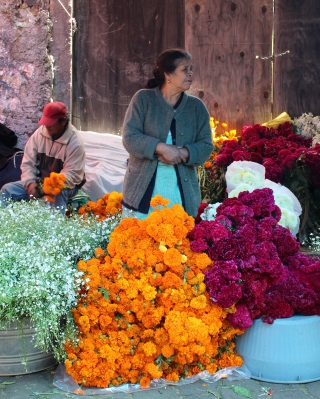
Walking through a Mexican market is one of the richest cultural and sensual experiences you can have. Dating back to pre-Hispanic times, they persist even today, despite the onslaught of supermarkets. There is a marked difference in the quality and offering between public markets and the supermarkets.

Mercado San Juan Pugibet
Centro West
Supermarkets offer only one quality of pumpkin, onion, apples, peppers, tomatoes and other products of the earth. If they are ugly, you put up with it, since that's all there is. But the supers make up for it by offering 20 different types of deodorant and, if they are lucky, even some gringo brands, which are the same as the ones here but cost twice as much—and, yes!—the labels are in English.

Supermarkets never offer the rich variety of products found only in the markets. Besides fruits, vegetables and all kinds of food, there are piñatas, crafts, flowers, medicinal herbs, clothing and pretty much anything else that comes to mind. Eating in one of the fonditas [lunch counters] guarantees tasty, economical dishes with the freshest ingredients.


Markets have been an essential part of life in Mexico City, although the growth of markets hasn't kept pace with the capital's steady growth. In recent decades, they stopped building public markets even as a thousand facilities for large supermarket chains were constructed.

The disappearance of public markets has resulted not only in the loss of many job opportunities but of the warm, personal treatment provided by the sellers—not to mention the richness of having several options of the same produce! The markets are places of community, of socialization—where networks are woven of kinship and cronyism that create a strong communal solidarity.

"Fondita" 

Fresh chicken breasts
Now we are seeing emergence of a hope that the market decline might be reversed. A few days ago [August 2016], a declaration was signed naming as an intangible cultural heritage these traditional expressions that take place in Mexico City's public markets.

One important aspect is that the markets are recognized not only as supply centers, but as custodians of traditions. Suffice it to recall Christmas. Where would we buy everything needed for that celebration? Figurines for the Nativity scene, hay, moss, poinsettias, corn husks for tamales, brown sugar and fruit for the punch served at the posadas and, of course, the piñatas, to mention just a few of the many products not found in the supermarkets.
See: Mexican Traditions: Las Posadas
It was announced that in 2017 the budget will be tripled in order to rescue the 329 traditional and specialized public markets found in Mexico City's 16 boroughs. The public markets employ 280,000 people, who annually hold more than 1,300 romerías [open-air festivities celebrating a religious event]. This means that every day there are at least three anniversary festivities in the markets of Mexico's capital city.

The declaration regards these public spaces as living and dynamic entities, with an ancient tradition fostering the development of Mexican culture by being the supply channel for 46 percent of Mexico City households.

Eduardo Vázquez, Mexico City's Secretary of Culture, explained that the declaration basically grants to the public markets an active role in the development of the social fabric by integrating and reflecting the ethnic, social and cultural diversity that has built Mexico City.

They are going to dedicate 200 million pesos [11 million USD] for the preservation of public markets; however, given the [deteriorated] state of many markets, a much larger amount is surely going to be needed in the near future.

Take the Merced Market, which some time ago suffered a fire that affected part of the nave, which measures the impressive length of 400 meters [437 yards] with 3,205 puestos [sellers' stalls]. Then there is the smaller nave, which sells meat and poultry and has an annex for meals. Around the outside is the pavilion for popular toys and such typical items as clothing, flowers and candy ...

A world of colors, aromas, sounds and tastes that awaken all the senses. In his memoirs, Chilean poet Pablo Neruda declared:
"Mexico is in the markets."
Spanish original

Related articles:

Friday, October 28, 2016

Día de los Muertos: 2016 | Reflections of an Expat

Día de los Muertos, Day of the Dead, is fast approaching. A dear Mexican friend living in Pátzcuaro, Michoacán (our home for our first three years in Mexico), posted British expat Clarita Mannion's thoughtful, beautifully written reflection on this most Mexican of traditions. I pass it on to you in its entirety. 


Let me die like a Mexican: embracing the Day of the Dead


“A civilisation that denies death ends by denying life.”

— Octavio Paz.


They say you only truly die when your name is spoken for the last time. Nowhere is this more true than in Mexico, where Día de los Muertos – or Day of the Dead – takes remembering lost loved ones to a whole new level.
At first glance, this national holiday may pass for a Mexican version of Halloween, with its spooky skeletons and sweet treats. But while modern Halloween exists purely to peddle pumpkins and face paint, Día de los Muertos is a bittersweet reflection on love, loss and life well lived.

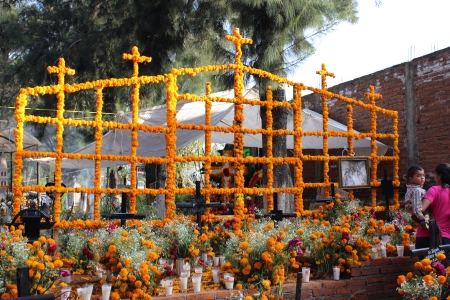
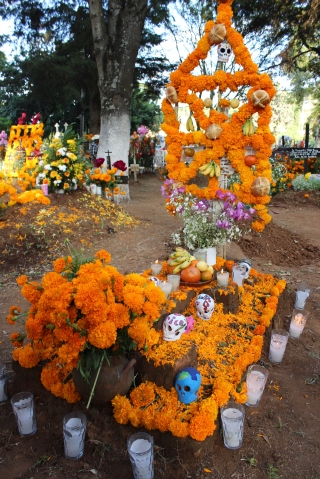
According to Mexican tradition, November 2nd is the one day when souls can leave the afterlife. To help guide lost loved ones back to earth, families build elaborate altars in homes and graveyards. These offerings are draped with flower garlands and colourful crêpe paper, and hung with corn cobs, fruit and sugar cane. Dozens of flickering candles light the way, while the scent of cempasúchil – Mexican marigolds – hangs in the air.

Water, salt and sweetbread, pan de muerto, are laid out to nourish the dead after their long journey home – and it doesn’t stop there. Children’s graves are festooned with sweets and toys, while tobacco and tequila are left to tempt the spirits of adults. Families even prepare platefuls of their loved one’s favourite meals for their short time back on earth.

All this may sound morbid, but Día de los Muertos is far from a day of moping and mourning. Families gather to remember those they’ve lost, not with sadness but with songs, stories and laughter. The foods from the offerings are eaten, music played and memories shared.

To outsiders, this lack of solemnity may even seem disrespectful. But as a friend explained,
“When someone you love dies, it affects you every day, so why would you be sad on the one day they’re back here with you?”
When you look at it like that, it’s hard to argue that the Day of the Dead is anything but beautiful. But how can it possibly comfort those who – like me – don’t believe in heaven, souls or anything else beyond this world?

As an atheist, I spent my first year in Mexico looking at Día de los Muertos from the outside in; as something only other people believed in. The religious. The spiritual. Those brought up in Mexican culture. Another couple of years on, though, and I was starting to understand that this remembrance is much more than merely symbolic.

Believe in what you will, let’s say all those who ever cared about a particular person gather together in one place to remember them by sharing their most vivid and vibrant memories. Surely then, for that one moment at least, that person’s spirit really is there?

And so, while I have endless wishes for my life, I now have only one for my death: 
let me die like a Mexican.
When I’m gone – with any luck many years from now – let me be remembered as Mexicans are. Let bright orange blossoms, the gentle glow of candles and the smell of my favourite foods guide me home; let me be brought back to life once a year through the love and laughter of those who knew me.
If that’s not life after death, I don’t know what is.
Clarita's blog: Thinking Through My Fingers

Wednesday, December 16, 2015

Mexico: Urban, Middle-Class Posadas Take On Features of U.S. Culture - Anthropologist

Traditional Mexican Piñata with Seven Cones
representing Seven Deadly Sins
Today is December 16th, the first day of the Mexican tradition of Posadas—'Inns', or more specifically, the pilgrimage of Joseph and Mary asking innkeepers for shelter. Posadas mark the nine days leading up to Christmas Eve on December 24th.
At the heart of Posadas are families and neighbors who gather to commemorate Joseph's and Mary's journey to Bethlehem in order to fulfill the Roman decree and await the imminent birth of their Child. The religious core of Posadas is the novena—praying the rosary together each day for nine days, each day representing one month of Mary's pregnancy.
The festivities begin by a re-enactment of the pilgrimage. Two children dress as Mary and Joseph; others dress as angels and shepherds. Knocking at different doors, the pilgrims recite the traditional request for lodging. Twice they are ritually turned away by the person designated to be the 'innkeeper' at that door. 
At the third door, the 'innkeeper' agrees to give shelter to Mary and Joseph, and the fiesta begins. Everyone os offered atole (sweetened corn drink) and three kinds of pozole (hominy soup): red (carne-beef), white (pollo-chicken) and green (green chiles). Yes, red, white and green are the colors of the Mexican flag. 
The children then enthusiastically take part in striking a piñata. The traditional style piñata has seven cones, each marked with streamers and represent the Seven Deadly Sins (pecados): greed, gluttony, sloth, pride, envy, wrath and lust. 
Four years ago, when we'd just moved to Mexico City, I wrote a post about our experiences with Posada in Pátzcuaro, Michoacán, including the Mesoamerican roots (hint: piñatas) of this very Mexican tradition. The post ends with this comment: "Today many Posadas have lost their religious roots. We're curious to learn how they are celebrated in our new urban home, Coyoacán in Mexico City. Stay tuned!"
Our apartment is in a seven-story condominium building. To our chagrin, we have indeed learned first-hand "how posadas are celebrated in urban settings". So the title of this piece that appeared today in La Jornada newspaper immediately caught my eye. Enjoy! 
 La Jornada: Emir Olivares Alonso

The chill of the early hours of a December night are no obstacle. A good jacket is enough to take to the streets and enjoy the evening. In colonias [communities], barrios, vecindades [two names for neighborhood], and pueblos [villages], the people, particularly the smaller ones, anxiously await these nine days. Among candles, lanterns, chants, prayers, procession, buñuelos [honey-laced, cinnamon fritter], ponche [fruit punch] and, of course, the piñata "game", the neighbors celebrate the traditional posadas.

Today, particularly among the middle class [and especially in the major cities], this celebration has been diversified by abandoning traditional Mexican features and adopting such influences from U.S. culture, including ornaments with figures of Santa Claus, reindeer and snowmen; Christmas trees and twinkling lights on house façades. In some places, posadas have ceased being a celebration for children and have become adult parties with drink, food and dance.

Andrés Medina Hernández from the Institute of Anthropological Research at the National Autonomous University of Mexico [UNAM] and a specialist in the posada tradition, points out that the middle-class is "most sensitive" to U.S. cultural propaganda [Medina's word], but the cultural heritage survives in working-class neighborhoods, pueblos [villages] and indigenous communities.

Traditionally, posadas were festivities with a religious tinge. Historical data relating the early years of the Spanish Colony recount that in 1587, Brother Diego de San Soria, of the Augustinian order in charge of the Convent of San Agustín Acolman, asked Pope Sixtus V for a papal document. The Pope gave his Aval [Backing] to celebrate bonus Masses annually between December 16 and 24 in several churches.

Across the centuries, the tradition was transformed and became a popular street festival that could take place in the atriums of neighborhood churches, in streets that neighbors took over for a few hours, in the great houses of the wealthiest people, or in neighborhood plazas. But the religious element was always kept intact, with festivities beginning with the procession of pilgrims and the so-called "request for shelter", "petición de posada" [Joseph and Mary asking the innkeeper for shelter].

In recent years, however, more of a consumer element has crept in:
"The entire U.S. cultural current—part of neoliberalism—promotes individualism. The posadas are a collective celebration, but abandonment of the collective spirit is encouraged in the middle-class sectors, which have now taken on drinking and dancing. Today posadas are an excuse to party."
Piñatas

Medina Hernández explained the transformation in both form and content of the traditional piñata—a key element of posadas. About 30 years ago, they were still made of clay and resembled stars (historical documents confirm their seven peaks refer to the Seven Deadly Sins) and were filled with piñata fruits. Now, however, they are made of cardboard and represent television personalities, sports and movie starts, and they are filled with sweets and chocolates produced by the large companies.

For Medina, other circumstances in addition to U.S. trends have influenced the diversification of posadas: the growing insecurity in some parts of the country, the loss of religiosity among many sectors of the population, and urbanization based on vertical condominiums where "relations between neighbors are not always cordial."

Andrés Medina Hernández concludes:
"[Traditional] posadas have not disappeared, but they are not reported by the media. Posada and other traditions are well rooted in Mexico City's indigenous pueblos, neighborhoods and marginal areas. [They are alive and well in Mexico City] in places like Xochimilco, Iztapalapa, Tláhuac, Milpa Alta; and in such communities as Guerrero and Aragón; and in other states. That's where they are."

Saturday, December 12, 2015

Reflections on Profound Meaning of the Virgin of Guadalupe in Mexico and Beyond


Virgin of Guadalupe

Surrounded by Sun's Rays, symbols of the Holy Spirit, the
Virgin stands on the Half-Moon, which represents the female 
principle not just in Mesoamerica, but in many of the world
cosmologies; Cherub below the moon is widely believed to

be Saint Michael, patron saint of Mexico.

It is almost impossible to let the Day of the Virgin of Guadalupe go by without notice. Should one, perhaps, lose track of the day, the cohetes (rocket firecrackers) would bring the needed reminder. Other posts have described how the Faithful mark the day.

The article translated below appeared yesterday in La Jornada. Its author, José Cueli, is a psychoanalyst who contributes regularly to the paper. Far from traditional journalistic prose, today's piece is a prose poem rich in cultural references.

When I first read it, two experiences immediately came to mind. The first took place at a bookstore in San Miguel de Allende, Mexico. The clerk was showing me a book whose theme seemed, to my Anglo nature, both fantastic and improbable. Reacting to my skepticism, she replied rather sharply,
"You simply won't understand Mexican culture until you understand magic and the supernatural."
Setting aside the magical realism of Colombian writer Gabriel García Márquez ("I don't invent anything; everything I write down is already there"), it's still taken some time for me to open up to the place where this aspect of human imagination and expression dwells. Cueli's piece is at home there.

The second experience took place in Chicago while I was getting a haircut. I mentioned to the Guatemalan-born hairstylist that we live in Mexico. Her reaction was remarkable: eyes widening in surprise and awe, she whispered reverentially,
"Oh, México ... México is very special."
Mexico is special in Central and South America precisely for being the place where the Virgin of Guadalupe—morena (brown-skinned), speaking Náhuatl—appeared to the newly baptized Nahua peasant Juan Diego. More precisely, La Virgen Morena appeared on the Hill of Tepeyac, site of the Nahua temple to Tonantzin, believed to be a manifestation of the Earth Mother, known as Coatlicue, the mother of all living things, conceived by immaculate and miraculous means, decider of the length of life itself. Hence, to the Mexica, the Earth was both Mother and Tomb—Giver of Life and Receiver of Human Remains decomposing to rejoin the Life-Force (Ollín).

The syncretism is striking. Many scholars have pointed out the similarities in sound and attributes between Guadalupe and Coatlicue. According to Friar Bernardo de Sahagún, Spanish missionary and primary historian of the period, the indigenous people continued to call the Lady Tonantzín until around 1560, when the Spaniards baptized her with the sole name of Guadalupe.

Over time, the Virgin of Guadalupe was also embraced by the criollos (Spanish born not in Spain, but in Nueva España—Mexico). The Virgin´s personal appearance on Mexican soil was seen as establishing a direct relationship between the land, the criollos and the Mother of God. Even as the Virgin adopted the Mexican people (el pueblo) as her own; el pueblo, in turn, adopted her as the Mother of Mexico. All of Mexico, el pueblo mexicano, could—and still does—adore her.

The Guatemalan hairstylist would add that the appearance of the Náhuatl-speaking, brown-skinned Virgin in Mexico, established a direct relationship not just with los mexicanos, but with all those who live in the Western Hemisphere. The plaza in front of the Basílica Antigua de Guadalupe, Ancient Basilica of Guadalupe, is appropriately named Atrio de las Americas, Atrium of the Americas.

Cueli's reflection incorporates all these cultural nuances. Respectfully, I present my translation to you as an unusual cultural expression of the profoundly rich inner life of many Mexicans.

_______________________

The Collective Miracle of the Union, José Cueli*

The collective miracle of the union in physical pain symbolizes the Mexican Spanish-Indigenous merger in the Virgin of Guadalupe. The encounter marks the fulfillment of an experience of exceptional intensity in keeping with the inner vitality it brings about. Rather than differences, there is identity—the identification of one with the other. Even more, confusion between the two. The fulfillment of an impossible presence of complete impossibility.

Inner purity turns into ecstasy in moments when I feel transported beyond outside appearances. An open emptiness in which I lose the difference between your [Virgin's] image and objects, imitator and imitated. In an extraordinary manner, a wonderment wells up in a feeling of uncommon fullness that ... in seconds ... gives way to brutal emptiness.

In which you disappear, and the perception no longer exists. Only the dream remains with its omens, alerts, memories ... an illumination that comes to me in an exceptional way ... and grows and pays the debt, my beloved, of pain in the realm of shadows, state of internal exhaustion, difficult to define. A transfiguration that discovers the profound experience of solitude. An intense confusion that imagines the summons to return to the routine ... heartbroken and melancholy.

Depression over the loss of self-exaltation. Clothed in the colors of a narcissism that becomes almost unbearable in that I seek, imagine and plan the return to those extraordinary moments of union, without which the future seems to stop making sense ... upon feeling myself abandoned, rejected by you, and threatened by a spiritual desolation, an incision that inserts confusion between opposites.
"In the current plaza of the Basilica of Guadalupe, called monumental, they have built two pyramid bases for the dancers on December 12. Four centuries later, representatives of the new cult see themselves as needed to erect what they destroyed four centuries ago. Undoubtedly, the XVI Century Convent and indigenous activity was the same as for the 'Calmecac', its students and priests." (Santiago Ramírez Ruiz).
Note: The Calmecac—"House of the Lineage"—was an academy for sons of Aztec nobility, where they received rigorous religious and military training.
"The slash of the Spanish la tizona [legendary sword] has not separated us from the ancient world, from the primal and original poetry of our explosive and magical responsibility. The myth became flesh. At the tip of la tizona, the feathered serpent, the pieces gathered up new and old life. They went into the woods and hid everywhere. Today they abduct and soar in words, blood and dreams, as vivid as in the codices—legends, fresh and monolithic." (Luis Cardoza y Aragón).
Note: In Spanish literature, 'la tizona' is the name given to one of the legendary swords used by El Cid to fight the Moors, who occupied Spain for 800 years, 711-1492 CE. 'The Plumed Serpent' is Quetzalcóatl, related to gods of the wind, of Venus, of the dawn, of merchants and of arts, crafts and knowledge. But, significant here, Quetzalcóatl was also the patron god of the Aztec priesthood, of learning and knowledge. The codices are the Aztec writings.
"The Virgin of Guadalupe is the surrogate mother who calms and satisfies. She stands as the symbolic banner of two cultures: one looks inward, where it has encountered philosophical truth 'under lock and key'; the other looks outward. For one ... restraint in man; for the other ... the legend." (Miguel León-Portilla) 
Spanish original

*José Cueli García, born in Mexico City in 1934, completed studies in medicine, psychology and psychoanalysis; holds the doctorate in psychology from the National Autonomous University of Mexico (UNAM). Since 1965, Dr. Cueli has been a professor in UNAM's School of Psychology.

Quotations are all taken from the same source: Selected Works (transl.), Obras escogidas, Ed. Línea, 1983. Writers cited are:
  • Santiago Ramírez Ruiz Sandoval (Mexico City, 1921-1989), physician (UNAM) and psychoanalist.
  • Luis Cardoza y Aragón (1901-1992), Guatemalan writer, essayist, poet, art critic and diplomat, spent much of his life in exile in Mexico.
  • Miguel León-Portilla (Mexico City, 1926- ), Mexican anthropologist and historian (UNAM), is a prime authority on Náhuatl thought and literature.

Friday, October 30, 2015

Halloween and Day of the Dead: Same? Different? Little of Each?

This question doesn't even come up in Mexico's traditional, rural regions, but it's increasingly relevant in Mexico's urban settings, where television and the supermarkets have introduced the trappings of Halloween into Mexican culture.  Along the culturally porous frontier region between Mexico and its northern neighbor, of course, this is indeed an intriguing question.

Halloween: Western European Tradition

Halloween, or Hallowe'en — a contraction of "All Hallows’ Evening" — is also known as Allhalloween, All Hallows' Eve, or All Saints' Eve. Regardless of what it's called, it is a yearly celebration observed in a number of countries on October 31, eve of the Western Christian feast of All Hallows' (Saints') Day that begins the three-day observance of Allhallowtide — the season in the liturgical year dedicated to remembering the dead, including saints (hallows), martyrs, and all the faithful departed believers.

Pre-Christian Roots

All Hallows' Eve is influenced by Celtic harvest festivals, particularly the Gaelic festival Samhain (pronounced / sah-win or sow-in), which marks the end of the harvest season and the beginning of winter or the year's "darker half". Traditionally, Samhain is celebrated from sunset on October 31 to sunset on November 1, which puts it about halfway between the Autumn Equinox (September 21) and the Winter Solstice (December 21).

Evidence exists that Samhain has been an important date since ancient times. It is mentioned in some of the earliest Irish literature, and many important events in Irish mythology take place or begin on Samhain. It was the time when cattle were brought back down from the summer pastures, and livestock were slaughtered for the winter.

Special bonfires were ritually lit. The bonfires' flames, smoke and ashes were deemed to have protective and cleansing powers and were also used for divination, especially regarding death and marriage. Some suggest the fires were a kind of imitative or sympathetic magic — they mimicked the Sun, helping the "powers of growth" and holding back the decay and darkness of the coming winter.

Samhain was seen as a liminal time; that is, when the boundary between this world and the Otherworld thinned and hence could more easily be crossed. This meant the 'spirits' or 'fairies' — Aos Sí (pronounced / ees shee) — could come into our world. At Samhain it was believed that the Aos Sí — gods and nature spirits — needed to be propitiated to ensure that the people and their livestock would survive the harsh winter. Offerings of food and drink were left outside for them.

The souls of the dead were thought to revisit their homes seeking hospitality. Feasts were held, and souls of dead kin were beckoned to attend. A place was set for them at the table and a spot was reserved for them by the bonfire.

Mumming (seasonal folk plays performed by troupes of actors) was part of the festival, as was guising, when people went door-to-door in costume (disguise), often reciting verses in exchange for food. The costumes may have been a way of imitating, and disguising oneself from, the Aos Sí. Impersonating these beings, or wearing a disguise, was believed to protect oneself from them. It is suggested that the mummers and guisers
"personify the old spirits of the winter, who demanded reward in exchange for good fortune."
On the custom of wearing costumes, Christian minister Prince Sorie Conteh wrote (2009):
"It was traditionally believed that the souls of the departed wandered the earth until All Saints' Day, and All Hallows' Eve provided one last chance for the dead to gain vengeance on their enemies before moving to the next world. In order to avoid being recognized by any soul that might be seeking such vengeance, people would don masks or costumes to disguise their identities."
From at least the 18th century, "imitating malignant spirits" led to playing pranks in Ireland and the Scottish Highlands. In the 20th century, wearing costumes and playing pranks at Halloween spread to England.

photograph
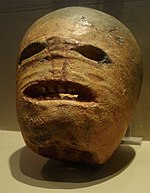
Traditional Irish Halloween turnip (rutabaga) lantern on display,
 Museum of Country Life, Ireland
The
"traditional illumination for guisers or pranksters abroad on the night in some places was provided by turnips, hollowed out to act as lanterns and often carved with grotesque faces."
Those who made them said the lanterns were to represent the spirits or, alternatively, to ward off evil spirits. They were common in parts of Ireland and the Scottish Highlands in the 19th century. In the 20th century they spread to other parts of England and became generally known as Jack-o'-Lanterns, which in North America are carved from pumpkins.

Christian Influences

Today's Halloween customs are also thought to have been influenced by Christian dogma and practices derived from it. Since the time of the early Church, major feasts in the Christian Church (such as Christmas, Easter and Pentecost) had vigils that began the night before, as did the feast of All Hallows'. Collectively referred to as Allhallowtide, these three days — eve of October 31 to sunset on November 2 — are a time for honoring the saints and praying for the recently departed souls who have yet to reach Heaven.

Introduced in the year 609, All Saints was originally celebrated on May 13, the same date as Lemuria, an ancient Roman festival of the dead. In 835, at the behest of Pope Gregory IV, All Saints was officially switched to November 1, the same date as Samhain. Some suggest this was due to Celtic influence; others suggest it was a Germanic idea. It is claimed that both Germanic and Celtic-speaking peoples commemorated the dead at the beginning of winter, which may have been seen as the most fitting time to do so, since that was when the plants themselves were 'dying'.

By the end of the 12th century the three days of Allhallowtide had become holy days of obligation across Europe and involved such traditions as ringing church bells for the souls in purgatory. In addition,
"it was customary for criers dressed in black to parade the streets, ringing a bell of mournful sound and calling on all good Christians to remember the poor souls."
In medieval Europe at Halloween,
"fires [were] lit to guide these souls on their way and deflect them from haunting honest Christian folk." 
Households in Austria, England and Ireland often had
"candles burning in every room to guide the souls back to visit their earthly homes."
'Souling', the custom of baking and sharing soul cakes (a small, round traditional cake) for all christened souls, has been suggested as the origin of Trick-or-Treating. The custom dates at least as far back as the 15th century and was found in parts of England, Flanders, Germany and Austria. Groups of poor people, often children, would go door-to-door during Allhallowtide, collecting soul cakes in exchange for praying for the dead, especially the souls of the givers' friends and relatives. Soul cakes would also be offered for the souls themselves to eat, or the 'soulers' would act as their representatives.

Halloween Customs in North America

The practice of guising at Halloween in North America doesn't appear until 1911, when a Kingston, Ontario, newspaper reported children going "guising" around the neighborhood. Another reference to ritual begging on Halloween appears, place unknown, in 1915, and a third shows up in Chicago in 1920. 

Trick-or-Treat is a customary Halloween celebration for children, who go house to house in costume, asking for treats such as candy or sometimes money, with the question, "Trick or Treat?" The word "trick" refers to "threat" to perform mischief on the homeowners or their property if no treat is given. But it turns out that Trick-or-Treat may be a 20th century invention. The earliest known use in print of the term "Trick or Treat" appears in 1927, in the Blackie Herald of Alberta, Canada.

American historian Ruth Edna Kelley of Massachusetts wrote the first history of Halloween in the U.S., The Book of Hallowe'en (1919). In the chapter "Hallowe'en in America", Kelley describes souling and has this to say on customs that arrived from across the Atlantic:
"Americans have fostered them, and are making this an occasion something like what it must have been in its best days overseas. All Halloween customs in the United States are borrowed directly or adapted from those of other countries."
Between the turn of the 20th century and the 1920s, thousands of Halloween postcards were produced showing children, but not Trick-or-Treating, which doesn't seem to have become a widespread practice until the 1930s. The term first appeared in the U.S. in 1934, and its first use in a national publication occurred in 1939.

Día de los Muertos / Day of the Dead: Mesoamerican Roots

Original peoples in South Central Mexico and North Central America (Mesoamerica) are known for having "very elaborate forms of spirituality" linked to the annual agricultural cycle grounded in the sun's annual passage across the heavens.

Mexico's geography, climate and natural forces, are very different from Europe's. The vulnerability of this land's early inhabitants to the vicissitudes of natural phenomena — volcanic eruptions, earthquakes, cyclones from the Pacific, hurricanes from the Caribbean and Atlantic, landslides, floods, and drought — honed in them a keen awareness that they were indeed not in charge; in fact, they were at the mercy of la naturaleza (forces of nature). The Mesoamerican worldview has been described like this:
"Rather than imagining a god separate from his creation, the thinkers of Mesoamerica conceived of the divine as the Life-Force itself, constantly creating, ordering, sustaining, destroying and recreating the world."
The Mesoamerican peoples perceived the cosmos as centered on the human world at the earthly level, around which the sun revolved in its daily cycle, rising to the zenith of Heaven, then descending into night and the Underworld. These themes appear in the design of the altars or ofrendas, offerings, that reproduce the Mesoamerican cosmovisión ("worldview"). The altars represent the
  • Underworld [ground level], where incensarios (censers burning copal) are placed; the 
  • Earthly level [midpoint], where offerings [bread, fruit, water, salt, tequila, cerveza] are placed; and the 
  • Heavens [upper level], with images and photographs of the dead.
Ofrenda, Offering, in private home;
a neighbor is placing her gift of fruit

The altars, characterized in most cases by their bright colors, are complete with copal incense and sweet drinks fermented from corn, chocolate, typical dishes like pumpkin or sweet tamales. It is customary to place the names of the deceased with their photographs.
"Here, what appears is a celebration of Life, there is a joy in being connected with the dead. (...) I believe that it is the end of a human cycle that is lived with great joy," observed Andrés Merino, a member of the Institute of Anthropological Research at the National Autonomous University of Mexico (UNAM) .
During this celebration, in addition to going to the cemeteries, children often go out on the streets to sing praises and ask offerings on behalf of the dead, with a chilacayote (a fruit similar to pumpkin) with a candle inside. Dr. Merino believes this custom leads to confusing Día de los Muertos with Halloween.

Spanish Catholic Influences

The Catholic Hispanic legacy is seen, for example, in the pan de muerto [bread of the dead], made with wheat flour [introduced by the Spanish], eggs, sugar and anise; in the placement of fruits and flowers not native to the region [also brought by the Spanish] on altars, and in the use of candles and such Christian concepts as "souls" in referring to the dead who return this one night in the year.

Same, Different, Little of Each?

At first glance, Halloween and Día de los Muertos are similar. Both relate to the agricultural cycle, itself linked to the sun's annual journey, and both occur at the midpoint between the Autumnal Solstice and the Winter Equinox. The belief that the souls of the dead return home on one night of the year seems to have ancient origins; it is found in many cultures throughout the world but, as the saying goes, 'the devil is in the details'.

The European harvest festival was motivated by anticipation of the "dark part" of the year and the fervant desire to gain protection against it. However, Mexico's unique geography and the Mesoamerican cosmovisión that grew up in response to the natural challenges faced by Mexico's early peoples gave rise to both a form and meaning of Día de los Muertos that is quite distinct from the symbolism of Halloween.

Nonetheless, the medieval Spanish Catholic legacy that is part of Mexican culture in general and Día de los Muertos in particular does share common elements with the tradition of Halloween. This becomes more understandable when we realize that the region inhabited by the Celts included a large part of the Iberian Peninsula (Spain).

The pan de muerto, for example, is similar to the soul cakes that are part of Halloween, as is the use of candles and reference to such Christian concepts as "souls" for referring to the dead who return on this one night.

Pan de Muerto / Bread of Death in shape of human with crossed arms
Photo: Reed
As as it did in Europe, human welfare in Mexico depended on the agricultural cycle for producing successful corn crops, which culminated with the "harvest festival" or "festival of the dead" presided over by the goddess Mictecacíhuatl, known as Lady Death, and her husband Mictlantecuhtli, Lord of the Land of the Dead. Today, Lady Death is represented as La Catrina, the character created by graphic artist José Guadalupe Posada and made popular by his disciple and friend, Mexican muralist Diego Rivera.

La Catrina is in center in this detail from Diego Rivera's
 Sueño de la tarde dominical en la Alameda Central /
Dream of a Sunday Afternoon in Alameda Central 
(1947)


Mexico / United States

Mexico and the United States are a single geological region, increasingly linked economically, socially and culturally. What better way, then, to introduce the cross-border cultural influence — which today pretty much runs in both directions — than by presenting Tucson Artist Hank Tusinski's ~:BANDA CALACA:~ now at the Tucson Museum of Art until January 3, 2016.

The work features a nearly life-size, 15-piece free-standing papier mâche skeleton mariachi band with musical instruments on an installation about 12 feet high, 25 feet long, and 6 feet wide. The work is unusual given that Tusinski is a devout Zen Buddhist:
"Tusinski’s work focuses on integrating the beliefs of Mesoamerica, Mexican contemporary indigenous communities, and contemporary Buddhists about death as a transformational process to be celebrated. A journey to Michoacán, Mexico, introduced Tusinski to the indigenous P΄urhépecha peoples’ use of music in their Festival of the Spirit as an embodiment of spirit. This is the well-spring of ~:BANDA CALACA:~." 
Tusinski says
“The fundamental dilemma of existence is the nature of life and death. There is potential liberation and joy in death. ~:BANDA CALACA:~ is offered with the intention of creating the opportunity to view this transition as energy that continues infinitely. The skeleton band represents the individual and the universal dance in the eternal flow.”
Dr. Julie Sasse, TMA Chief Curator and Curator of Modern and Contemporary Art, said:
“Tusinski’s ~:BANDA CALACA:~ is a riot of color, pattern, and imagery. His work reminds us to celebrate life in death, to honor the past in the present, and to embrace the universality of spiritual openness.”
~:BANDA CALACA:~  ...  an energetic representation of the Life-Force itself ...

~:BANDA CALACA:~
Hank Tusinski
Photo: Courtesy of the Artist

See also: Día de los Muertos.


Tuesday, May 20, 2014

Sunday in Coyoacán: Encountering Medieval Spain in a Neighborhood Park

Yes, we're pretty much hooked on Mexico! Sunday afternoon we went for a quiet stroll in a park near the ex Convento Churubusco. Although this neighborhood park wasn't particularly crowded, it nonetheless bustled with the energy of a pickup soccer game being played on the basketball courts by neighborhood youth and the sounds of little kids clambering on the jungle gyms.

Our plan was to stroll around the perimeter, then explore the center. Unlike many paths in Mexico, which are nothing more than unevenly placed rough stones, the walkway was smooth with newly laid paving stones. We ambled along, commenting lazily on the huge palm and juniper trees and the few random flowers able to grow in the deep shade.

In the distance, the faint sound of group singing reached our ears. Strolling on, people-watching all the while, we paused to enjoy various fountains and a bust of Lázaro Cárdenas commissioned by the state of Michoacán. As we turned to cross the park, the singing grew louder. Now I could hear guitars. My first thought was whether it might be a rondalla group—serenaders who accompany themselves on their own stringed instruments.

Then we became aware that the music was coming from a kiosk at one side of the park. As we neared, we could see it was an actual performance. About a dozen singers with guitars and other stringed instruments stood in front of a small audience of perhaps fifty sitting in white plastic chairs.

At first we thought it was a private party, but when we mounted the stairs, a young man brought two chairs so we could sit down. When we were settled, Reed leaned over and whispered in my ear, "It's a Tuna ... a group of troubadours from the university like the ones we heard in Morelia."

In Morelia, the Tuna walks along the esplanade, stopping to serenade people sitting at the outdoor cafes, but here they were giving a most informal performance. The music was just right for a lazy Sunday afternoon in the park. The voices, accompanied by soft string sounds accentuated by tambourine, drum or even castanets, sang lyric songs about love and life. 

Have a listen! Here's a 13-minute YouTube recording of a mix of Tuna songs. Lovingly chosen, the music is good. The visuals are photographs of various Tuna groups dressed in the medieval university dress  that is the tradition and hallmark of a Tuna. While working on this post, I listened with growing pleasure both to this recording and to others listed below.

On Sunday, the occasion was highly informal. We suspect the audience was made up of family and friends. Members of the group took turns introducing the songs, a little girl (about five years old) clung to her troubadour-mom's knees for awhile, and a toddler meandered around until recaptured by her grandmother.

"So What's a Tuna?"

The origins of the name Tuna stretch back to the rondalla tradition that arose in Medieval Spain and Portugal and refers to an ensemble of plucked, stringed instruments. In Spanish, the last meaning of the verb rondar is "to serenade," but its primary definitions are to patrol or wander—suggesting the wandering troubadour or serenader.

According to Wikipedia, there were four types of rondalla:
  • Groups of young men who played and sang regularly in front of homes; these were often serenades that a young man arranged for a young woman as a sign of his serious intentions;
  • Bands of musicians known as murza or murga, who begged for alms;
  • A group of musicians known as comparsa [troupe], who played together onstage; and 
  • Groups of university musicians known as estudiantina [student-like], who were dubbed “tuna”. 
The Spanish brought the Tuna tradition with them to New Spain, today's Mexico. Estudiantina musicians in Spain and Mexico wear 16th century attire: "short velvet breeches, ornate shirts and a short cape with multicolored ribbons". Some songs feature a tuno swirling his or her cape in elegant and increasingly complex moves. On Sunday, we saw both a young woman and a young man display their skills with the cape.

Tuna Group in Guanajuato, Mexico
Note: Variety of shapes and sizes of their instruments
(Photo: Wikipedia)
Stringed Instruments

Given my Northern European heritage, my idea of stringed instruments before moving to Mexico was limited to violin, viola, cello, double bass, harp ... and maybe the highly suspect ukulele!

Living in Pátzcuaro, Michoacán, broadened my horizon stringed instrument-wise because on the nearby Purhépecha Meseta [Highlands] is located the pueblo of Paracho, known world-wide for the quality of its stringed instruments. The photo above suggests the multitude of different kinds of stringed instruments played in Mexico and throughout Latin America. 

I had a vague idea about the lute as a medieval English and even French instrument and maybe I even had a vague notion of the mandolin (a member of the lute family), but the Mexican vihuela or bandurria or the ...? Well, you get the idea!

Bandurria
Here's a YouTube solo performance of the Lágrimas Negras Bandurria [1:19] "Bandurria Black Tears."

Mexican Vihuela
YouTube solo performance of Valdarrabano, Soneto [1:19 min] on the Mexican vihuela.   

Lutes ... all sizes and shapes!
The mandolin is in the Lute Family

Umpteenth Cultural Wakeup Call!

We in the U.S. may be known for our cultural myopia, but I pride myself on being at least a little bit culturally aware. So imagine how humbling it felt to discover that the words "lute" and "oud" derive from the Arabic al-ʿud (العود — literally means "the wood").

In turn, ʿud may be an Arabized version of the Persian name rud, which meant "string," "stringed instrument," or "lute." Moreover, "wood" may have been placed in the name to distinguish the instrument with its wooden soundboard from its skin-faced predecessors. Gianfranco Lotti suggests that the appellation "wood" originally carried derogatory connotations because of early Islam's proscriptions on all instrumental music. 

Thus it is that the origins of our Northern European family of stringed instruments are most likely found in instruments from Persia brought to Spain by the Muslim Moors from North Africa who dominated the Iberian Peninsula for 800 years (711 to 1492). Ferdinand and Isabel, in fact, celebrated their final victory over the Moors at Granada by funding Christopher Columbus' voyage West!

So we circle around again to the origin of the name Tuna, which may come from the French roi de Thunes, "king of Tunis," a title given to leaders of vagabonds or wanderers [rondar].

But there is also the legend of a real King of Tunis. Geography alert: Tunisia is on the Mediterranean Coast of Africa between Algeria, its western neighbor, and Libya, on its eastern flank.

This King of Tunis, known for his love of music and partying, enjoyed walking around the streets at night playing and singing, which may explain the origin of both 'king of the vagabonds' and of the Tuna.

¡Bienvenida a México! where life is never dull, and there's always something new to learn and appreciate on the cultural front!

Still Curious?

As an undergraduate music major, I developed a real love for the pure simplicity of Renaissance music. Here are a couple of other pieces, among many I've just discovered on YouTube. Enjoy!

Wednesday, March 26, 2014

On the Flanks of Ajusco Volcano: Fiesta, Family and Much More

The response of Jenny's readers to the recent post about buying embroidered cushion covers from Chiapas was delightful, but it also aroused no little angst: How on earth was I to come up with another tale so grounded in our everyday experience of interacting with Mexico's ordinary people?

Oh, me of little faith! To my astonishment, another remarkable story has unfolded over the last couple of weeks. It all started as I was standing in line at Santander Bank waiting to make a deposit. Suddenly behind me, I heard a distinctly Mexican voice tentatively ask, "Señora Jenny?"

I turned to see a tall Mexican man smiling at me:
"Excuse me," I said, "I don't remember you. How do I know you?"
He told me that in early January he had driven me back from Médica Sur. Then I remembered!
"¡Qué milagro!" — "What a miracle!" I exclaimed, and I meant it.
The truth is I'd been trying to find him for the last couple of weeks. Ever since our visit to Tepoztlán, we've wanted to visit Ajusco Volcano, which is the mountain range separating the Valley of Tepoztlán from the Valley of Mexico [Mexico City], but I couldn't find the card given to me by the taxi driver who'd told me he lives there.

Later, he'd tell me that it was the first time he'd been in that bank. Walking by with his wife, he decided he could get his banking business done in that branch ... on that day. What's equally weird is that Santander isn't my bank either. I was only there to make a deposit in payment for a purchase!

Yes, he was indeed the driver of the taxi I'd hailed on my way back from a doctor's appointment. The way back to Coyoacán features a dramatic view of Ajusco, which rises improbably behind Mexico City's sprawling modernity.

On a Clear Day You Can See Ajusco Volcano, Southeast Mexico City
Photo: Jenny, leaning out of bedroom window and twisting left, south

In that first encounter, I remember remarking to the driver how beautiful and dramatic Ajusco is.
"We live there, on the side of Ajusco," he'd replied.
"You're kidding," was my delighted reaction. "My husband and I want to visit, but we need a guide. It's not somewhere to be visited without someone who knows the area." 
"I would be delighted to drive you. I'd like you to meet my wife, she's involved with tourist activities," he instantly replied.
That's how it started. When we arrived at our building, the driver gave me his card, which I somehow managed to misplace; hence, my two-week search trying to locate him now, three months later.

After I made my bank deposit, I waited. Writing on the bank's counter, I got his name, Carlitos, and telephone numbers: both cell phone and house line. When we got outside, I met his wife, a lovely woman who seemed slightly baffled, but friendly.

All through the week, I kept checking the weather, which through Saturday was monotonously the same: Clear with 10% Chance of Rain. Sunday's forecast was also stubbornly consistent: Cloudy with 30% Chance of Rain. No matter how many times I checked, the forecast stayed the same.

Finally, Reed and I just kind of looked at each other and said, "Let's go anyway." So I called Carlitos, and we arranged for him to pick us up at 11:00 AM Sunday morning.

Sunday: Cerro de Ajusco

Sunday morning dawned clear. Just a little after 11:00 AM, Carlitos arrived with his wife, Maristel. After a brief discussion to agree on the best route, we set out. By the time we arrived at the first lookout, haze had settled over the Valley of Mexico.

But if haze stopped Reed from taking photos, it couldn't mask the drama of the panorama. Urban sprawl and modern skyscrapers faded to the background, as I was once again struck by the bare bones of the geography of 'the' Valley of Mexico. Later I discovered that the Cuenca de México, catchment area for the chains of cerros, hills, that surround and define this basin is actually comprised of four valleys.

Before the Spanish arrived, the area was a system of lakes, which the Spanish filled in and drained during the first two hundred years of the Colonial Era. But what caught my eye were the extinct craters of volcanoes that had erupted hundreds if not thousands of years ago. Mother Nature at work!

I found this map of the Cuenca de México, the catchment area or drainage basin, that is Mexico City today.

Legend (Click to Enlarge)
Dark Green: Cuenca, Drainage Basin or Catchment, of Mexico City
Brown Triangles: Principal Mountains [At edge (periphery) of Catchment Area]
Turquoise Blue: Lakes Existing in 21st Century
Gray-Green: Lakes in the 16th Century [When Spanish Arrived]
Brown-Red Circles: Principal Population Areas
Yellow: Metropolitan Area of Mexico City

Getting back in the car, we began the climb up the side of Ajusco along its only road—a modest two-lane road that passes through three pueblos, each with its own small parish church.

Fiesta in Pueblo of Santa María Magdalena Petlacalco

At the second pueblo, we were in luck. It was their Fiesta associated with the First Friday of Lent. Located on a rise, the church was built during the first third of the 18th century. The Fiesta is in honor of The Lord of the Column (Señor de la Columna).

According to legend, the carved wooden statue of El Señor de la Columna was found by a peasant early one October morning on the shore of the Pacific Ocean in Lurín, Peru (Photo: Internet). 

Much of the Fiesta takes place in the Atrium, a large square in front of the Church. Small as this pueblo is, its Fiesta has all the traditional elements and conveys the intense energy of these liturgical celebrations. Here's my loose translation of the schedule:
  • First Friday: The fiesta begins with a traditional pilgrimage to the Sanctuary of the Señor de Chalma (outside Toluca), another miraculous manifestation of the Suffering Jesus in the days before the Crucifixion.
  • Afternoon: Procession of "El Señor de la Columna" tours the entire pueblo in the afternoon and evening along streets adorned in purple and white bunting, with runners laid down for the miraculous image to travel on. 
  • Saturday: Pilgrims returning from Chalma are received at the entrance to the pueblo and greeted with the traditional Dance of the Chinelos; the word "chinelos" derives from the Nahuatl word “zineloquie” meaning “disguised.”
Dance of the Chinelos (Photos: Reed)
  • Day: The Atrium of the Church is the "site of much joy and traditional dances"; 
  • Night: A party with bands and dancing, the sky is lit with the burning of Traditional Castillos [literally "Castles," but also Fireworks Towers].
Castillo, or Fireworks Tower
Castillo, Ready to Fire!
  • Sunday: Rocket salvos and traditional dances "fill the Atrium with joy."
  • Holy Mass: Celebrated for First Sunday of Lent, with traditional Dances of the Chinelos.
  • Afternoon: Traditional Jaripeo (Rodeo). 
  • Night: Another display of Traditional Pyrotechnics [Castillo] and Band Music. 
One of several bandas, bands, featuring trumpets 

It was hard to believe that we were still in Mexico City, the Federal District of the Republic of Mexico ... because the Ajusco region is puro, puro, puro [quintessentially] pueblo ... indigenous abuelas, grandmothers, wrapped in their rebozos ... chickens in the yards, men and boys riding horses ... cows ... wide open panoramas of this incredible countryside ... rows of mountain chains ... extinct volcanoes ... manicured fields surrounded by stone walls reminiscent of the New England countryside. ¡Ay, México, lindo y querido! Mexico, beautiful and beloved!

Comida Mexican-Style

After our tour, Carlitos and Maristel invited us to have comida, dinner, at their home on a country lane in the pueblo of San Tomás Ajusco.  Their house is large by Mexican standards and extremely comfortable. We loved its large windows. We spent our time in the diningroom, which has large windows along one side and French doors opening to the yard on a second side. Mexican-style, we sat and talked ... and ate ... and talked some more ... for lord knows how long ... three, four hours???

From the beginning, I'd had a good feeling about Carlitos, whose intelligence and professional bearing foster confidence. As it turns out, both he and Maristel graduated from UNAM (National Autonomous University of Mexico, one of Mexico's premier universities): Carlitos in accounting; Maristel in administration.

Carlitos told us that accounting and administration students take the same classes for the first-year of their programs. They laughed when I quipped, "But one year was enough...."

Their 21-year old daughter is now studying Biology at UNAM; their 18-year old son is studying Veterinary Medicine (first year) and wants to migrate to Australia. Their 12-year old daughter wants to be an actress. Given her science-oriented older sibs, why am I not surprised?

Carlitos just gave up his accounting office because the landlord was asking exorbitant increases—sound familiar to Jenny's readers? He has also owned and run a Papelería, Stationery Store. Clearly, Carlitos is an entrepreneur at heart. I suspect the taxi might be a placeholder while he figures out what he'd like to do next.

Maristel is currently taking part in a research project to explore the tourist potential of Xochimilco, famous for its floating gardens. But Maristel told us that Xochimilco's rich prehispanic history invites development to grow the economy by increasing tourist activity. Needless to say, we are eager to explore those sites with her!

For their part, the entire family was clearly taken that we USers were so enjoying their hospitality. For our part, we simply appreciated having the opportunity to spend an afternoon with an extraordinarily nice family ... including young people who actually talked to us!

Day's End

We had left at 11:00 AM and arrived back home at 7:00 PM. Dare I admit to dozing on the ride home ... Mexico City is 7,000 ft. ... the pueblo of San Tomás Ajusco is at 10,000 ft ... the peak of Ajusco Volcano is 13,987 ft—almost another 4,000 ft above the pueblo.

Both Reed and I seemed to have suffered some of the effects of high altitude, but we had such a memorable day, it was more than worth it. Moreover, Carlitos and Maristel are eager to show us other parts of the outer reaches of Ajusco, Milpa Alta and Xochimilco—all of which, believe it or not, are still within the boundaries of the Federal District, Mexico City. We can hardly wait.

Still Curious?

Here's Reed's photo album of the day: Fiesta in Pueblo Santa María Magdalena Petlacalco. Spoiler alert: I borrowed a couple of his photos.

While writing this post, other of Jenny's posts kept popping into my mind. Here are the best ones:
  • A description of the Dance of the Chinelos was hard to come by. A friend who lives in Tepoztlán kindly sent me this one, which first appeared in Jenny's post The Sacred Valley of Tepoztlán.
"Cortés defeated the Aztecs in 1521. By 1870, the Spanish colonists in Nueva España were organizing elegant dances for the Carnaval (Mardi Gras) that precedes Lent, but only peninsulares, those born on the Iberian Peninsula, Spain, could attend. Tired of being excluded from Carnaval, a group of native-born young men organized a cuadrilla ['posse'], disguised themselves in old clothes, covered their faces with pieces of manta, Mexican muslin, and began to shout, whistle and skip through the streets of town, mocking the Spanish, calling them huehuenchis, "old uglies" or "people who dress in old clothes.
"The first local celebration was so successful that the following year the young people organized another cuadrilla. To represent the Spanish, they added beards to their masks. In 1872 the young people again took to the streets, this time accompanied by a wind band whose members were disguised in masks that not only had exaggerated beards and mustaches but blue eyes, in order to further ridicule the Spanish in revenge for the humiliations they had inflicted. 
"As the party became increasingly popular, its character gradually evolved and became ritualized as a subtle and fun way to protest. Then people decided to hold their own celebration. The corno, horn, was a constant in a mix that blended ancient rituals with those of the new, imported Spanish culture. The end result was pagan-religious or religious-pagan events, depending on who was in charge.  
"The dance—fun, festive, cheerful—keeps rhythm with the humorous notes of village bands. The colorful dances hustle and rumble like the cohetes, rockets, launched incessantly. All this energy culminates in the famous "leap of the chinelo," which is the typical dance of Carnaval. Performed on several occasions throughout the year, the dance has changed little for more than a century. 
"The dancers' garments are richly decorated with multi-colored sequins and beads. The cone-shaped hats are fully embroidered and decorated with faux pearls in an apparent nod to Arab-Moorish-Spanish ancestry."
Yet another reminder that Moors from Northern Africa occupied the Iberian Peninsula for eight hundred years, during which time the primary occupation of Spanish nobles was warfare that finally succeeded in 1492. Riding high from the victory at Granada, Ferdinand and Isabella agreed to finance Christopher Columbus's voyage West into the setting sun. The rest, as they say, is history.
Spanish evangelizers used the story of the Moors' ultimate defeat to impress on the indigenous peoples of Mexico what would happen if they refused to submit to the Spanish king (Crown) and the Christian God (Cross). One of the dances of the Purhépecha people of Michoacán is the Dance of the Moors.   
Here are the two short [One 1:17; Other 1:05] YouTube videos I made of the Chinelo dancers we saw at the fiesta in Santa María Magdalena Petlacalco.
  • Pilgrimage is a tradition with very deep roots in Mesoamerican culture. An earlier post, Pilgrimage, describes Mesoamerican pilgrimages as
  • "...collective endeavors for guaranteeing the continuity of the universe against catastrophic dissolution in an unstable world.assure ...."
    The tradition of pilgrimage remains strong throughout Mexico. Here, the pueblo's formal reception of its returning pilgrims on Saturday morning reinforces the essentially collective nature of pilgrimage that is still alive. 
  • Cohetes (rockets) are such an integral part of Mexican culture that it's impossible to imagine Mexico without them. Not a day goes by in Mexico City that we don't hear cohetes going off! Here's a great post from MexConnect: Cohetes: A Mexican Tradition.
Usually coheteros are older men, but these jóvenes, young men, were having a high old time setting off rockets right in the street.
Cohetes, rockets
  • Jaripeo (Bull-Riding) is also a strong pueblo tradition that developed around the bulls brought to Nueva España by the Spanish. Here's Jenny's post: Mexico Traditions: Jaripeo.