Showing posts with label Dia de los Muertos. Show all posts

Saturday, October 30, 2021

Day of the Dead Transformed by Commercialization Over the Centuries

The Conversation, October 27, 2021 | By Mathew Sandoval*

As a Mexican-American who celebrates Día de los Muertos, or the Day of the Dead, at the end of October and beginning of November, I’ve noted an increasing concern the past several years that the holiday is becoming more commercialized

The mass-marketing of the Day of the Dead is evident in the costumes that people buy for the day. Credit: Man Hon Lam / EyeEm Getty Images

Indeed, for those who hold the holiday sacred, it’s jarring to see the extent to which it’s now mass-marketed. The evidence is everywhere. The holiday aisles of Target are stuffed with cheap Day of the Dead crafts during October. Halloween stores sell Day of the Dead costumes. Nike makes Day of the Dead shoes. California and Arizona sell Day of the Dead lottery tickets. Disney famously tried to trademark “Día de los Muertos” before its 2017 film “Coco.” The examples go on and on.

The bottom line is that Día de los Muertos and its associated imagery, skulls and skeletons have become trendy and a prime opportunity for companies to make a profit.

But as a researcher of culture and performance, I know only too well that the truth is Day of the Dead has always been commodified.

The Roots of Commercialization

Day of the Dead is what anthropologist Hugo Nutini calls a syncretic holiday, meaning it’s a cultural product of two different religious traditions that hybridized during the European colonization of the Americas.

Day of the Dead brings together the annual feasts for the dead celebrated by pre-Hispanic Indigenous cultures such as the Aztec, Maya, Zapotec and Mixtec peoples. During Mexico’s 300-year-long colonial period, which started in 1521, these Indigenous rituals were merged with the Spanish Catholic holy days for the dead known as All Saints, celebrated on Nov. 1, and All Souls on Nov. 2.

Early Spanish chroniclers in Mesoamerica such as Diego Duran and Bernardino Sahagún documented the Aztec feasts for the dead known as Miccailhuitontli and Huey Miccailhuitl. Duran wrote in the 1570s that he was astounded to see how lavishly the Aztecs spent on supplies for their offerings to the dead.

Sahagún noted the overwhelming bustle and financial activity that took place at the market in the capital city of Tenochtitlán, modern-day Mexico City, during the Aztec ritual feasts.

All manner of foods and goods were sold to citizens to celebrate the Aztec feasts of the dead. In this respect, there wasn’t much distinction between commercial and religious activity. The religious feasts supported the market and vice versa.

The Catholic religion also emphasized commercial activity in relation to All Saints and All Souls Day. According to 16th- and 17th-century Catholic belief, the majority of souls landed in purgatory after death, rather than heaven or hell. It was the responsibility of the living to help alleviate the suffering of souls in purgatory and assist them in getting to heaven. This could be done through prayer or by making offerings to the souls.

In Mexico that meant Spanish colonizers and newly converted Indigenous Catholics were tasked with purchasing directly from the church candles and other religious items that could be used in offerings to those souls in purgatory. Additionally, they could pay their local priest to say special prayers for the souls during Día de los Muertos, a practice that remained in effect through the 20th century.

The Colonial Era

As Day of the Dead became a more popular and elaborate festival in Mexico, the associated commercial activity grew in size. According to anthropologist Claudio Lomnitz, in the 1700s, Day of the Dead generated the largest annual market in Mexico City.

In fact, the plazas and streets were so overwhelmed during the holiday with vendors, carts, booths and makeshift markets that the local government deemed it a “public disorder.” Mexico City’s mayor and city council eventually had to control Day of the Dead’s economic frenzy by enacting laws and issuing vendor permits. In other words, the holiday had become so commodified in Mexico City that it required government regulation.

By and large the markets and vendors in Mexico sold items related to the holiday – food, candy, bread, alcohol, candles, toys and religious items. However, according to Lomnitz, by the 1800s, the Day of the Dead markets in Mexico City were also selling clothing, shoes, furniture, tools, home decor and many other things.

The swell of commercial activity on Day of the Dead also presented an opportunity for musicians, dancers and other entertainers to perform on the streets for money. In short, Day of the Dead in Mexico City and other urban areas carried both religious and economic significance.

Modern-Day Commercialization

Day of the Dead’s commercialization was also quite pronounced in rural Mexico. A number of anthropologists in Mexico and the U.S. writing about Day of the Dead in the early and mid-20th century make special note of the sizable holiday markets. They write that villages are transformed into commercial fairs where people gather from communities many miles away to buy and sell foods, goods and services during the festival.

The scholarship of anthropologists Stanley Brandes and Ruth Hellier-Tinoco has been influential for understanding how Mexico began “selling” Day of the Dead to the outside world in the mid-20th century. Mexico’s tourism industry started promoting the holiday to U.S. and European travelers as an “authentic” Mexican experience.

Many guidebooks and travel brochures highlighted Day of the Dead as a cultural event for tourists to attend and buy folk art related to the holiday. Additionally, Mexico’s tourism industry positioned certain regional celebrations as the most “traditional” Day of the Dead festivals for tourists to explore.

Mexican candy in the shape of sugar skulls being sold on the occasion of the Day of the Dead in Michoacan, in the western part of Mexico. Source: ©fitopardo/Moment via Getty images

Hellier-Tinoco has shown how Mexico’s “selling” of the Day of the Dead on the rustic island of Janitzio in the state of Michoacán transformed the small community ceremony into a spectacle attended by more than 100,000 tourists a year.

Given all this evidence, there doesn’t appear to be an era when Day of the Dead wasn’t intimately tied to financial activities and profiteering. But the holiday’s commercialization has also ensured its survival.

In 2019, I talked to a grandmother building a Day of the Dead ofrenda, an altar with offerings for her family’s dearly departed that included candles, food, flowers, and festive decorations. For years she’d tried to get her grandchildren to help her erect the altar for their ancestors, to no avail. It wasn’t until they watched Disney’s “Coco” and saw sugar skulls at Target that they took interest in the holiday. Now they eagerly help their grandmother build the altar.

Commercialization is and has been transforming Day of the Dead. But, from what I’ve seen, it’s also giving a new generation a chance to be proud of their culture.

+   +   +

*Mathew Sandoval, is a Senior Lecturer at Barrett the Honors College at ASU's Downtown Phoenix campus. He holds a PhD in Culture & Performance from UCLA, an MA in Individualized Study with a focus on Performance Studies from NYU, and a BA in English with a focus on Performance at the University of Nevada Las Vegas. Dr. Sandoval is also a member of ASU's Chicano /Latino Faculty & Staff Association.

Dr. Sandoval is currently researching the transborder holiday Dia de los Muertos (Day of the Dead). He focuses on the large-scale public celebrations of the holiday in Los Angeles and the US Southwest in order to examine the ways the holiday has developed from ancient MesoAmerican ritual to American popular culture. His research analyzes issues of performance, interculturalism, race, hybridity, indigeneity, spirituality, and cultural appropriation & commodification. Furthermore, he writes about the way Day of the Dead intersects with his experiences coming of age as a working-class mixed-race Chicano.


Disclosure Statement.

Mathew Sandoval is affiliated with the Mesa Arts Center, an arts nonprofit that stages an annual Day of the Dead celebration. He serves on its annual Day of the Dead organizing committee. Dr. Sandoval is also affiliated with the Hollywood Forever Cemetery's Dia de los Muertos festival, serving as a judge for its altar competition.

Partners.

Arizona State University provides funding as a member of The Conversation US.

View All Partners.


We believe in the free flow of information

This article is republished from The Conversation under a Creative Commons license.

Friday, October 28, 2016

Día de los Muertos: 2016 | Reflections of an Expat

Día de los Muertos, Day of the Dead, is fast approaching. A dear Mexican friend living in Pátzcuaro, Michoacán (our home for our first three years in Mexico), posted British expat Clarita Mannion's thoughtful, beautifully written reflection on this most Mexican of traditions. I pass it on to you in its entirety. 


Let me die like a Mexican: embracing the Day of the Dead


“A civilisation that denies death ends by denying life.”

— Octavio Paz.


They say you only truly die when your name is spoken for the last time. Nowhere is this more true than in Mexico, where Día de los Muertos – or Day of the Dead – takes remembering lost loved ones to a whole new level.
At first glance, this national holiday may pass for a Mexican version of Halloween, with its spooky skeletons and sweet treats. But while modern Halloween exists purely to peddle pumpkins and face paint, Día de los Muertos is a bittersweet reflection on love, loss and life well lived.

According to Mexican tradition, November 2nd is the one day when souls can leave the afterlife. To help guide lost loved ones back to earth, families build elaborate altars in homes and graveyards. These offerings are draped with flower garlands and colourful crêpe paper, and hung with corn cobs, fruit and sugar cane. Dozens of flickering candles light the way, while the scent of cempasúchil – Mexican marigolds – hangs in the air.

Water, salt and sweetbread, pan de muerto, are laid out to nourish the dead after their long journey home – and it doesn’t stop there. Children’s graves are festooned with sweets and toys, while tobacco and tequila are left to tempt the spirits of adults. Families even prepare platefuls of their loved one’s favourite meals for their short time back on earth.

All this may sound morbid, but Día de los Muertos is far from a day of moping and mourning. Families gather to remember those they’ve lost, not with sadness but with songs, stories and laughter. The foods from the offerings are eaten, music played and memories shared.

To outsiders, this lack of solemnity may even seem disrespectful. But as a friend explained,
“When someone you love dies, it affects you every day, so why would you be sad on the one day they’re back here with you?”
When you look at it like that, it’s hard to argue that the Day of the Dead is anything but beautiful. But how can it possibly comfort those who – like me – don’t believe in heaven, souls or anything else beyond this world?

As an atheist, I spent my first year in Mexico looking at Día de los Muertos from the outside in; as something only other people believed in. The religious. The spiritual. Those brought up in Mexican culture. Another couple of years on, though, and I was starting to understand that this remembrance is much more than merely symbolic.

Believe in what you will, let’s say all those who ever cared about a particular person gather together in one place to remember them by sharing their most vivid and vibrant memories. Surely then, for that one moment at least, that person’s spirit really is there?

And so, while I have endless wishes for my life, I now have only one for my death: 
let me die like a Mexican.
When I’m gone – with any luck many years from now – let me be remembered as Mexicans are. Let bright orange blossoms, the gentle glow of candles and the smell of my favourite foods guide me home; let me be brought back to life once a year through the love and laughter of those who knew me.
If that’s not life after death, I don’t know what is.
Clarita's blog: Thinking Through My Fingers

Friday, October 30, 2015

Halloween and Day of the Dead: Same? Different? Little of Each?

This question doesn't even come up in Mexico's traditional, rural regions, but it's increasingly relevant in Mexico's urban settings, where television and the supermarkets have introduced the trappings of Halloween into Mexican culture.  Along the culturally porous frontier region between Mexico and its northern neighbor, of course, this is indeed an intriguing question.

Halloween: Western European Tradition

Halloween, or Hallowe'en — a contraction of "All Hallows’ Evening" — is also known as Allhalloween, All Hallows' Eve, or All Saints' Eve. Regardless of what it's called, it is a yearly celebration observed in a number of countries on October 31, eve of the Western Christian feast of All Hallows' (Saints') Day that begins the three-day observance of Allhallowtide — the season in the liturgical year dedicated to remembering the dead, including saints (hallows), martyrs, and all the faithful departed believers.

Pre-Christian Roots

All Hallows' Eve is influenced by Celtic harvest festivals, particularly the Gaelic festival Samhain (pronounced / sah-win or sow-in), which marks the end of the harvest season and the beginning of winter or the year's "darker half". Traditionally, Samhain is celebrated from sunset on October 31 to sunset on November 1, which puts it about halfway between the Autumn Equinox (September 21) and the Winter Solstice (December 21).

Evidence exists that Samhain has been an important date since ancient times. It is mentioned in some of the earliest Irish literature, and many important events in Irish mythology take place or begin on Samhain. It was the time when cattle were brought back down from the summer pastures, and livestock were slaughtered for the winter.

Special bonfires were ritually lit. The bonfires' flames, smoke and ashes were deemed to have protective and cleansing powers and were also used for divination, especially regarding death and marriage. Some suggest the fires were a kind of imitative or sympathetic magic — they mimicked the Sun, helping the "powers of growth" and holding back the decay and darkness of the coming winter.

Samhain was seen as a liminal time; that is, when the boundary between this world and the Otherworld thinned and hence could more easily be crossed. This meant the 'spirits' or 'fairies' — Aos Sí (pronounced / ees shee) — could come into our world. At Samhain it was believed that the Aos Sí — gods and nature spirits — needed to be propitiated to ensure that the people and their livestock would survive the harsh winter. Offerings of food and drink were left outside for them.

The souls of the dead were thought to revisit their homes seeking hospitality. Feasts were held, and souls of dead kin were beckoned to attend. A place was set for them at the table and a spot was reserved for them by the bonfire.

Mumming (seasonal folk plays performed by troupes of actors) was part of the festival, as was guising, when people went door-to-door in costume (disguise), often reciting verses in exchange for food. The costumes may have been a way of imitating, and disguising oneself from, the Aos Sí. Impersonating these beings, or wearing a disguise, was believed to protect oneself from them. It is suggested that the mummers and guisers
"personify the old spirits of the winter, who demanded reward in exchange for good fortune."
On the custom of wearing costumes, Christian minister Prince Sorie Conteh wrote (2009):
"It was traditionally believed that the souls of the departed wandered the earth until All Saints' Day, and All Hallows' Eve provided one last chance for the dead to gain vengeance on their enemies before moving to the next world. In order to avoid being recognized by any soul that might be seeking such vengeance, people would don masks or costumes to disguise their identities."
From at least the 18th century, "imitating malignant spirits" led to playing pranks in Ireland and the Scottish Highlands. In the 20th century, wearing costumes and playing pranks at Halloween spread to England.

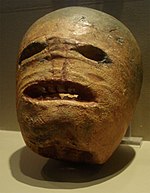
photograph
Traditional Irish Halloween turnip (rutabaga) lantern on display,
 Museum of Country Life, Ireland
The
"traditional illumination for guisers or pranksters abroad on the night in some places was provided by turnips, hollowed out to act as lanterns and often carved with grotesque faces."
Those who made them said the lanterns were to represent the spirits or, alternatively, to ward off evil spirits. They were common in parts of Ireland and the Scottish Highlands in the 19th century. In the 20th century they spread to other parts of England and became generally known as Jack-o'-Lanterns, which in North America are carved from pumpkins.

Christian Influences

Today's Halloween customs are also thought to have been influenced by Christian dogma and practices derived from it. Since the time of the early Church, major feasts in the Christian Church (such as Christmas, Easter and Pentecost) had vigils that began the night before, as did the feast of All Hallows'. Collectively referred to as Allhallowtide, these three days — eve of October 31 to sunset on November 2 — are a time for honoring the saints and praying for the recently departed souls who have yet to reach Heaven.

Introduced in the year 609, All Saints was originally celebrated on May 13, the same date as Lemuria, an ancient Roman festival of the dead. In 835, at the behest of Pope Gregory IV, All Saints was officially switched to November 1, the same date as Samhain. Some suggest this was due to Celtic influence; others suggest it was a Germanic idea. It is claimed that both Germanic and Celtic-speaking peoples commemorated the dead at the beginning of winter, which may have been seen as the most fitting time to do so, since that was when the plants themselves were 'dying'.

By the end of the 12th century the three days of Allhallowtide had become holy days of obligation across Europe and involved such traditions as ringing church bells for the souls in purgatory. In addition,
"it was customary for criers dressed in black to parade the streets, ringing a bell of mournful sound and calling on all good Christians to remember the poor souls."
In medieval Europe at Halloween,
"fires [were] lit to guide these souls on their way and deflect them from haunting honest Christian folk." 
Households in Austria, England and Ireland often had
"candles burning in every room to guide the souls back to visit their earthly homes."
'Souling', the custom of baking and sharing soul cakes (a small, round traditional cake) for all christened souls, has been suggested as the origin of Trick-or-Treating. The custom dates at least as far back as the 15th century and was found in parts of England, Flanders, Germany and Austria. Groups of poor people, often children, would go door-to-door during Allhallowtide, collecting soul cakes in exchange for praying for the dead, especially the souls of the givers' friends and relatives. Soul cakes would also be offered for the souls themselves to eat, or the 'soulers' would act as their representatives.

Halloween Customs in North America

The practice of guising at Halloween in North America doesn't appear until 1911, when a Kingston, Ontario, newspaper reported children going "guising" around the neighborhood. Another reference to ritual begging on Halloween appears, place unknown, in 1915, and a third shows up in Chicago in 1920. 

Trick-or-Treat is a customary Halloween celebration for children, who go house to house in costume, asking for treats such as candy or sometimes money, with the question, "Trick or Treat?" The word "trick" refers to "threat" to perform mischief on the homeowners or their property if no treat is given. But it turns out that Trick-or-Treat may be a 20th century invention. The earliest known use in print of the term "Trick or Treat" appears in 1927, in the Blackie Herald of Alberta, Canada.

American historian Ruth Edna Kelley of Massachusetts wrote the first history of Halloween in the U.S., The Book of Hallowe'en (1919). In the chapter "Hallowe'en in America", Kelley describes souling and has this to say on customs that arrived from across the Atlantic:
"Americans have fostered them, and are making this an occasion something like what it must have been in its best days overseas. All Halloween customs in the United States are borrowed directly or adapted from those of other countries."
Between the turn of the 20th century and the 1920s, thousands of Halloween postcards were produced showing children, but not Trick-or-Treating, which doesn't seem to have become a widespread practice until the 1930s. The term first appeared in the U.S. in 1934, and its first use in a national publication occurred in 1939.

Día de los Muertos / Day of the Dead: Mesoamerican Roots

Original peoples in South Central Mexico and North Central America (Mesoamerica) are known for having "very elaborate forms of spirituality" linked to the annual agricultural cycle grounded in the sun's annual passage across the heavens.

Mexico's geography, climate and natural forces, are very different from Europe's. The vulnerability of this land's early inhabitants to the vicissitudes of natural phenomena — volcanic eruptions, earthquakes, cyclones from the Pacific, hurricanes from the Caribbean and Atlantic, landslides, floods, and drought — honed in them a keen awareness that they were indeed not in charge; in fact, they were at the mercy of la naturaleza (forces of nature). The Mesoamerican worldview has been described like this:
"Rather than imagining a god separate from his creation, the thinkers of Mesoamerica conceived of the divine as the Life-Force itself, constantly creating, ordering, sustaining, destroying and recreating the world."
The Mesoamerican peoples perceived the cosmos as centered on the human world at the earthly level, around which the sun revolved in its daily cycle, rising to the zenith of Heaven, then descending into night and the Underworld. These themes appear in the design of the altars or ofrendas, offerings, that reproduce the Mesoamerican cosmovisión ("worldview"). The altars represent the
  • Underworld [ground level], where incensarios (censers burning copal) are placed; the 
  • Earthly level [midpoint], where offerings [bread, fruit, water, salt, tequila, cerveza] are placed; and the 
  • Heavens [upper level], with images and photographs of the dead.
Ofrenda, Offering, in private home;
a neighbor is placing her gift of fruit

The altars, characterized in most cases by their bright colors, are complete with copal incense and sweet drinks fermented from corn, chocolate, typical dishes like pumpkin or sweet tamales. It is customary to place the names of the deceased with their photographs.
"Here, what appears is a celebration of Life, there is a joy in being connected with the dead. (...) I believe that it is the end of a human cycle that is lived with great joy," observed Andrés Merino, a member of the Institute of Anthropological Research at the National Autonomous University of Mexico (UNAM) .
During this celebration, in addition to going to the cemeteries, children often go out on the streets to sing praises and ask offerings on behalf of the dead, with a chilacayote (a fruit similar to pumpkin) with a candle inside. Dr. Merino believes this custom leads to confusing Día de los Muertos with Halloween.

Spanish Catholic Influences

The Catholic Hispanic legacy is seen, for example, in the pan de muerto [bread of the dead], made with wheat flour [introduced by the Spanish], eggs, sugar and anise; in the placement of fruits and flowers not native to the region [also brought by the Spanish] on altars, and in the use of candles and such Christian concepts as "souls" in referring to the dead who return this one night in the year.

Same, Different, Little of Each?

At first glance, Halloween and Día de los Muertos are similar. Both relate to the agricultural cycle, itself linked to the sun's annual journey, and both occur at the midpoint between the Autumnal Solstice and the Winter Equinox. The belief that the souls of the dead return home on one night of the year seems to have ancient origins; it is found in many cultures throughout the world but, as the saying goes, 'the devil is in the details'.

The European harvest festival was motivated by anticipation of the "dark part" of the year and the fervant desire to gain protection against it. However, Mexico's unique geography and the Mesoamerican cosmovisión that grew up in response to the natural challenges faced by Mexico's early peoples gave rise to both a form and meaning of Día de los Muertos that is quite distinct from the symbolism of Halloween.

Nonetheless, the medieval Spanish Catholic legacy that is part of Mexican culture in general and Día de los Muertos in particular does share common elements with the tradition of Halloween. This becomes more understandable when we realize that the region inhabited by the Celts included a large part of the Iberian Peninsula (Spain).

The pan de muerto, for example, is similar to the soul cakes that are part of Halloween, as is the use of candles and reference to such Christian concepts as "souls" for referring to the dead who return on this one night.

Pan de Muerto / Bread of Death in shape of human with crossed arms
Photo: Reed
As as it did in Europe, human welfare in Mexico depended on the agricultural cycle for producing successful corn crops, which culminated with the "harvest festival" or "festival of the dead" presided over by the goddess Mictecacíhuatl, known as Lady Death, and her husband Mictlantecuhtli, Lord of the Land of the Dead. Today, Lady Death is represented as La Catrina, the character created by graphic artist José Guadalupe Posada and made popular by his disciple and friend, Mexican muralist Diego Rivera.

La Catrina is in center in this detail from Diego Rivera's
 Sueño de la tarde dominical en la Alameda Central /
Dream of a Sunday Afternoon in Alameda Central 
(1947)


Mexico / United States

Mexico and the United States are a single geological region, increasingly linked economically, socially and culturally. What better way, then, to introduce the cross-border cultural influence — which today pretty much runs in both directions — than by presenting Tucson Artist Hank Tusinski's ~:BANDA CALACA:~ now at the Tucson Museum of Art until January 3, 2016.

The work features a nearly life-size, 15-piece free-standing papier mâche skeleton mariachi band with musical instruments on an installation about 12 feet high, 25 feet long, and 6 feet wide. The work is unusual given that Tusinski is a devout Zen Buddhist:
"Tusinski’s work focuses on integrating the beliefs of Mesoamerica, Mexican contemporary indigenous communities, and contemporary Buddhists about death as a transformational process to be celebrated. A journey to Michoacán, Mexico, introduced Tusinski to the indigenous P΄urhépecha peoples’ use of music in their Festival of the Spirit as an embodiment of spirit. This is the well-spring of ~:BANDA CALACA:~." 
Tusinski says
“The fundamental dilemma of existence is the nature of life and death. There is potential liberation and joy in death. ~:BANDA CALACA:~ is offered with the intention of creating the opportunity to view this transition as energy that continues infinitely. The skeleton band represents the individual and the universal dance in the eternal flow.”
Dr. Julie Sasse, TMA Chief Curator and Curator of Modern and Contemporary Art, said:
“Tusinski’s ~:BANDA CALACA:~ is a riot of color, pattern, and imagery. His work reminds us to celebrate life in death, to honor the past in the present, and to embrace the universality of spiritual openness.”
~:BANDA CALACA:~  ...  an energetic representation of the Life-Force itself ...

~:BANDA CALACA:~
Hank Tusinski
Photo: Courtesy of the Artist

See also: Día de los Muertos.


Tuesday, October 27, 2015

Día de los Muertos (Day of the Dead) Traditions

This morning I saw a photo on Facebook of an ofrenda (offering, altar) in the home of a thoroughly modern young Mexican friend in observance of Día de los Muertos — Day of the Dead. Her photo reminded me of the importance of Día de los Muertos throughout Mexico.

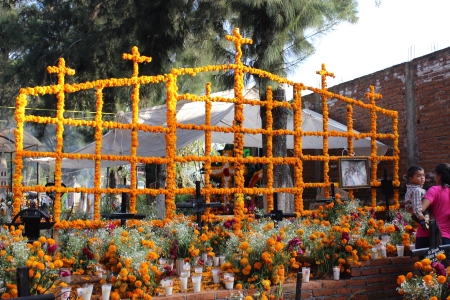
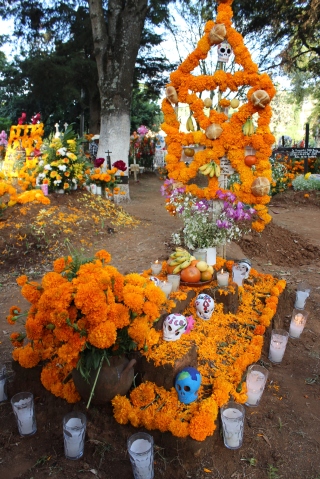
Graves in observance of Día de los Muertos in Tzurumútaro Cemetery,
outskirts of Pátzcuaro, Michoacán 


A few minutes later, I received a lovely note from a long-time, faithful follower of Jenny's blog, letting me know that she is referring first-time visitors to Mexico to Jenny's Día de los Muertos posts. It occurred to me that it might be useful to have them all in one place, so I've listed them at the bottom.

Día de los Muertos is actually a two-day celebration:
November 1 is dedicated to the souls of children who have died and to those of adults who have never married. In the predawn hours of November 2, it is believed that the spirits of all who have died are able to return to their homes, guided by the candles and burning copal (incense).
Families keep vigil through the night to welcome these souls either next to ofrendas set up in their homes, or at their graves in the cemeteries, which are bathed in candlelight. The profusion of traditional orange marigolds gives the light an unforgettable amber glow. In the background is heard the soft murmur of family members conversing quietly in quite an ordinary way. In no wise is this a sad occasion; rather, it is a profound moment for recalling Life in Death.

Día de los Muertos (Link to Page display of Posts described below)

These first three posts were written just after we  moved from Pátzcuaro, Michoacán — where we'd made our home for three years — to Mexico City. Feeling somewhat disoriented in our new urban setting and homesick for the traditions that now felt so far away, I found myself drawn to tell the story of Día de los Muertos as I had come to understand it from the Purhépecha tradition:
This highly personal post deepens the spiritual meaning of death in Purhépecha communities:
Then, last year, I came upon an article in the Mexican press that provided the long-sought answer to a key question about this powerful tradition:
Here's one describing Día de los Muertos Observances in other parts of Mexico:
Here's an excellent account of what happens in the first four years after death, grounding the tradition in 'Aztec' (Nahua) philosophy.

Saturday, November 1, 2014

Day of the Dead Altars: Symbols

Today is the first day of Día de los Muertos, Day of the Dead, a two-day commemoration of those who have died.

One year when we lived in Pátzcuaro, we traveled to a nearby pueblo to visit their panteón, cemetery. On the way, we passed a house whose street door was wide open. Inside we could see a seven-tier altar in commemoration of the grandmother, who had died that year.

Seven-Tier Family Altar Honoring the Grandmother
Photo: Reed Brundage

I've always wondered about the meaning of the seven levels, so I was pleased to come across this article in Aristegui Noticias [News]:
"If there is one tradition that unites Mexicans, it is Día de los Muertos, Day of the Dead. November 1 and 2 are two days dedicated to those who have departed. It makes no difference whether they left yesterday or a hundred years ago. The deceased return because we call them. 
"They return to enjoy what they find on the altar dedicated to them. Or they return to listen to us sing their favorite songs in the graveyards. They return, and we find them at some point, whether in the cemetery or in what was once their house, where their photographs are still displayed."
The altar is an essential component of Día de los Muertos. Altars with two levels represent Heaven and Earth. Altars with three levels represent Heaven, Purgatory and Earth. The most traditional altar has seven levels, which represent the levels the deceased must pass through in order to rest in peace.

As with most things in Mexico, there is great variation in the arrangement of the altar levels. Here's how they appear on the diagram (starting at the top):
  • Level 1: Image of Saint to whom deceased is devoted;
  • Level 2: Intended for the Souls in Purgatory and that the Deceased might have permission to leave that place;
  • Level 3: Salt is placed to purify the Spirit of the Children from Purgatory and so the body is not corrupted on the journey;
  • Level 4: Pan de muerto, Bread of the Dead, is offered as nourishment for the Souls;
  • Level 5: Food and Fruit preferred by the Deceased;
  • Level 6: Photo of the Deceased to whom the altar is dedicated;
  • Level 7: A Cross fashioned of Seeds, Fruit, Ash or Lime; serves so Deceased may expiate his or her sins.
Source: Notimex via Aristegui Noticias

Across the bottom of the diagram is a row of circles displaying the principal elements used in altars:
  • Water: Water of Life is offered to Souls of the Dead to alleviate their thirst;
  • Candles: Candles and votive lights guide Souls to their old homes and illuminate their return to their ultimate abode;
  • Cut Paper: Represents the Wind and Festive Joy;
  • Flowers: Adorn the altar ...
  • Orange petals of marigolds, cempasúchil, form the path that guides the Souls;
  • White represents the Sky;
  • Yellow represents the Earth;
  • Purple represents mourning and cleanses the place of bad spirits.
  • Figure of Dog Xoloitzcuintle [Mexican Hairless]: Allows the Spirits of Children to feel content as they arrive at the banquet;
  • Woven Bed Mat, Petate: Serves as a bed or table so the Spirits may rest; 
  • Bread of Dead, Pan de Muertos: Its circular form represents the Cycle of Life and Death; it has four appendages in the form of a Cross that symbolize the Four Cardinal Directions;
  • Sugar Skulls: Allusion to the Death that is ever-present;
  • Drinks: Deceased Spirit's favorite beverages.
Let me leave you with one more image. The altar shown below is dedicated to those who have died in the violence in Mexico. The walls are covered with white handkerchiefs on which the story of a victim's death has been stitched in red thread by a member of the group Fuentes Rojas, Red Fountains | Bordando por la Paz, Embroidering for Peace.

Photo: Fuentes Rojas Facebook Page 

Thursday, November 1, 2012

Mexico's Día de los Muertos (Day of the Dead) Blends Indigenous, Spanish Traditions

Paying respects on November 1 at the Panteón (Cemetery) 
with flowers and other offerings, Mixquic, Mexico City
Photo: Elizabeth Ruíz/Cuartoscuro
Last night I reread Jenny's previous Día de los Muertos (Day of the Dead) posts. I didn't see how I could improve on them. Their descriptions of the roots of the annual celebration deep in the soil of the Mesoamerican cosmovision is compelling.
But this morning I came upon this article in Milenio, a Mexican newspaper. I've translated it for Jenny's English-language readers. Links to the three original Jenny's posts are provided in Still Curious? (scroll down).
Sand painting for Día de los Muertos in Oaxaca. Photo: Internet

Milenio: November 1, Mexico • The legacy of the pre-Hispanic Mesoamerican and Catholic traditions converge in Mexico on the Day of the Dead, a festival of the dead, whose rituals are authentic living testimony to this cultural fusion.

In an interview, Andrés Merino, a member of the Institute of Anthropological Research National Autonomous University of Mexico (UNAM), observed:
"The origins of the celebration of the Day of the Dead in Mexico predate the arrival of the Spanish (...), but are fused with the medieval Catholic tradition."
Original peoples in South Central Mexico and North Central America (Mesoamerica) are characterized as having "very elaborate forms of spirituality" linked to the harvest and structured around a cycle of four celebrations culminating with the "harvest festival" or "festival of the dead". Merino added:
"The dead play an important role in the entire agricultural cycle, their support is requested at critical moments, such as for arrival of the rains for growing corn. (...) They are the intermediaries with the gods of rain."
The festivities were presided over by the goddess Mictecacíhuatl, known as "Lady Death" (currently related to "Catrina", character created by the graphic artist José Guadalupe Posada [and made popular by Diego Rivera]) and her husband Mictlantecuhtli, Lord of Land of the Dead.

With the arrival of the Spanish, the harvest tradition was merged with Catholic medieval customs and modifications appeared in the preparation of offerings and altars—the ones seen today reflect this cultural fusion (syncreticism).
"The offerings are great symbolic, artistic expressions. There is an order in the way they are represented, and it is here where this tradition of combining the cultures appears," he said.
The Catholic Hispanic legacy is seen, for example, in the pan de muerto [bread of the dead], made with wheat flour [introduced by the Spanish], eggs, sugar and anise; in the placement of fruits and flowers not native to the region [also introduced by the Spanish] on altars, and in the use of candles and Christian concepts, such as "souls" to refer to the dead who return this one night in the year.

Family Altar, Pátzcuaro, Michoacán, to honor the Grandmother, who had died in the past year. Photo: Reed Brundage
The Mesoamerican origins, meanwhile, appear in the design of the altars that reproduce the cosmovisión ("worldview") unique to these cultures. The altars represent: the
  • Underworld, where incensarios (censers burning copal) are placed; the 
  • Midpoint [earthly level], where offerings [bread, fruit, water, salt, tequila, cerveza] are placed; and the 
  • Upper level [heavens], with images and photographs of the dead.
The altars, characterized in most cases by their bright colors, are complete with copal incense and sweet drinks fermented from corn, chocolate, typical dishes like pumpkin or sweet tamales, and it is customary to place the names of the deceased with their photographs.
"Here, what appears is a celebration of Life, there is a joy in being connected with the dead. (...) I believe that it is the end of a human cycle that is lived with great joy," observed the expert.
During this celebration, in addition to going to the cemeteries, children often go out on the streets to sing praises and ask offerings on behalf of the dead, with a chilacayote (a fruit similar to pumpkin) with a candle inside. Merina believes this custom can confuse Day of the Dead with Halloween, a festival of Nordic tradition, which has been introduced into Mexican culture through the influence of television and the supermarkets.
"The Halloween influence has to do with the middle class that goes to the supermarkets, which reflect the influence of U.S. television. (...) But this is not the tradition in the traditional communities," he added.
In 2003 UNESCO declared The Day of the Dead to be an Intangible Heritage of Humanity. The celebration lasts for two days: November 1 is dedicated to the souls of children who have died and adults who have never married. In the predawn hours of that last day (November 2), Mexicans keep vigil in cemeteries for all their dead.

Still Curious?

Sensitive photos of Día de los Muertos vigils on Janitzio Island (Pátzcuaro, Michoacán) convey their beauty and simplicity, followed by photos of altars prepared in Oaxaca.

Related Jenny's Posts:
Report of traditional Día de los Muertos customs in Andrés Mixquic a pueblo-mágico in the Delegación (Borough) of Tláhuac, Mexico City (Spanish only), and how they are slowly, sadly, changing.

Wednesday, November 2, 2011

Día de los Muertos: "Yo Soy la Tierra"—"I am the Earth"

For those of us steeped in the Western tradition, experiences that challenge our taken-for-granted assumptions about how the world ‘is’ can startle and unsettle us. But when we lean into these challenging experiences rather than rebuffing them, we open ourselves to a deeper understanding of what it means to be human.

Renowned Mexican anthropologist Guillermo Bonfil Batalla studied indigenous traditions and practices. In introducing Bonfil Batalla's master work, México Profundo, his English translator wrote:
"An ancient agricultural complex provides their [indigenous communities'] food supply, and
  • Work is understood as a way of maintaining a harmonious relation with the natural world;
  • Health is related to human conduct; and
  • Community service is often part of each individual's life obligation.
  • Time is circular, and
  • Humans fulfill their own cycle in relation to other cycles of the universe."
At times living in Mexico is a wild ride. We go along day-to-day assuming that we are more or less in the modern world, then suddenly something happens that brings us up short, and we become aware of having landed in a completely different universe. So it was one day when my Spanish teacher Alicia, who is Purhépecha, announced,
“Yo soy la tierra”—“I am the earth.”
“What?” I asked, startled as much by the abruptness of her announcement as by her words, which I had instantly understood.
She repeated her statement, more insistently, emphatically,
“Yo soy la Tierra”.
My face must have betrayed confusion because when Alicia repeated the phrase for the third time, “Yo soy la Tierra” her voice tone had softened ... more inviting than insistent.

Her words left me mute—without a thought in my head, incapable of framing a response. I had never before heard anyone utter words so simple, yet so profound. Words spoken matter-of-factly, with tremendous dignity, Alicia's tone conveyed the urgency that lay just beyond her words.

I reflected. In the Spanish language and in Mesoamerican religious thought, each word in the simple sentence is pregnant with meaning:
  • Yo – I, the ‘me’ that is me—no ‘other’—Alicia was saying that she is, herself, the earth.
  • Soy – am: the ‘essence’ of being itself—in Spanish the verb ser ('to be') is used when referring to an essential, unchanging quality (e.g., “Soy madre”); a second verb estar (also 'to be') is used to refer to a state or condition that can change (e.g., “Estoy cansada” – I am tired).
  • La tierra – the earth, the soil. In Mesoamerican thought, the earth is a complex symbol—domain of the earth goddess, Tonantzin, it is also the locus of the Underworld.
Alicia continued. Before her death, her grandmother had given Alicia three dichos (sayings).

I. 
 “La tierra es la madre | Lo que tú haces a la madre, vas a recibir.”
The Earth is the Mother | What you do to the Mother, you are going to receive.
The Earth is the Mother: Tonantzin is believed to be a manifestation of the Earth Mother, known as Coatlicue, the mother of all living things. Conceived by immaculate and miraculous means, Coatlicue is the one who decides the length of life. To the Mexica, the earth was both mother and tomb, giver of life and receiver of human remains at death. The process of decomposition both feeds the earth and culminates in reunion with the Life-Force that animates the universal cycle.

What you do to the Mother, you are going to receive: Alicia pointed out that everything we eat and everything that enters our bodies originates from the earth in one form or another—not just plant foods, but beef, fish and poultry as well.
She then related ancient agricultural wisdom for cultivating the earth, including the custom of planting multiple crops in the same field. Beans and squash planted with corn, for example, deliver nitrogen that nourishes the corn plants in a natural, organic manner, without negative side effects.

It isn't difficult, then, to imagine the sense of honor felt by campesinos working their ancestral lands—their work enables them to maintain a harmonious relationship with natural forces as they care for—in English, we might say husband—Mother Earth herself.

Nor is it difficult, then, to imagine the profound sense of violation occasioned by such extractive practices as open pit mining, illegal logging of sacred forests, fracking—which constitute a veritable rape of Mother Earth.

Moreover, this violation, this rape is not without consequence, for humankind is destined to 'receive' in kind 'what it has done' to Mother Earth, which leads quite naturally to the grandmother's second dicho, saying:

II. 
 “No siembres para que no coseches.” 
“Don’t sow that you need not harvest.”

The similarity of this saying with Saint Paul’s injunction to the Galatians is unmistakable: “As you sow, so shall you reap.” There is a similar saying in the Old Testament, “He who sows the wind shall reap the whirlwind” (Hosea 8:7). But Alicia assured me that her Purhépecha grandmother intended neither of these meanings.

To explain, she related this anecdote: Apparently in the 1950’s, foreign agricultural companies gave free chemical fertilizers to the campesinos. After using them, the campesinos discovered that not only were the fields unable to grow anything without using these expensive fertilizers, but the people feared eating foods grown with chemicals because they feared putting those chemicals in their bodies. Health is related to human conduct ....

For the same reason, many indigenous people reject western medicine in favor of traditional medicines that originate from medicinal herbs and plants locally grown. Not coincidentally, one consequence of Mexico’s geography are its diverse ecosystems. In fact, Mexico is one of the planet's countries with the greatest biodiversity. It is a resource that Mexico's peoples have drawn upon for three thousand years.

III. 
 “Tú eres hijo de la tierra y ella va a darte lo que necesitas, pero el día que mueras ella se alimentará de ti y entonces te preguntará ¿qué hiciste conmigo?”
“You are a child of the earth, and she [Mother Earth] is going to give you what you need, but on the day you die, she will feed herself on you, and then she will ask, 
‘What did you do with me’?”

This final saying is perhaps the most profound. When her grandmother died, Alicia felt sad but at the same time peaceful because she felt that now it was her grandmother’s turn to feed the earth. As Alicia observed,
“The daughter must to return to her mother….”
Traditional burial rituals are helpful. It is the family’s responsibility to prepare the grave. I can only imagine the range and force of feelings expressed by family members as they perform this final task for a loved one. Surely there are feelings of sadness at losing the participation of this beloved family member in the family’s daily life.

But there is also calm in their confidence that they are preparing the resting place for the daughter, mother, grandmother and great-grandmother as she goes forth to rejoin the Life-Force itself.
Time is circular, and humans fulfill their own cycle in relation to other cycles of the universe.
And now we come to the grandmother's last words, “…and [Mother Earth] will ask, ‘What did you do with me’?” A difficult, even profound, question — one each of us is called to answer for ourselves....
Qué le vaya bien—May it go well with you.

Monday, October 24, 2011

Día de los Muertos: Mesoamerican Roots

It is mid-October. Mexico's annual remembrance of the Día de los Muertos (Day of the Dead) is fast approaching. This is our fourth autumn in Mexico. It has taken me this long to gain even a basic understanding of the rich cultural context that gives meaning to this powerful annual ritual whose roots extend deep into the cultural soil of Mesoamerica.

So let's start at the beginning. We have written about the vital role of geography in Mexico's cultural and political development. Mexico's vulnerability to the vicissitudes of natural phenomena—volcanic eruptions, earthquakes, cyclones from the Pacific, hurricanes from the Caribbean and Atlantic, floods and drought—conveyed to the land's early inhabitants a keen awareness that they were not in charge; in fact, they were at the mercy of la naturalezza (forces of nature).

World of Spirit and World of Nature

In their book, The Masks of the Spirit, Roberta and Peter Markman describe the theology underlying the Mesoamerican world view:
"Rather than imagining a god separate from his creation, the thinkers of Mesoamerica conceived of the divine as the life-force itself, constantly creating, ordering, sustaining, destroying and recreating the world" (p. 111).
Again the Markmans:
"Creation is seen in a series of organic metaphors that bring together seeds and bones, the sun and birth, man and plants in a complex web of meaning that suggests the equivalence of all life in the world of the spirit—a web of meaning that sustains the world of nature. Life in this world, the myth suggests, must be understood in terms of that underlying spirit." [emphasis added]
In Mesoamerican culture, then, the world of spirit, mysterious and inaccessible, was synonymous with the Life-Force, while the world of nature inevitably ended in death. Permanence was found in the world of spirit; the world of nature offered ceaseless change culminating in death, but a death that nonetheless offered passage to the world of spirit.

Addressing this theme, an Aztec poet wrote,
Let us consider things as lent to us, O friends,
only in passing are we here on earth,
tomorrow or the day after,
as Your heart desired, Giver of Life,
we shall go, my friends, to His home.
The conclusion is inescapable: beyond is the place where one lives. To the poet, permanence was to be found in the world of spirit; this world offered nothing more than flux ending in death.

The great question for Mesoamerican thinkers was to explain how the gap between the two worlds was to be bridged—put differently, how the existence of life and spirit was to be reconciled. Though life is transitory, humans nonetheless had to be enabled to participate in a ritual relationship with the source of the spirit (Life-Force) that animates human activity.

Their solution was a creator god who had no other characteristic than creativity itself. Located in the center of the world of spirit, he was known as Ometeotl (literally, two-god) by the Aztecs and Hunab Kuh by the Maya.

Rarely represented in figural form, Ometeotl played little part in ritual. But as the dual, bisexual god who ruled over the highest heaven of the Nahuatl cosmos, Ometeotl embodied a key Mesoamerican principle: duality, which recognizes the interdependence of opposites (light-dark, night-day, life-death, order-disorder, etc.). In China, this principle is yin and yang.

Creation Myths of Mesoamerica

The creation myths of various Mesoamerican people are more explicit tales that link this underlying duality to the creation of humans and the maintenance of their daily life. They are efforts to transform the vulnerability of their communities—completely dependent on the planting and harvesting of maíz, corn—into a secure realm.

Here's how the Maya document, the Popul Vuh, describes the creation of first man and first woman:
And so then they put into words
        the Creation,
        the shaping
        of our first mother and father.
Only yellow corn
        and white corn were their bodies.
Only food were the legs
And arms of man. 
                                     Popul Vuh
The myth makes explicit the dependence of human welfare on successful corn crops. First mother and father, in fact, are themselves made of corn. By extension, as sons and daughters of corn, so is the current community made of the corn they take in.

In the Aztec (Méxica) creation myth (Aztec Cosmovision: Stone of Five Suns), the gods must try five times to successfully produce beings capable of speech—and thus capable of praising the gods. In the creation of the Fifth Sun, Quetzalcóatl (Plumed Serpent) and a brother god descend to the Underworld to retrieve the bones of the previous population. Once back on the earth's surface, they grind the bones like corn and sprinkle the bone meal with their own blood to create today's people.

But even after the creation of people, there is still no sun. The gods meet in darkness gathered around a great fire at Teotihuacan. Two gods volunteer to throw themselves into the fire in order to create the Fifth Sun. One god is beautiful and haughty; the other is diseased and lowly.

The lowly god doesn't hesitate to throw himself upon the pyre when its heat is strongest but the haughty god hesitates, so the fire is less intense when he jumps. In this way, the lowly god who did not hesitate to sacrifice himself becomes the sun, and the haughty god who hesitated becomes the moon.

This sacrifice of the gods for humans at the moment of creation establishes the central idea that humans, reciprocally, are expected to sacrifice to the gods in order to assure the continued survival of the community.

The Cycle of the Sun: Birth, Death and Rebirth

Mesoamericans perceived the cosmos as centered on the human world, around which the sun revolved in its daily cycle, rising to the zenith of Heaven, then descending into night and the Underworld.

My favorite depiction of this spatial arrangement is at Toniná, in Chiapas, where the central staircase (horizontal stones at the center) represents the axis mundi connecting the Earthly plane (in the middle) to Heaven above and the Underworld below:
Spatial representation of Cosmovision at Toniná 
  • Heaven (inverted pyramid above), with its thirteen levels; 
  • Earthly plane (horizontal band at midpoint); and the 
  • Underworld ( lower pyramid), with its nine levels. 
The god Ometéotl resided at the highest level of Heaven. The Underworld existed below the surface of the earth and was accessible through caves and springs.

The sun’s path was understood to begin at sunrise in the East and to pass through thirteen levels, or stations—six up to Heaven’s zenith at station seven, before descending through six more stations, for a total of thirteen. At sunset the sun begins its passage down through the nine levels, or stations, of the Underworld—passing its nadir at midnight before beginning its ascent of four more stations culminating in next day's dawn. Including the stations at the level of the earth—sunrise and sunset—the sun’s daily journey covered twenty-four stations, comparable to our own 24-hour day.

The passage of the sun through the Underworld was deemed perilous. Sunrise was not guaranteed—instead, ever present was the possibility that the sun might be devoured by the gods of the night and fail to rise. This primal fear led to various sacrificial rituals designed to assure the successful daily return of the sun. The essential duality—day-night; light-dark—is perhaps the most basic duality in Mesoamerican thought.

Passage of the Deceased through the Underworld

When humans died, it was believed that all but a few had to follow the night sun’s path and travel for a year through the Underworld before reuniting with the Life-Force in the Heavens. Warriors who died in battle and women who died in child birth went straight to Heaven.

The rituals of Dia de los Muertos address this Underworld journey of the deceased. Later posts relate preparations for Día de los Muertos and its ritual observances. For more information about books cited here, see Best Reads.


Día de los Muertos: Preparations

Not surprisingly, the roots of the annual observance of Día de los Muertos (Day of the Dead) extend deep into the soil of Mesoamerican culture. The following narrative relies on photos taken and experiences enjoyed over the three years we lived in Pátzcuaro, Michoacán, home to the Purhépecha people.

Before the arrival of the Spanish, the Purhépecha empire was a large one, extending north and west of Lake Pátzcuaro. In their time, they were unconquered in wars waged annually with the Mexica (Aztecs) to the east, yet when the Purhépechas saw their enemy's fate at the hands of Cortés, they surrendered to the Spanish without a fight.

Today the Purhépecha people reside in  pueblos surrounding Lake Pátzcuaro and on the Meseta (Highlands) west of Pátzcuaro.

Día de los Muertos is perhaps best understood in the broader context of the Mesoamerican cosmovision (see earlier post). Here's what a useful short book of Pátzcuaro's legends has to say about Día de los Muertos [my translation]:
"For [the Purhépecha] death was not something that provoked fear; on the contrary, it was treated as a natural process that fulfills man's purpose, who therefore during life prepares himself for death. 
"This view of death is one of the basic elements in the cosmogony [worldview] of the ancient peoples, who believed that death is a form of the continuity of life. 
"The Mexicas [Aztecs] were considered the people of death. Their philosophy of mortality and immortality was expressed in various poems that describe life as only a passing state, but death as rebirth—it is to live forever. 
"Consider this poem of Netzahualcóyotl, who lived between 1391 and 1471—dying fifty years before the arrival of the Spanish in 1519:
We are mortal
all of us have to depart,
all of us have to die on the earth...
Like a painting,
we are erased [from the earth].
Like a flower,
we depart drying
here above the earth ...
Consider this, mighty lords of eagles and tigers,
although you might be of jade,
although you might be of gold,
you also will go there
to the place of rest."

Dulces in the Mercado 

Preparations begin early in October. As calabazas (pumpkins) begin to appear in the mercado, dulce vendors set up their tables under the Portal on the Plaza de Vasco de Quiroga (Plaza Grande).

Tables of Dulces set up under the Portal, 
Plaza Vasco de Quiroga, Pátzcuaro, Michoacán

Tourists—not just foreign but Mexican as well—visit Pátzcuaro during Día de los Muertos, where the Island of Janitzio is deemed to be the ultimate destination.


Rows of sugar-sculpted Angelitos (Little Angels)
Calaveras (Skulls) de Chocolate
Coffins with skeleton; pulling a string that comes out at the foot of the coffin causes the skeleton to rise up and peer out of the coffin — delightful example of the playful mockery of death that characterizes these dulces
Elegant señor and señora — the attention to detail is astounding.
¡Viva México! is printed in tiny red letters on the topside of el señor's sombrero

Preparations in Casa and Pantéon (House and Cemetery)

But preparations for Día de los Muertos involve much more than Pátzcuaro's famed dulces market. Before the Spanish arrived, Día de los Muertos was observed in the Pantéon. This practice was tolerated by the first Spanish missionaries, whose conversion strategy was to interpret indigenous religious beliefs as incomplete but that were, nonetheless, on the road leading to full expression in the Catholic religion with Christ on the Cross.  

The indigenous were allowed to celebrate their ancient fiestas  (marking the seasons), but the missionaries reinterpreted those fiestas as events occurring on the Catholic liturgical calendar. Hence, Día de los Muertos is linked with All Saints Day. Thus rose the syncretism — creative fusion of indigenous and Catholic beliefs — quite evident in today's observances.

In the seventeenth century, the Spanish elite banned all fiestas as 'pagan'. In response, the indigenous moved their observances from the Panteón to the privacy of their own houses. In the twentieth century, after the Mexican Revolution, the 1917 Constitution banned all religious fiestas outside the church. Subsequently, this ban was lifted in response to popular pressure. Today observances are held in private homes and in the cemeteries.

On November 1, families may build ofrendas in their homes or decorate graves with offerings of flowers, candles and food (fruit and bread). They then keep vigil part or all of the night. On the morning of November 2, the food is shared with everyone present.

Two Days of Observances

Fall is the time for the marigolds to bloom. Familiar with marigolds as a border flower in the garden, we were puzzled by orange flowers blooming profusely in fields that stretch forever — marigolds are native to Mexico! Oh, and did I mention the pink Cosmos that also grow wild in the fields and bloom in October?

The panteón in Tzurumútaro, just down the road from our house, has a rich and beautiful tradition of Día de los Muertos observances.

Pickup truck loaded with cempasuchitl, marigolds

The flowers: gold for Heaven, white for purity, red for life

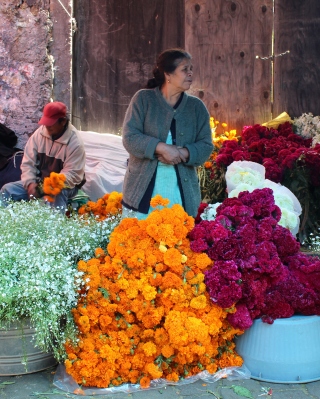
Marigold vendors

As Día de los Muertos approached, our housekeeper, Evangelina, began describing the rituals to us. The former owner of our house had died during the past year. Clearly, she felt a need to honor his death. As she remarked to me,
"So many people have passed through this house in the thirty years I have worked here; who knows what has happened to all of them; it is important to honor them."
Evangelina's husband is Purhépecha, and Tzurumútaro is their pueblo, so it seemed natural for us to focus our attention on Tzurumútaro. With Evangelina's help, we laid out this ofrenda (offering):


We went to town to buy a traditional white lace mantel and the flowers (orange marigolds, white bridal veil, and dried red flowers). Candles guide the spirits to the ofrenda. Evangelina was adamant that the candles not be allowed to go out for the forty-eight hours of November 1 and 2 — a challenge and responsibility I am pleased to report we fulfilled.

Our ofrenda had almost all the essential elements. Water is deemed essential for the spirit's journey through the Underworld (white pitcher), as is salt (little dish in front). Other liquids, such as tequila or cerveza may also be laid out. Fruit and bread provide sustenance to the spirits during their visit.

Only later did I realize that the ofrenda lacked photographs of the departed. But not to worry — Día de los Muertos observances were just getting started.

Still Curious?

Related Jenny's Posts:
See also, Jenny's Page, Best Reads.