Showing posts with label narcotraffico. Show all posts

Saturday, July 7, 2018

The Activists Using Embroidery to Protest Mexico's Murder Epidemic

Broadly.VICEJuly 3, 2018 Lauren Cocking

For Fuentes Rojas, a collective that reclaims public space through peaceful protest, stitching is one way to remember those who have been disappeared or killed in their country.
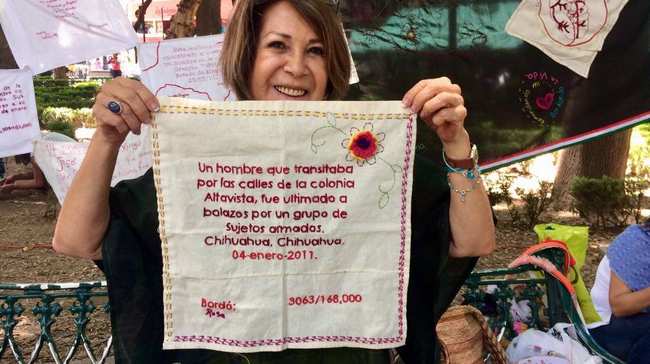
A member of the Fuentes Rojas collective holds up a handkerchief stitched in memory of an anonymous victim from Chihuahua, murdered in 2011. Photo courtesy of the Fuentes Rojas Archives

Jenny's translation of bordado text displayed in above photo: 
A man traveling through the streets of the Colonia Altavista, 
was killed by bullets fired by a group of armed subjects. 
Chihuahua, Chihuahua. 04 January 2011. 
[His Death is Number] 3063 / 168,000 [Total Violent Deaths up to 2011]


Rows of handkerchiefs are strung between the trees, fluttering in the early Sunday afternoon breeze. Some are simple, threaded with stark block black letters, while others bear an elaborate, blood-red outline of Mexico. Each one carefully spells out a name and tells a story.  One reads:


“Anabel Flores Salazar, a reporter for the
crime beat of the Sol de Orizaba, was
taken from her home by a group of armed
men on February 8th. The victim’s body was
found with the head covered by a bag,
handcuffed and with the feet tied.”


Referencing the 2015 forced disappearance of 43 students in Guerrero, another reads:


“Mauricio Ortega Valerio, 18 years.
Ayotzinapa, Mexico.
Alive they were taken,
alive we want them back.
Never again.”


I’m in Coyoacán, Mexico City and in front of this patchworked web of handkerchiefs, some black, some white, some pink, sit a group of women — Elia Andrade, her sister Tania Andrade and Regina Méndez (plus her tiny xoloitzcuintle dog, Tonalli) — who together make up the founding members of the Fuentes Rojas collective, a group dedicated to reclaiming public space through peaceful protest.

Their method of choice? Embroidery.
“Sometimes [the sewing sessions are] really peaceful, sometimes we stitch alone”, Elia Andrade tells me. 
“The minute people come closer to read the handkerchiefs, and they realize what they say, there are many people that reject it [and then] there are people that start talking to us.”
Originally, the Fuentes Rojas focus was on homicide victims, of which there were roughly 70 per day in Mexico in 2017. They’d stitch the names and stories in vibrant red thread—naming the dead is a technique also employed by Chiapas’ radical resistance movement, the Zapatistas, Andrade told me. 

Creating a captivating, tangible memorial that was hard to ignore was just the point, especially in a country with such a high track record of impunity.
“Many people wander through Coyoacán and many people, many families, try not to hear about these things, or they don’t want to open their eyes to the true situation in which the country finds itself; so it seems to us very important that we disrupt these spaces and not in a violent way, but a peaceful way… because we must find other ways to relate to one another that go beyond violence,” Andrade notes.
As time went by, the group broadened their focus:
“more people joined and there were many who’d experienced the disappearance of children or parents.”
In response, and although color codes aren’t always rigidly adhered to, Fuentes Rojas introduced green thread (“for hope”, explains Andrade), pinks for femicide victims—in 2016, at least seven women a day were murdered in gender-based killings—and black for deceased journalists (six reporters have died in 2018 alone).

And while the occupation of public space was always high on the agenda for Fuentes Rojas (“Public space only exists when one inhabits and occupies it, no?” Andrade points out), embroidery wasn’t always their calling, something at which their name—literally ‘Red Fountains’ in Spanish—suggests. 

Inaugurated in 2011, the collective first grew out of a Mexico City march held by the poet Javier Sicilia in memory of his murdered son, Juan Francisco. (This march in itself would flourish into the Movement for Peace with Justice and Dignity [MPJD], a.k.a. the Mexican Indignados Movement.) The Andrade sisters and Méndez were invited to participate in peaceful but public protests, during which they would dye the fountains red; however, after several meetings they found themselves warming to the idea of needlework instead.
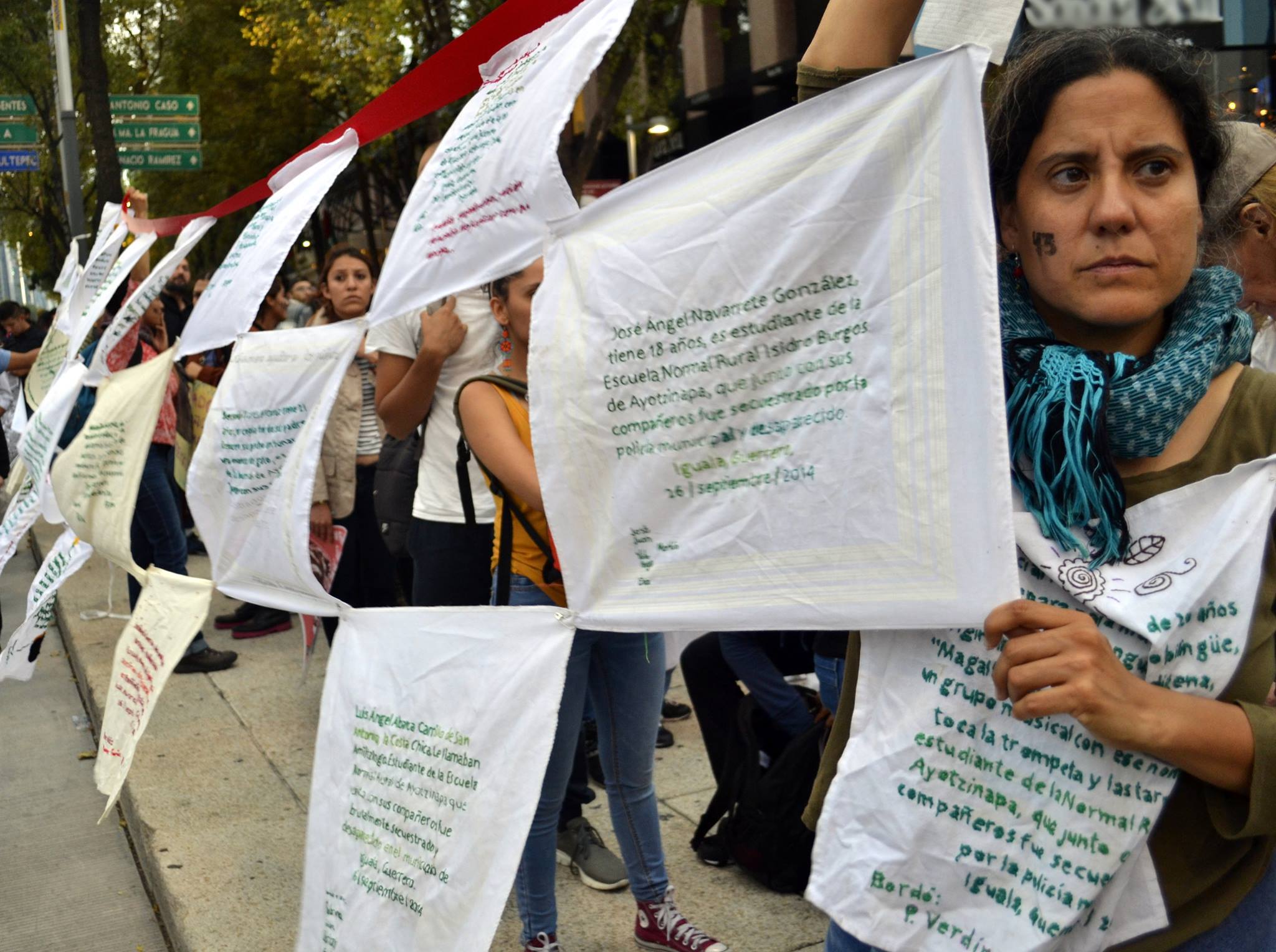
Tania Andrade carries some of Fuentes Rojas' handkerchiefs on a 2017 march in protest of the 2015 Ayotzinapa student disappearances. The green thread signifies hope for their safe return. Photo courtesy of Fuentes Rojas Archives

Turning craft into a political statement might be nothing new—the Suffragettes could tell you that—but in Mexico, Fuentes Rojas gave rise to a new wave of craftivism. Much like the stories woven into each handkerchief, the word about Fuentes Rojas’ project spun a web across the country, beginning in Guadalajara, then Puebla, and making its way into other towns and cities from there.

Andrade notes that “the initiative comes from us, from this collective,” but some of the contacts they’d invited to stitch with them formed “break-off cells and collectives, dubbing themselvesBordando por la Paz’ (‘Stitching for Peace’).”

I spoke via email with Teresa Sordo, the coordinator of one of these groups, Bordamos por la Paz Guadalajara. The
“intention from the beginning was to denounce [the killings and disappearances], go out into parks to find people that needed to talk about the topic that until now had been silenced by the government with the help of the media.”
Meanwhile, Hazel Dávalos of the similarly aligned Bordeamos por la Paz [Let's Embroider for Peace] in Ciudad Juárez, adds that the handkerchiefs work to remind the viewer that victims
“are people, not numbers.”

It’s clear that their craft is political, but is it ‘art?’

No, came the resounding answer, from Dávalos at least:
Our work is a political statement. We prefer not to call it art,” before elaborating that “by calling it art, we’d be closing off our protest to elitist spaces.”
Other public protest movements in Mexico do consider their work ‘art.’ Take the yarn bombing collective Lana Desastre, pioneers of the phenomenon in Mexico. They’ve embroidered everything from Mexico City metro cars to Day of the Dead altars, and even displayed 52 giant woolen breasts (under the Spanish pun ‘Lactejiendo’; ‘Lac-knitting’ which, unfortunately, doesn’t have quite the same ring to it in English) in the garden of Mexico City’s Vasconcelos Library. Their work is both to “protest and beautify public spaces” Miriam Mabel Martínez, a member of Lana Desastre, writes to me.

Art or not then, all of these collectives, by weaponizing and politicizing a medium so typically associated with the ‘feminine,’ one that is in and of itself intricately linked to the storied Mexican textile tradition of elaborate embroidery and needlework, potently condemn Mexican impunity while lending a voice to the silenced.

As Andrade puts it,
“every stitch, every breath, every emotion, every chat; what we’re interested in is empathy. We appeal to the emotions, completely different from those of power or violence. Yes, it’s a peaceful protest, but it’s also hard-hitting.”

Monday, April 9, 2012

Art & Friendship in Zirahuén, Michoacán

Our weekend visit to Pátzcuaro, Michoacán, also included a delightful Sunday—yes, it was Domingo de Ramos, Palm Sunday—spent visiting our dear friend, Debra Breckeen.

Artist Debra Breckeen

Debby lives in a small house in the woods above Lake Zirahuén, just outside the pueblo of Zirahuén. 

Lake Zirahuén from Debby's porch

To enter Debby's garden is to step into an idyllic space, where the artist's eye and touch have delightfully enhanced the setting's natural beauty.

Debby's Garden

We greet our old friend, Ponito, as he happily presides over his woodland surroundings! Some time ago, Reed spotted Ponito as Debby drove us along Avenida de las Americas on our way to the west side of Lake Pátzcuaro. On the return trip, Reed asked her to stop at the artisan's shop—and the rest is history, as they say.

Crafted from branches of avocado trees, we three found
Ponito in one of the artisan shops devoted to wood
carvings of all kinds.

Cola de Caballo (horsetail, snake grass, puzzle grass) is one of the planet's oldest plants. A 'living fossil', it is the only surviving genus of a family of vascular plants that reproduce by spores, rather than seeds, and it has flourished for over one hundred million years. In Debby's garden, horsetails grace an old fountain.

Cola de Caballo, horsetail,
soften the lines of an old fountain.

We enjoyed a delicious brunch of Chiapas coffee, Mexican scrambled eggs, black beans, and sweet breads topped off—after a barely respectable delay—with blackberry cobbler and even more coffee! Have I mentioned that Debby is a terrific cook?

Needless to say, we chatted. We three never seem to run out of topics requiring our immediate and total attention. Toward the end of the day—it's not even clear to me now how exactly it happened—we began to talk about Debby's embroidery art. The conversation began slowly, but gained momentum as we realized the commonality of our experiences here in Mexico.

Newcomers Together

Debby arrived in Michoacán in August of 2007. She spent a year living in Morelia while she searched for a house, but as it happened, all three of us moved to the Lake Pátzcuaro area the following August (2008). As we were settling into Casa Mariposa on Lake Pátzcuaro, Debby was settling into her house in the pine forest above Lake Zirahuén.

We met Debby while taking Spanish at CELEP, Pátzcuaro's ever-enriching school of Spanish language and Mexican culture. After decades of professional lives, Reed and I were intent on learning Spanish and embedding ourselves as much as possible into the Mexican community. Debby spotted us first, and we immediately sensed a common bond: cultural curiosity.

Debby was way ahead of us. For nearly twenty years, she had spent her summer vacations in Capula, a nearby pueblo. During those lazy summer visits, she dreamed of creating a new, simpler, even idyllic, life as a single woman living in the Mexican countryside. Certainly, her house tucked among the pine trees in the hills above Lake Zirahuén near Pátzcuaro is the ideal spot—in the tradition of Thoreau's Walden Pond.

Like all newcomers, Debby's first year or so was filled with renovating her house and moving in. Once more or less settled, she focused on getting acquainted with her surroundings, her neighbors and the larger community of Zirahuén—activities parallel to what Reed and I were doing in Pátzcuaro.

In order to keep busy in the evening, Debby picked up a long-time avocation: embroidery. As she began to stitch, something unexpected happened. Her designs began to take on a life of their own. The pieces in her hands had something to say to her, and—as the artist she is—she listened.

Nine and Nine (2008).
The maíz is a native species.
Left click to enlarge image.

At first glance, the pieces ask, what is real? Moving from Houston’s cosmopolitan culture to the culture of rural Mexico inevitably presented challenges, and cultural ambiguity took its place alongside cultural curiosity.

Debby’s art addresses this ambiguity. One early piece depicts two pineapples resting side-by-side. Each is distinctive. It’s tempting to conclude that one is real and the other ideal, but which is which? 

Real and Ideal Pineapples (2008)

The intricacy of fine stitchery is evident in this detail: 

Detail: Real and Ideal Pineapples (2008)

Debby has been influenced by the thought of David Foster Wallace who, in his own way, also asks, what is real?  Wallace:

". . . the exact same experience can mean two totally different things to two different people, given those people’s two different belief templates and two different ways of constructing meaning from experience.”
The Outside World Intrudes

Living in Zirahuén, Debby has become increasingly aware of the vulnerability of Zirahuén’s Purhépecha community to external, global forces beyond its control. News events, once viewed as at a distance, have become increasingly immediate as she sees negative consequences wreaking havoc with the daily lives of friends and neighbors. An early piece, Bees and B52's, captures these external threats.

Bees and B52's (2008)

External forces like NAFTA (1994) opened Mexico's economy to the outside world, but with decidedly mixed results for the ordinary people of Mexico. In this early piece, the gray-stitched, ever-smiling face of Colonel Sanders (KFC)—self-satisfied, confidently resolute—is an ominous backdrop for Mexico's traditional chicks and flowers. 

Colonel Sanders (2008)

Another piece seems to reflect Debby's hometown roots in Houston, Texas. An elegantly saddled Mexican horse trots along the border that was, literally, drawn as a line in the sand at the end of the Mexican-American War—for Mexicans it is La Intervención, The Intervention

Helicopters make an early appearance in this piece. As it flies, the chopper casts its dark shadow on the land, the path, the border, along which trots the riderless horse. 

Border (2008)

Why Helicopters? 

A few years ago, helicopters began flying over Zirahuén as part of Mexican President Calderón’s military initiative against narco trafficking. It is impossible to ignore them. The percussive beat of rotary blades chops into human consciousness. Debby says, “I always go out to see them.

In this piece, provocatively titled Temporary, a pair of scissors lies entangled among five multi-colored, cut flowers resting on a table. The scissors are poised to chop yet more flower stems—choppers? Not to be ignored is the black barcode ominously marking the flowers for commercial offer—NAFTA!

Temporary (2009)

Why Embroider? 

Traditionally, embroidery has been a symbol of the feminine, domestic, even genteel role associated with women’s work. But this traditional gentility is now being subverted by what is happening in our world.

In Debby’s sure hands, stitchery takes on a subversive quality—presenting an essential contradiction between medium and message. Before moving to Mexico, her art form was drawing. Of stitchery, Debby says,
Embroidery is like drawing in slow motion. I plan the piece before I begin, but what happens inside the overall design is not planned. As I work, I’m inserting myself into the piece.
At about this time, Debby stitched two swans—one real, the other Disney-like fanciful, or ideal! Yet we notice the subversive line of helicopters lurking below the water line, below the level of consciousness. The work is speaking to Debby, and she is listening....


Swans (2009)

Depicting the Invisible...the Unspeakable

In his commencement address at Kenyon College, D.F. Wallace told this parable:
“Two young fish are swimming along, and they happen to meet an older fish swimming the other way, who nods at them and says, ‘Morning, boys, How’s the water?’ And the two young fish swim on for a bit. Then eventually one of them looks over at the other and says, ‘What the hell is water?’"
Real and Ideal features two fish, swimming side by side. The fish farther away may be the more realistic; the blue scales of the nearer, vividly colored, fish appear like waves of water. Notably, reality is breaking through the boundary normally imposed by a frame. Yet, who is to say? 

Real and Ideal (2012)

Wallace concludes:
…the most obvious, important realities are often the ones that are hardest to see and talk about.” 
And so it is with Debby’s art. 

A pernicious ambiguity has invaded pueblo life, such that, “It’s impossible to know who's who.” The natural beauty that surrounds the artist in her rural home is contradicted by Mexican friends who caution, “Do not leave your house after 7:00 PM.”

The piece titled NAFTA displays a row of partially shucked native corn. Shockingly, a Glock pistol nestles among the ears—a strident protest against NAFTA, which has already devastated Mexico’s agricultural communities, and against genetically-modified corn, which promises to do even more damage to the native corns domesticated by Mexico's original peoples millenia ago—native corns that have adapted to Mexico’s world-famous biological diversity and the land's nearly countless ecosystems.

NAFTA (2011)

Arguably Debby's most important piece to date features a gorgeous gallo (rooster) stitched in vivid color set beside a row of army helicopters in olive drab. Behind the proud gallo is a shadow rooster stitched in shades of gray—a fighting cock, mouth wide open, ready to attack. Again, reality breaks through and threatens to destroy traditional boundaries of civility....

Cock and Copters (2011)

In Debra’s art, it is impossible to ignore the message:
a simple life set in an idyllic world of nature is being invaded by powerful external forces.
By juxtaposing Bees and B52s, Flowers, Scissors and Barcodes, Corn and Glocks, Cocks and Copters, Debra Breckeen’s embroidery art—in itself a subversive activity—warns us not to take for granted either the natural world, or life as we wish it to be.  

Still Curious?

For more about Debra Breckeen's life in Michoacán, including videos of parades in Pátzcuaro, Google this—d.breckeen@Flickr—then take your pick...and enjoy!

Related Jenny's posts:

  • Debra Breckeen's Embroidery Art and the Art of Seeing reviews the exhibition at the Centro Cultural Antiguo Colegio Jesuita held April 4 to May 4, 2014, in Pátzcuaro, Michoacán. 
  • In June 2011, Debby began offering a class in crewel embroidery to the ladies of Zirahuén. Although proficient in the embroidery techniques of deshilado ('Pulled-Thread') and punta cruz ('Cross-Stitch'), the ladies weren't familiar with the crewel embroidery stitches that are Debby's art form. The Art of the Zirahuén Ladies Sewing Circle in Michoacán, México relates the story of the group's first year, including photos of the ladies' work.
  • Jenny's Neighborhood: Making Friends Mexico City-style includes a description of Debby's recommended method for framing embroidery pieces (bordados) for optimal effect.
  • Multicultural, Multidisciplinary Art Show: Artists and Indigenous Bordadoras (Embroiderers) Join Aesthetics describes the exhibit titled Hasta MostlaUntil Mostla, scheduled to open August 23, 2012, at the Spanish Cultural Center in Mexico City. The exhibit is a multidisciplinary project that gathers together the drawing, photography and video contributions of seven artists from Mexico, Spain and Latin America, who lived for two months in the traditional community of Joltocán in the Huasteca Region, State of Hidalgo. The focus was on traditional indigenous embroidery; the artists focused their artistic creations on the interactions within this group of women from very different backgrounds who nonetheless share the same need to communicate their surroundings through their art.
The international citizen's blog Global Voices published this post:
  • English: Embroidering for Peace: Threads, needles and fabrics have become warriors for peace in Mexico. In cities like Monterrey, Guadalajara and Mexico City, men and women of all ages have decided to speak out and share their thoughts and experiences on violence by participating in a collective relief effort through embroidery.
  • Español: México: Bordando por la paz: Hilos, agujas y telas se han convertido en guerreros de la paz en México. En ciudades como Monterrey, Guadalajara y Ciudad de México, hombres y mujeres de todas las edades han decidido hablar y compartir sus ideas y experiencias sobre la violencia participando en un esfuerzo colectivo de labor humanitaria a través del bordado.
The 'drug war' in Mexico is complex and complicated. If you're interested in expanding your awareness, here are good web sites to explore:
  • Insightcrime.org provides reliable, in-depth coverage of key issues and developments. 
  • Mexico Voices searches the Mexican press for opinion pieces by leading Mexican figures discussing the efforts of Mexicans to build a true democracy; also reported are the results of scientific studies and population surveys. 
  • Americas MexicoBlog posts current U.S. and Mexican news reports on the US-backed War on Drugs in Mexico.    
Unanticipated consequences of NAFTA:
Climate change poses other threats:  
  • "Traditional Maize Can Cope with Climate Change," introduces exciting new research currently underway on Mexico's traditional (non-genetically-altered) corn species: http://ipsnews.net/news.asp?idnews=105035
  • "Climate Change Can Drive Migration," discusses Mexico's geographic vulnerability to the effects of phenomena like prolonged droughts and, conversely, devastating rainstorms and flooding; soil degradation, lack of water and rising sea levels; environmental degradation is tracked as a driver of migration—both internal and cross-border: http://ipsnews.net/news.asp?idnews=105047