Showing posts with label Mexico sense of time and place. Show all posts

Saturday, June 1, 2013

A Sense of Time in Mexico

Once we'd decided to move to Mexico, Reed and I began reading everything we could get our hands on about Mexico, including a delightful book titled On Mexican Time: A New Life in San Miguel de Allende. Written by U.S. expat Tony Cohan, it is a readable, affectionate account of the cultural adventures encountered by Tony and his wife as they slowly made the transition from life as busy professionals in Los Angeles to full-timers in Mexico.

As I began this post, the title On Mexican Time quickly came to mind. Mañana must be nearly a universal idea these days. At the least, it conveys the notion that Mexicans have a concept of time a bit different from that held by most folks in the U.S. But what is it exactly?

I was reminded of this when we had to replace the vertical blinds in our bedroom. The strong winds that come up in the afternoon had broken several of the slats, which meant we had a gaping hole about 18" wide. But finding someone to replace them seemed a 'mission impossible' until Victor, our trusted vigilancia (building guard and informal majo domo), introduced us to Antonio, the albañil (master tradesman) who does a lot of work in our building. We began to believe that new blinds might be in our near future.

Antonio arrived promptly the same day to measure the window, and he told us he'd return on Friday at noon with the sample book so we could make our selection. The story gets a little complicated here, so before I go on, bear with me while we take a small detour. It'll be worth it, I promise.

Time Viewed in Mexico

Twenty years ago I did a two-year project with Pemex (Mexican oil company). One of my co-consultants recommended the little book Mexican Etiquette and Ethics: Anticipating and Understanding Mexican Social and Business Behavior (1996). I just discovered that the book has been lightly updated, and it remains remarkably useful. Where it seems outmoded, we ask ourselves, Does this still apply today? If not, we use the text as a jumping off point for understanding our own experience.

One section, titled Hora Mexicana / Dealing with Polychronic People, draws on the work of social scientist Edward T. Hall, who identified two kinds of time values that operate in different cultures:
  • Monochronic, or one-thing-at-a-time time, which includes most people in Anglo-European cultures, including most people in the United States; and
  • Polychronic, or many-things-at-a-time time, which includes most Asians, Mexicans and most other Hispanics.
Monochronic people (M-people) see time (M-time) as moving constantly forward in a straight line. Compulsively measuring time in tiny segments to keep track of its passing, they schedule things to happen sequentially—one at a time in specific time frames, and they tend to be obsessed with things happening "on time". M-people find any deviation in their precisely structured use of time to be very upsetting. Sound familiar?

Polychronic people (P-people) have a much more amorphous view of time. When we visited Teotihuacan, I wrote about the Mesoamerican view of space and time. Teotihuacan's first god-kings and city planners designed Teotihuacan to illustrate their vision of the cosmos. Above all, the Mesoamerican view is a cyclic view of time represented by the symbol ollin, the Life-Force that animates all life.


Ollín - Intertwining Ribbons represent the Life-Force that neither begins nor ends.


P-people, then, have a far more fluid, even seasonal sense of time. By seasonal I mean a morning, a mid-day, afternoon and evening recognized more as seasons than as specific hours, let alone minutes. Even days and nights are somewhat seasonal, or fluid. Far more open-ended than precisely segmented into strict minutes and hours, or even days and weeks, seasons neither start nor stop 'on the dot'. Instead, they seem to flow into each other. Agrarian societies all over the world, operate on P-time.

P-people routinely schedule—or allow—many things to occur at the same time. They are at ease juggling things around so that eventually all of them—or, at least, some of them—get done. They don't think twice about scheduling more than one appointment at the same time, accepting more than one work assignment that is "supposed" to be done in the same time frame, or intermittently doing two or three things during the same time period.

I wish I could remember where I came across this definition of mañana, but it is very useful. When a person on P-time agrees to do something mañana, it doesn't necessarily mean in twenty-four hours. It means that the task now has a place on the doer's list of commitments, and it will get done...when it more-or-less rises to the top of the list, or when it seems to be the next natural thing to do.

Maybe now's the time to mention that one of Mexico's many cultural divides is between the global, neoliberal business sector and the rest of Mexico. A relatively latecomer to the world scene, M-time arrived with industrialization, which demands it. As key sectors of Mexico become increasingly global, more and more Mexicans are becoming accustomed to M-time. Many here in Mexico City even speak of being puntual, punctual.

Back to the Vertical Blinds

But Reed and I don't live in modern Mexico and, most assuredly, neither does Antonio. So we weren't surprised when he didn't show up at the agreed-upon time. Feeling ourselves to be 'old Mexico hands', we were cool for the first several days, figuring that he'd show up in good time. Nothing.

Then one day as I passed through the Lobby, and there he was! Victor was on duty, so we had a lighthearted exchange around "What happened?"  I told Antonio that I thought he wasn't interested in doing the work. The genuinely shocked look on his face told me that he did want the work, which reassured me enormously.

He hung his head in mock guilt and agreed to come on the following Monday at noon, but Monday noon came and went with no sign of Antonio. Maybe now's the time to mention another trait we've noticed: it seems to be very difficult for Mexican tradespeople to tell us that they either don't have or can't do something.

Three weeks had now passed, and I'd given up when I again came across Antonio in the Lobby. This time he told me that the salesman had brought the sample, but he had to pay for it and he didn't have the money.
"But now I have it," he added, and we made yet another appointment.
This time I decided to pull out the stops—well, actually, I pulled out the only stop I know: suffering. I told him that so many of the slats have broken that now when our upstairs neighbor across the air-shaft leaves a light on in the bathroom, it shines right on my face so I can't sleep:
"Estoy sufriendo, Antonio; es muy dificil"—"I'm suffering, Antonio; it's very difficult". 
I was appealing to Antonio's chivalry and his sense of honor toward women. Maybe my tactic worked, because this time he arrived at the appointed hour with sample book in hand. We chose the color and made an appointment for him to install the blinds on the following Saturday at noon.

Now here's the fun part of P-time. I next chanced upon Antonio on Monday, and he told me he had the curtains and could install them on Thursday at 4:00 PM. On the appointed day, I made a quick trip to the local market, arriving back at 3:30 PM, a full half hour before our appointed hour.

Who was waiting for me in the Lobby with the new curtains at his feet? Antonio...all smiles. He'd been chatting with his good friend, Victor, while he waited for me to return. Obviously, installing my blinds had risen to the top of Antonio's list. When I mentioned this to Reed, he observed,
"Yet another example of the personalismo, where business is conducted subjectively based on personal relationships rather than objectively based on an impersonal fee-for-service transaction."
To us M-timers, a specific date and time is sacrosanct, but for people operating on P-time it is just one more task that will occur sometime in its season. I'm convinced that personalizing my experience—I'm suffering because I can't sleep—is what propelled installation of our blinds to the top of Antonio's list. Oh, yes—the blinds look great, and I'm sleeping much better, thank you!

Still Curious?

Jenny's Post: Mesoamerican God-Kings As City Planners.

Another book by Tony Cohan Mexican Days: Journey into the Heart of Mexico.

Friday, June 22, 2012

Awakening to the Rhythm of Life in Mexico

I waken early. Once awake I linger in bed for a few minutes listening to our Coyoacán neighborhood as it wakes up to another day in the Valle de México, Valley of Mexico.

Song of the Cenzontle

First comes the song of the cenzontle (curve-billed thrasher, Taxostoma curvirostre), who begins to sing in the predawn minutes then continues singing pretty much all day long. A cenzontle lived in the trees and shrubs of our garden in Pátzcuaro, Michoacán. He also loved to perch on the ridge of the roof and sing, so we got a good look at him.

Curve-billed thrasher
Photo: Gerrit Vyn (Cornell Web Site)

The word cenzontle comes from the náhuatl word cenzon-tlahtol-e, formed from centzontli ("four hundred") and tlahtolli ("word" hence, "song"). Males have been known to have repertoires of fifty to two hundred songs. After numerous tries over almost a week, today I succeeded in getting a good recording of the centzontle's song at the Botanical Garden in Chapultepec Park.

The cultured and enlightened ruler of Texcoco, Nezahualcóyotl, wrote this poem about the beauty of the cenzontle's song:
I love the song of the cenzontle,
bird of four hundred voices;
I love the color of jade and the enervating perfume
of the flowers;
but I love more my brother
man.
Amo el canto del cenzontle,
pájaro de cuatrocientas voces;
amo el color del jade y el enervante perfume
de las flores;
pero amo más a mi hermano
el hombre.
According to the shamanic tradition out of which grew Mesoamerican religious thought and practices, each person has an animal spirit, called a nahua. The cenzontle is the traditional nahua of women blessed with beautiful singing voices.

Street Sweeper

Another early morning sound is the clatter of metal wheels as the street sweeper's cart bounces along the pavement, followed by a brief silence, then...the slow, steady, swish-swish strokes of the street sweeper's barrido manual.


Street Sweeper with his barrido manual on Paseo de la Reforma (Mexico City).
The natural fiber brooms are traditional and distinctive.
The tradition of sweeping predates the arrival of the Spanish. We saw nearly identical brooms in Michoacán, and we have seen them elsewhere in Mexico, which suggests that the tradition was widespread throughout Mesoamerica—and continues today. 

Until I went down to take this photo, I hadn't realized that our
street sweeper also sweeps the sidewalk. The woman in the coral dress has a
broom in her left hand. Housewives and household help throughout Mexico routinely sweep the walks in front of their homes. From our neighbor's house on the corner, her family runs a tiendita, neighborhood grocery and snack shop.  

Mesoamerican cultures had invented the wheel, but in the absence of animals that could be domesticated to pull vehicles with wheels, they had no incentive to invent the cart. Above all, Mexico's mountainous terrain made horse or ox-drawn carts impractical. On the mountain paths, humans carrying loads on their backs were most efficient. So, instead, they put wheels on animal figures in honor of the deities.


Jaguar carved in obsidian with wheels.
Recently, Reed came upon a list of activities associated with each month of the solar calendar. In essence, community life was organized to assure that the community produced what it needed not only to survive but to stay healthy: water festivals occurred in early spring to assure arrival of the life-giving rains, followed by planting rituals, etc., throughout the year. Sweeping and bathing rituals were practiced the same month as feasts for celebrating the harvests. It certainly makes sense to schedule cleanup of place and people after the annual harvest commotion!

Calzada de Tlalpan


We live a couple of blocks from the Calzada de Tlalpan, a busy six-lane expressway that follows the same route as the original causeway built by the Aztecs to provide access by land to their island capital at Tenochtitlán. During the night, traffic noise just about disappears, but it picks up by 4:30 AM and by 6:00 AM it is a dull roar.

Volcanoes

By the time I get up, the sun is rising behind the volcanoes visible from our living room windows.


Popocatéptl is at the right; Popo's beloved Iztaccíhuatl lies to the left on her
funeral bier with her head almost at the ma
rgin—the crater of an extinct volcano
forms her b
reast; her knees and feet extend along the mountain range to the right.

The Many Layers of Mexico's Culture

I haven't even made my coffee yet, but I've already experienced many layers of Mexican culture. The cenzontle and the volcanoes, of course, put me in direct contact with the natural forces that are a vital cultural component. The street sweeper's broom hearkens back to Mesoamerican times, but the wheeled cart is a Spanish innovation. It was the Spanish who brought with them the draft animals—horses, oxen, burros—needed to pull carts.

Earlier posts have discussed the Mesoamerican cosmovision, or view of the universe. They showed how early peoples conceived of time as cyclic rather than linear. The sun's diurnal cycle (day, night) is the most obvious. It was closely followed by others grounded in astronomical observations: the lunar month, the Venus cycle and, of course, the sun's annual cycle (north to the summer solstice; south to the winter solstice). BTW—yesterday was the summer solstice. Because we are so far south, it means that at high noon, we stand on our own shadows. Wild!

To Mesoamerican thinkers and theologians, the astronomical cycles merged with the annual cycle of the seasons and the organic cycle of plant growth, which combined to form an all-encompassing cosmic system. To their minds, this cosmic system was sustained by the spiritual energy of the ollín, or life-force.

Ollín, endless motion, the life-force itself, was conceived to be the essence of all existence. This representation from Tlatelolco is the most commonly seen symbol for ollín. Note the circle at the center, which becomes the column in the object that follows. 

During a recent visit to the Templo Mayor Museum of Tenochtitlán in the center of Mexico City, I was surprised to see a very different representation of ollín:


This column is said to represent the axis mundi (world axis that connects the earthly plane with the heavens above and the underworld below); the spirals represent ollín, endless motion (energy) or life-force, that is the essence of all existence. 

All of which brings to mind a memorable Spanish class—one of many at CELEP in Pátzcuaro. My teacher and I were discussing the Mesoamerican concept of time as cyclic and contrasting it with the Western concept of time as linear. As we chatted, it suddenly dawned on me that cyclic and linear concepts of time represent two extremes. What it would mean, I mused, if time were conceived as a spiral instead? Like a cycle, a spiral passes over the same points, but with each pass it moves over a slightly different point, either higher or lower.

According to the museum curator's note, the spiral represents the ascent and descent of ollín—movement of divine forces (energy)—between the three levels of existence: the heavens above, the earthly plane, and the underworld below. Thus, at the very center of the Mesoamerican cosmovision rests the spiraling cycle of energy, the ollín, the life-force that drives the universe.


Walking to the Tianguis de sábado, Saturday Open-Air Market,
we were struck to see this topiary in front of a sports gymnasium.
Appropriately, it is shaped into the form of ollín. 

So in the cenzontle's song, in the sun rising over the volcanoes, in the sounds of the street sweeper's cart wheels and the rhythmic swish of his broom, in the traffic noises from the Calzada de Tlalpan, each morning I experience anew the never-ending, always-changing rhythm of ollín. 

Still Curious?

If you'd like to listen to another of the cenzontle's songs, click on Cornell's web site for the curve-billed thrasher. Scroll down and click on "Sound". The second recording (Robert B. Angstadt, Texas, April 1961) captures the 'call and response' songs of two male cenzontles. The first male 'calls'; then, from a distance, a second male 'responds' with a song based on a descending scale. It is this song that captured our attention in Pátzcuaro. It also captivated a neighbor, who told us it is the song of the cenzontle.

Although my skills as a videographer are a tad challenged, I thought you might like to hear the distinctive swish of the street sweeper's barrido manual, which I finally managed to capture on this video (15 sec).

Here's my best street sweeper video (2:06) filmed today, where against all odds I managed to capture cart and worker. I enjoy it when the sweeper puts his barrido manual, broom, back on the cart—the 'flag' of his trade!  I still haven't figured out how to edit the video. I recommend you stop at 2:06! If I could figure out how to do it, I'd cut the rest.

Until I tried to video the street sweepers' activities, I hadn't understood their schedule. What I hear from bed is their 6:00 AM arrival down the main street that crosses our street. Then they make a loop and come back to our street, which is when I made this video (35 sec). This segment is also technically challenged but if you have patience, you will glimpse two men pushing their carts down the street.
Anecdote: There's a story behind why I'm filming the street sweepers from our balcony. The first morning, I went outside, greeted the street sweeper and asked if I could film him working. Although his facial expression remained genial (no 'mask'), he was adamant: "No se permite", it isn't allowed.   
He then explained that a friend of his had been photographed, and it had caused all kinds of problems for him at the 'bodega' (I assume he meant the staging area where they store their carts). I quickly assured him that I had no desire to cause him problems, and I asked if I could photograph him with his back to me: 
"I really want a picture of your barrido manual." 
He was agreeable to that, and I snapped the photo that appears above in the post. He also indicated that it would be okay for me to photograph him from our balcony, so that's why I filmed from above.  
Moving on...here's the original Spanish of the curator's note [Templo Mayor Museum, Mexico City]:
"La pieza cilíndrica con relieves espirales recuerda la forma en que los mexicas, de acuerdo con su cosmovisión, concebían el movimiento de las fuerzas divinas cuando se desplazaban entre los niveles celestes del universo, la superficie terrestre y el inframundo".

Friday, July 16, 2010

Mexico Culture: What makes it so different from U.S. culture?

Friday, July 16, 2010
by Reed Brundage

Shopping Town: U.S. Culture Seen Through a Mexican Lens

Returning recently to the U.S. from Mexico and staying at a hotel in a Chicago suburb, I was struck at a visceral level by the dramatic contrasts between that world and the world where I now live in Mexico. Put differently, I not only saw but felt the differences in my body.

I was acutely aware of how the humanly constructed environment, el medio ambiente, communicates the primary cultural values of a society and shapes our experience, actions, values and worldview.

Cultural Environment

Our cultural environment is not something separate from us. It is like the air we breathe. We absorb it, and it becomes indistinguishable from our very selves. The relationship is symbiotic, mutually self-sustaining.

This post is an effort to illustrate, through one example, some of the differences in cultural environment between Mexico and the U.S. and to communicate how our environments shape who we are. The contrasting experiences are conveyed by photos taken from both worlds—both cultures.

Mexico is grounded in two what may be called ‘classical’ cultures: the Mesoamerican culture that developed in the center of what is now the Americas over the course of more than three thousand years, and the Spanish culture that developed in Europe on a foundation of millennial-old Mediterranean cultures.

While there are great differences between the two cultures, there are also similarities. Mexican culture is a fusion of the two.

Cultural Space and Time: History

The most basic elements of cultural environment are those that define where we are in cultural time and space. These dimensions serve to locate us in a particular history. In Mexico, both its indigenous and Hispanic cultures have organized cultural space around a clearly defined centro, defined by structures that embody the religious and political powers at the heart of the culture.

In Mesoamerican culture, these centros are public gathering spaces dominated by pyramids. In the Hispanic culture of colonial Mexico, el Centro is a public plaza delineated by the town’s principal Catholic church on one side and government offices on the other. In such a space, you always know where you are—both physically and culturally.
Pyramids of the Purhépecha people at Ihuatzio, Michoacán
Plaza Vasco de Quiroga, Pátzcuaro, Michoacán
In the United States, it is quite different. In the suburban United States, the only centro is the shopping center. In fact, in the suburban town we were visiting, one of several shopping centers is called, simply and aptly, ‘Shoppingtown’.

Shoppingtown would like you to believe that you are in the center of some ideal small town, but in no particular time or place. Its main street is decorated with various cultural symbols that refer to a number of different historical times and places.
French fountain with Egyptian sphinx-like lions
Sundial with Greek symbols of the Zodiac 
Other historical cultural referents include nineteenth century-style street lamps and columns imitating those of the Egyptian Temple of Dendur. The ‘town’ sponsors a summer classical music festival in its ‘town square’.

Space and Time in Mesoamerica

Mesoamerican cities were intentionally designed as cultural environments according to a plan. Actually, the plan was cosmic in the sense that it recreated on earth the space and time dimensions of the Mesoamerican cosmovision, thus enabling all community members to locate themselves in relation to the center of their cultural universe.

Two dimensions determined the center. A vertical axis, centered on the pyramid, connected the everyday, horizontal, terrestrial world to the gods in the Heavens above and the Underworld below.

The four cardinal directions, radiating out from the center, located people within the horizontal plane of the earth. Each direction was identified by a color and associated with a particular god who ruled over it.
Mayan World Tree, rising vertically from the Underworld, passes through the horizontal, terrestrial plane  to reach the Heavens. 
In this traditional representation of the Mayan World Tree, the cardinal directions are marked by their colors (outside the circle, along the border):
  • Red for the East, where the sun rises,
  • Yellow for the South, where the sun resides,
  • Black for the West, where the sun passes into the night, and
  • White for the North, where it is cold because of the absence of the sun.
It's significant that the movement of the sun (a natural phenomenon) marks, and thereby creates, both time and space. The astronomical observations of various peoples who made up Mesoamerican culture were sophisticated and included development of a 365-day solar calendar.

Space and Time in Shoppingtown

In contrast, the builders of Shoppingtown want to be sure that you know not so much where you are as how to get where you (and they) want (you) to go—hence signposts.

A map not only helps visitors  find their way, but it also presents the overall design of this cultural space.


Eerily, Shoppingtown’s design mirrors the design of Mesoamerican cities. The Center is occupied, not by a temple of the gods, but by Macy’s—a ‘temple of commerce’. The four cardinal directions (more or less) are marked with colors that identify four parking garages, and the entrance gates through which visitors must enter this ‘town’, and which they must be able to locate when they want to leave.

Other renowned ‘temples of commerce’ mark the four cardinal directions: Bloomingdale’s to the North, Lord & Taylor to the East, and Nordstrum’s to the South.

And just as Shoppingtown has no real cultural location, nor does it exist in any continuous historical time. Yes, it exists in the contemporary, late twentieth to early twenty-first century United States, but nothing appears in Shoppingtown that connects it with any real past or geographic location.

Many of the Main Streets of small U.S. towns show their history, even if it is only to the nineteenth century. The Main Street of Danbury, Connecticut, where we last lived in the U.S., retains its Victorian character in its ornate, orange-brick facades. But Shoppingtown has been un-moored from these cultural underpinnings.

The pseudo-historical references decorating Shoppingtown’s Main Street are over-ridden by the architecture of the shopping center, whose geometric modernism presents space and time as mathematical, ahistorical abstractions. Straight lines, angles, squares, and cubes of steel, stone and glass create an anonymous and timeless space.


The stores themselves are equally impersonal, communicating a freedom—or perhaps a disconnect—from time and place.


Compare this timeless, impersonal anonymity with what might be called the ‘shopping center’ of Pátzcuaro, el mercado.
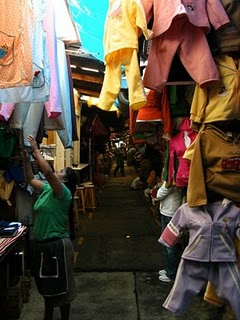
The wide, covered Portal is lined with vendor's stalls, called puestos
Clothes Stall (Puesto)
Shoe Stall
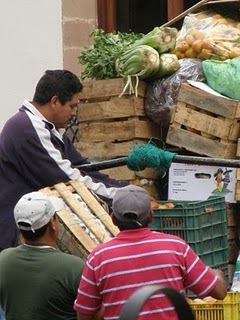
Unloading Fruits and Vegetables 
The mercado is quite simply the heart and soul of a Mexican city or pueblo. It is the place where things are sold and bought, but most of all, it is a place of people—vendors who are more often than not family and relatives, friends  and colleagues. They are people who have known one another all their lives and who help one another—in making change (a never-ending struggle) for a customer, or in finding an item in another stall when it isn’t available in their own.

Now consider this reaction when I took a picture inside of Macy’s.

This man told me that no one was allowed to take pictures of the inside of the store. I asked, “Why?” His response was, “Because of the competition.”

As I left, he also came outside for a smoke—by himself.


In Pátzcuaro’s mercado, going out by yourself for a smoke—or for anything else, for that matter—would hardly ever happen.


In Pátzcuaro as anywhere else in Mexican culture, place, time and people (el pueblo) are inseparable, interrelated, interconnected. El pueblo refers both to a people and their place, located within a continuous, acknowledged history.

In Shoppingtown, there are no connections to any of these concrete, cultural, historical human realities. So as you leave this place that is No Where and of No Time, where No One lives, you are reminded:


Postscript: Fall 2011
As many of you already know, Reed and I moved from Pátzcuaro, Michoacán, to Coyoacán, Mexico City, in August 2011. We would be less than truthful if we failed to mention that 'Shoppingtown' has arrived here. 

Mexican Shopping Malls are almost indistinguishable from those in the U.S. We even shop there sometimes.  But in Mexico the malls, which are humongous, coexist with many traditional mercados.  Some are weekend markets, but others operate full-time. Mexico remains ... inimitably, México.