Showing posts with label cultural fusion. Show all posts

Sunday, May 13, 2012

Max Returned to His Room: a Eulogy for Maurice Sendak, from Mexico

Maurice Sendak, author and illustrator of children's books, famous for, among other things, "Where the Wild Things Are", died on Tuesday, May 8 at age 83. His legacy? Books. Books for people. Here is a eulogy from Mexico, written by Jorge Flores Oliver. 

Also known as 'Blumpi, Flores Oliver is an illustrator, drawer of comics, essayist and culture journalist. He has been published in many Mexican newspapers and periodicals. He has a blog of his comics at http://sarcomic-strips.blogspot.mx/ 
by: BLUMPI

MilenioJorge Flores Oliver:

After a day's work, Mary Joseph, my three-year old daughter, when not asleep, hopes that for at least a few minutes she can continue with any of the activities with which she is entertaining herself. She can be playing with the dogs, painting or playing soccer. Or reading. Like Olivia, the little pig created by Ian Falconer, she takes four or five books in her hands and pretends to read them all. I, like Olivia's mother, negotiate with her until I convince her that she only read one or two. To see her running toward my room with a book under her arm is one of the scenes that produces the greates pride in me. And also that she does not like Disney princesses. Sometimes one of the books she chooses is 'Where the Wild Things', a book that at first disconcerted me, but which helped me learn to appreciate the different.

'Where the Wild Things Are´ (1963) is a difficult book. It doesn't begin as books often begin, but in an abrupt manner, a bit like the tales of a young child who daydreams and invents stories. It's a challenging book. I bet many parents are startled and do not know what to do when they read it for the first time to their children and get to the part where
His mother called, "MONSTER!" 
and Max said "I will eat you!"
And I also bet that, in many cases, it is the first and last time they open that book. Thus it is that the literature of Maurice Sendak transgresses in a special way. Sendak leads you to see things from a perspective that is hardly traditional, fulfilling what he said to Steven Colbert in an interview just earlier this year: "I do not write for children. I write," What this statement implies is that he wrote with all the obstacles and all the facility that could occur to him, because his readers are not idiots.

That's a lot of respect to have for the reader, but no pity. Because, as he explained to Spike Jonze, "I don't believe in children; I don't believe in infancy; I don't believe in this demarcation, "Oh, you ought to say this to them! You ought to say that to them." These are the words of Sendak in a part of 'Tell Them Anything You Want: A Portrait of Maurice Sendak,' the documentary that--oh, damn chance (or life, or luck, or death), was produced by the likewise recently deceased Adam Yauch.

But Sendak elaborated this theme of childhood a bit more in a conversation with Art Spiegelman (hey, I've already written too many articles about him, so I'm not going to go back and say who he is). Published in 1993, in The New Yorker, it is presented as a comic drawn by the two artists, who walk near Sendak's country home in Connecticut and carry on a talk about the creative process and children's books. "CHILDREN are cannibals and psychotic; They vomit on you with their mouth!" exclaims Sendak, but before arriving at that, this dialogue occurs:
MS: Books for children ... books for adults ... that is nothing more than marketing. Books are books! 
AS: I suppose so. But when parents give their children 'Maus', my book about Auschwitz, I think it is child abuse ... I want to protect my children! 
MS: Art, you cannot protect children ... they know everything! ... In fact, childhood is deep and rich. It is vital, mysterious and intense. I vividly remember my own childhood ... I knew terrible things ... but I knew that the adults ought not to know ... because it would scare them.
• • •

What did Sendak know? He knew of death. He knew, too, that sometimes there is nothing more to do than disappear, to close the door of mother's house behind you, to embark to an island inhabited by wild things and not return until they bring dinner to your room. These are the things that children do, they walk around the house wearing outlandish pajamas, naked, scaring the dog, shouting: "I don't care!"

• • •

One minute you're alive and the next, not. One minute your parents are at your side and the next, someone has eaten them and, in the next, three cooks are baking you, and the next you're celebrating your birthday. The title of the documentary by Spike Jonze sums up all this. Children (such as Pierre, Max and Mickey, protagonists of Sendak's books) have to know everything, because they understand and are not idiots. "Tell them what you want. If it´s true, tell them."

What do children do? To what are they devoted? You have to take a look at Sendak's alphabet book "Alligators All Around". Some examples, F: Forever fooling, P: Pushing people, U: Usually upside down, T: Throwing tantrums. But all these are activities that not only children do, we all do, including alligators.

Sendak was a complex child: sickly, homosexual and Jewish, and he lived traumatized by events he encountered in his childhood, one of them, the death of much of his family during the Holocaust. But to live without vital worries does not produce good art, or it produces bloodless art. At the age of four he found out about the sad case of the kidnapping of the 20 month-old son of aviator Charles Lindbergh, who was kidnapped and was not found until two months later, dead, with a fractured skull, near the house of his parents. Childhood terror.

But Sendak, rather than hide it, revealed it (albeit partially, we'll see why). If children are rebellious, relentless, cruel, nasty, arrogant and difficult, rather than sweeten the reality, he displayed it as it is. If his character Pierre walks around naked through the "Night Kitchen", it is because "children are not only learning about their body, but adjusting themselves to it." Sendak unveiled partly because he never dared to come out of the closet. Instead, he always tried to appear to be very heterosexual (if that's possible) in the eyes of his parents.

Maurice Sendak (1928) died in a hospital in Danbury, Connecticut, at 83 years of age, after suffering a stroke. In his home you can see a cardboard cutout of Barack Obama standing, together with his collection of Mickey Mouse toys. Obama paid ​​him one of the best compliments there could be: reading to a group of children "Where the Wild Things Are" (if George W. Bush had done the same, it would have been an insult; moreover, he would have read it standing on his head. Well, as we know, this is the world upside down).

God bless milk and God bless Maurice. Spanish original. Translated by Reed

Tuesday, December 27, 2011

Holiday Traditions Criss-Cross the Border

From ancient times, international trade has been the mechanism for spreading the practical products of culture—foods (spices, sugar, tea, coffee, chiles, potatoes, rice, wheat, tomatoes...), plant products (cotton, silk, wool...). The list is seemingly endless.

But the international traders often brought home more than products...sometimes they also brought home ideas and cultural practices. Modern technology has simply amplified these traditional effects.

Navidad Blanca (White Christmas)

So it is that Mexico City this year proclaimed a Navidad Blanca. Some Christmas Trees were available when we lived in Pátzcuaro, but they sell briskly in Mexico City. Mexicans tend to prefer the taller Christmas Trees imported from the U.S. and Canada. This year over a million were imported and sold.

Locally-grown, Mexican trees are smaller, greener, softer, but they often go unsold. The issue has become controversial, politically charged.

In Mexico City's Zócalo, the giant plaza bounded by the Cathedral and National Palace (seat of the Mexican government), a giant artificial Christmas Tree has been set up—perhaps to avoid getting embroiled in the controversy, which was even debated in the Mexican Senate.

0
In the background is the Cathedral (left) and the National Palace (right). 
To complete the scene, a highly popular ice-skating rink has also been installed. You might excuse this newcomer for thinking...New York City's Rockefeller Center!

A giant ice-skating rink rests in front of the Christmas Tree; the Cathedral is in the background.
But this is, after all, Mexico!  So at night there is always an abundance of fireworks!

Fireworks display in the Zócalo (Mexico City)


Cultural Fusion at la frontera

This cultural fusion is probably most evident at la frontera (the border), an arbitrary line quite literally drawn in the sand. At the conclusion of the Mexican-American War, the U.S. and Mexican governments established a joint survey commission that sent surveyors from both countries to determine the location of the border—the legal, international boundary that would delineate land the U.S. was 'annexing' from Mexico.

No less a respected authority than George Friedman (founder of the Stratfor Report, which objectively applies a geopolitical perspective to global intelligence issues) lays out the geographic and cultural reality:  Northern Mexico and the Southwest United States are a single geographic unit whose culture reflects and sustains its Spanish-Mexican heritage.

Nowhere is this more evident than in the border towns—El Paso, Texas/Ciudad Juarez, Mexico; Brownsville, Texas/Matamoros, Mexico; Laredo, Texas-Nuevo Laredo, Mexico; McAllen, Texas/Reynosa, Mexico; San Diego, California/Tijuana, Mexico. Nogales literally straddles the border—part in Arizona, part in Mexico.

Until recently, the border was a mere formality that did not affect the life of these vibrant border communities. Residents shopped on both sides of the border, nor was it uncommon for large, extended families to have members living on both sides.

Reed came upon a somewhat rambling but nonetheless interesting article on the mixing of Mexican and U.S. holiday traditions—and commerce! The piece was published in Frontera NorteSur—a journalism project of the University of New Mexico in Las Cruces, NM, located about 30 miles from El Paso, TX/Ciudad Juarez.

The piece focuses around the Mercado Mayapan, which was founded by former garment workers who banded together to promote grassroots economic development. The Mercado Mayapan is a place where residents and visitors can shop for fair trade-oriented holiday gifts while reaffirming traditional culture. “It’s not about the consumerist aspect,” a spokeswoman said, “It’s more about the get-together”—fiestas!

To celebrate Navidad, the Mercado sponsored mariachi bands, a traditional posada, and a giant piñata for children of all ages!   

The Mercado is also reviving another tradition that counters today's rampant commercialism. On the morning of the Posada, Orozco and several friends did a trial run of a tianguis (exchange by barter), which they'd like to hold on a regular basis. For their first tianguis, market friends traded body care products and natural foods including oatmeal, fresh mint and chiles curtidos (chiles in vinegar).

Holiday Traditions Straddle the Border

From here, the piece broadens out to include various holiday customs celebrated on both sides of the border.  In Puerto Vallarta, for example, restaurants feature traditional Thanksgiving dinners to their large U.S. and Canadian expat community, tourists and, tellingly, Mexican nationals as well.  

Other holidays have become transcultural, including Día de los Muertos (Day of the Dead) and Halloween, where Mexican skulls (calaveras), notably la Catrina, are showing up in the U.S., and young people south of the border are dressing up in ghoulish Halloween costumes. For our part, Reed and I were startled to see carved pumpkins (jack o'lanterns) adorning a grave in a Pátzcuaro panteón (graveyard)! 

One unfortunate byproduct is the extension of Black Friday into Mexico. In November Mexico City sponsored a 'Good Weekend'—the Mexican version of the famed (or, infamous, depending on your point of view) U.S. discount day.  

The piece wraps up with a lovely anecdote. An older woman, Lydia Zavala, has brought her great-niece to the Mercado Mayapan to shop for jewelry and a CD. Asked why she chose the Mercado, Zavala replied, “It’s handmade, and we’re supporting these artisans as opposed to supporting corporate America,” Zavala said. “This is the only place in El Paso that celebrates the Mexican traditions well…we need to keep it alive. We need to keep all these traditions alive.”

The reality is more complicated, but what is abundantly clear is the transcultural ambiance of these border towns. Since 1550 B.C. when the first Phoenician traders set forth in their galleys hugging the coasts of the Mediterranean Sea, through the Age of Exploration...and Trade, up to today's gigantic container ships, the peoples and the cultures of the world have been exchanging products and ideas.

We are all enriched by this millenniums-old tradition of trade and cultural exchange.  Enjoy!

Still Curious?
 
If you'd like to read the original article, here's the link: http://fnsnews.nmsu.edu/2011/12/20/contesting-and-reclaiming-the-holidays/

Friday, September 2, 2011

Mexico Culture: ex-Convento Churubusco - Part I Daily Life

As a child growing up in Palo Alto, California, I was intrigued by the string of Franciscan Missions established by Father Junipero Serraa day's walk apart on El Camino Real (the ‘King’s Highway’). The simplicity of California Spanish Mission architecture—red-tile roofs, white adobe walls—piqued my budding cultural curiosity: How was life lived by the Franciscans and Indians who made their homes within mission walls?

So I was keen when Reed suggested a visit to nearby ex-Convento de Churubusco. The convent (monastery) was founded in 1524 by Franciscan Friars, a mere three years after destruction of the capital of the Aztec Empire,Tenochtitlán, by Cortés, his army and indigenous allies. In response to Cortés’s explicit request for monastic orders to evangelize the indigenous peoples, the Spanish king initially sent twelve Franciscans.

On Cortés’s orders, Spanish soldiers destroyed the Aztec temple on this site honoring the Aztec's primary god, Huitzilopochtli ("Southern Hummingbird"). Using indigenous labor, the Friars subsequently oversaw construction of this convent church—reusing stones from the ancient temple. In many instances, colonial churches were constructed using the foundations of destroyed temples. It is said that the name Churubusco derives from Spanish mispronuncation of the town's original name, Huitzilopochco.

The difference between eighteenth century California Mission style and the sixteenth century Spanish Baroque style found at the ex-Convento (monastery) Churubusco is stunning. From Wikipedia, I learned that the Franciscan missionaries in California lacked both the skilled craftsmen and the building materials available to their brethren in Mexico. Elsewhere, I've commented on the quality of the craftsmanship in the Mesoamerican cultures.

The grounds are much larger than any that have survived of the California Missions. The ex-Convento grounds enclose five, perhaps six, acres. Here’s the link to a Google Map of the site: Arial view.

Visible on Google Map are five points of interest:

1. Templo de San Diego (Convent Church) is labeled; its deep red roof in the form of a cross, stands out;

2. The Convent’s four walls mark its boundaries:
  • West Wall (Left side): Church entrance is through a doorway into an atrium (forecourt); 
  • Southwest Corner (Lower left): External walls enclose two sides of a large patio with formal walkways and a fountain in the center; 
  • Southeast Corner (Lower right): External walls enclose two sides of the patio de servicios (kitchen garden), in the tree-filled corner; 
  • East Wall (Right side): The wall passes a long, blue-grey roofed building, possibly a classroom wing; this Northeast Corner was once a huerta (orchard) of fruit trees; look for the corner beyond the smaller, square building; 
  • North Wall (Upper): The wall runs beside several structures, we guess may be school buildings. 
3. Note: The south wall of the church is a shared wall with the Convent—organized around three inner patios.

4. Note: The long, one-story wing between the formal patio in the Southwest (lower left) Corner); parallel to the wing, a long stone walkway from the South Wall connects to the main Convent building (North).

Travelers and pilgrims seeking food and shelter gained access to the Convent grounds through an impressive, wooden gate cut into the South Wall. Today’s visitors—including us!—enter through the same ancient wooden gate.

In front of us stretches the long stone walkway shown below, lined with neatly trimmed boxwood hedges!

Travelers and pilgrims seeking food and lodging in the Convent walked this stone walkway from the front gate to the Convent building itself.
Just inside the gate, visitors glancing to their left viewed this formal patio beckoning from beyond the cool, dark arches.
Just inside the entrance, this area probably served as a reception and waiting area. 
 At the Convent end of the long, one-story building separating the stone walkway from the formal patio, we come upon this second hallway entrance to the formal patio.
 This passageway is a classic example of Spanish colonial architecture. Transitions from enclosed, darkened spaces to those of openness and light are architectural metaphors for birth and salvation.
Accepting the invitation, we enter the formal patio garden dominated at its center by this graceful fountain.

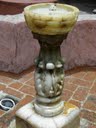
Traditional Spanish Colonial fountain
The fountain's design roots extend back to the Moorish gardens of Spain. Islamic Moors brought the paridaida ("paradise", or walled garden, dating back as early as 4,000 B.C.) from Persia to Spain. In Spanish, pared means wall. Muslims later took these same garden traditions east to India. The Taj Mahal is the notable example.


Returning to the stone walkway, an open doorway beckons us to enter to the Patio de Servicio ('service garden' or kitchen garden).


Vegetables to feed the friars and their visitors, and herbs to treat the sick were grown in the Patio de Servicios
The blue decorative tile around the doorway is called azulejo (blue tile). Azulejo is used in important places in the Convent. Although azul means 'blue' in Spanish, it is an Arabic word; technically, it is a loanword—a word taken from one language and incorporated into a second language.

Linguists estimate that about 8% of words in the Spanish dictionary—the total of loanwords and roots— have Arab sources. After Latin, Arabic has exerted the greatest lexical influence on the Spanish language.

Patio de servicio or kitchen garden

Exit from patio de servicio
Like visitors of old, this tranquil patio captures our attention as we enter the Convent building.
Classic Spanish Colonial Patio
Alabaster Fountain 
The painted arches, a style we have not seen elsewhere in Mexico, are striking. Reed is reminded of photos of a mosque in Spain.
Here it is:  Mezquita Mosque in Córdoba, Spain
(Photo Courtesy of Wikipedia)
As we walk the Convent's hallways and rooms, we become increasingly aware of Moorish influence on Spanish colonial architecture. We remind ourselves that the Moors conquered Spain in 711 A.D. and were not driven out until 1492. Less than thirty years later, in 1521, Spain conquered Mexico. A mere three years after the destruction of Tenochtitlán, the Spanish constructed this Convent (1524).

Leaving the ground floor, we climb steep, stone stairs—no railings! Our reward is this balcony view of the fountain below:
The shape of the fountain, whose design goes back to Persian times, represents the world, oriented to the four cardinal directions.
A similar, four-pointed Moorish fountain in the Garden of the Sultana, Generalife ("Architect's Garden"), Granada, Spain (Photo Courtesy of Wikipedia)
Balcony view: Geometric arches create tranquility
Reed and I walk slowly through the Convent's corridors and rooms, absorbing their energy. A series of photographs follows—with minimum text. My intent is to let the pictures convey a sense of lives lived within the confines of these walls.
Second floor hallway; the walls and floors tilt as much as they appear to do in the photo
Friars glimpsed the formal patio garden through this second-floor window
Rich example of azulejo graces this half-flight staircase  
Sculpture of Franciscan Friar 
Window in stairwell; again, the contrast of enclosed darkness pierced by Heaven's Light

This graceful cupola lights an interior stairwell
Detail from the same stairwell; the complex simplicity of the graphic design is eye-catching
We left the Convent the way we had entered, down the long, stone passageway and out through the massive wooden gate. Then we made our way around the corner to the entrance to the church.
Gated entrance to the Atrio (front court) of Templo de San Diego
This dome, with its blue, white and yellow tiles, is in mudéjar (Moorish) style; it covers a small, outdoor baptismal font in the Atrium of the church.   
My thoughts return to my girlhood question, How might life have been lived by those residing within these walls? Comparisons to the California Missions are difficult, if not impossible: the mild, coastal climate meant a life of relative ease for California's mostly sedentary indigenous peoples; in any event, it did not give rise to anything comparable to Mesoamerican culture.

In stark contrast, Mexico's distinctive geography produced one of the great civilizations of human history. Cortés's explicit intent was the destruction of all forms of this civilization's culture—buildings, art, writings. It is in this context that the Convento de Churubusco was built. The early years of the Spanish occupation were characterized by intense activity as Cortés expanded territory under his control, awarded land to his soldiers and oversaw construction of Mexico City on the very site of Montezuma's capital, Tenochtitlán.

The question naturally arises:  With all he had to do, why did Cortés decide to establish a Convent at this location?  The following map shows the answer.
Huitzilopochco (orange-tinted shapes, southwest) and Tenochtitlán,
Aztec capital situated on a large island (red-tinted shapes, north), in middle of Lake Texcoco,
are linked by a causeway (straight line) built by the Aztecs to provide land access to their island capital.
  

Huitzilopochco's strategic value is now apparent. Its siting on the southern causeway gave the ancient town control of southern access to the Aztec capital. By constructing the Convento de Churubusco, Cortés assured this essential control.

The military necessity is in stark contrast to the tranquility of the Convent's architecture and gardens. We have to believe that many of the Convent's early visitors were Spanish soldiers. Over time, of course, their visitors would also have included Spanish soldier-landowners and their families. The tension between tranquility and violence is a theme that re-emerges throughout Mexican history up to and including the present day.

In the next post, I'll explore the military history of the Convento de Churubusco. To our great surprise, this history involves Mexico's neighbor to the north, the United States.

Stay tuned for Part II—coming soon!

Sunday, April 24, 2011

Holy Saturday: Silent Procession in Pátzcuaro

The Procession of Silence on Holy Saturday night before Easter Sunday is a time of deep penance. 


Men dressed in medieval-style robes of purple or black, their faces and heads covered by conical caps, walk barefoot through the streets, together with images of the Crucified Christ, the Sorrowing Virgin Mary, and John, the Disciple whom Jesus charged with caring for his mother, Mary. 


Children carry symbols associated with the Crucifixion. 

Boy dressed as Roman soldier

Women and girls dress as the women following Jesus. The girl dressed in black in the center represents Mary, who is following a white-robed angel and accompanied by other women.


History of Conical Hoods

A word is needed to explain the conical hoods.  For our countrymen and women in the U.S., the connection to the Ku Klux Klan is instantaneous and fraught.  Here's the story as we understand it. 

The conical cap has a long history throughout the world. It was used during the Spanish Inquisition as part of the clothing of humiliation worn by people charged with heresy before the Inquisition. There is some evidence that this practice is the historical root of the student's Dunce Cap.

Pointed hoods were also used by various Spanish secret orders and Catholic lay confraternities for processionsspecifically, the Capirote, or conical cap, was worn during Semana Santa processions held in Seville, Spain.

But the story of how the medieval conical cap came to be adopted by the Ku Klux Klan is a curious example of cultural diffusion. During the making of the movie (1915), The Birth of a Nation, the costume designer reached into the medieval ages to get a costume idea for the Klan, which by the 1920's had nearly died out. The designer came up with the medieval Spanish Capirote. In the wake of the movie, the Klan experienced a resurgence and adopted the conical cap seen in the movie.

It should be noted that although "Birth of a Nation" is honored for its technical innovations as one of the One Hundred Best American Films, the racial undertones are deeply disturbing to contemporary audiences.

Conical Cap in Pátzcuaro

But it is safe to say that the tradition of the conical cap in Pátzcuaro's Silent Procession is grounded in the medieval tradition of Spanish lay confraternities, as introduced in Nueva España by the Spanish monastic orders. In Pátzcuaro, barefoot penitents march in the Silent Procession in search of atonement for their sins.


The Procession of Crosses on Good Friday Night and the Procession of Silence conveyed to Reed and me powerful feelings of the suffering that humans are capable of inflicting on one another—as represented by the image of the Crucified Christ. 

But these annual processions also convey the love and devotion that Mexican Catholics have for these very realistic images that provide them with a tangible connection to their God.


Monday, April 11, 2011

Mexico Traditions: ...and Pepsi!

Note to Readers:  Jenny's Journal is beta testing new Google+ Dynamic Template. We're already excited about the results. Daily visits have more than doubled! 
Click on Tips for Navigating in New Template for ideas on how to tailor your visit to your preferences. Use Comment feature located at bottom of post to tell us about your experience with the new template.  BTW - The moving gears mean processing. For now the Dynamic Template can be slow to load. Use Send feedback in white box at bottom right corner to send technical issues directly to the Google+ Technical Support Team.

 *  *  *  *  *


It's hard to believe, but the third anniversary of our arrival in Mexico is fast approaching. I remember it well!

As we rode toward our new life from the airport towards Morelia (state capital of Michoacán), we were confronted by a huge red, white and blue sign painted on a pristine white wall: “Bienvenidos a Michoacán ... Pepsi.”

I was in trouble. I took a deep breath.

As a corporate consultant, my last U.S. client was...Pepsi. Projects often fail to start or finish as planned. This one was no exception. When we arrived in Morelia, the project was in full swing—much to the deep distress of my beloved husband who was furious that I would be work-distracted as we began settling into our new home in a new culture and speaking a new language.

Once we were comfortable in our rented house, we began to poke around. Reed's distress sensitized him to see the Pepsi logo all around. But, honestly, it wasn't hard. Pepsi really was "...everywhere you want to be."

The familiar red, white and blue circular logo was painted on wall after wall along the streets and highways of Michoacán. Awnings, tables and chairs in restaurants sported the Pepsi logo. Sadly, even our favorite neighborhood family restaurant wasn't exempt. The Pepsi logo was visible in every pueblo we visited on the meseta (rural highlands) and on the islands in Lake Pátzcuaro.

Pepsi at feet of Purhépecha woman in traditional dress

Pepsi showed up on the back of shirts worn by deliverymen bringing Santorini bottled water to our house. Obviously the deal is, "We'll paint your wall or donate table, chairs, awnings if you'll display the Pepsi Logo." It is impossible to escape Pepsi in Mexico. 

One day Reed looked down the driveway to see a Pepsi truck improbably parked on the berm about fifty feet away from our front gate. Deliveries were in progress across the street to our neighbor's tiny convenience store—really nothing more than a window counter open to the street. When I heard Reed's anguished cry of protest, I feared for our marriage!
In front of our gate—¡Qué barbaridad!
Before arriving here, I hadn't thought much about how the U.S. and Mexican economies relate to each other. So these statistics surprised me:
  • Some 18,000 U.S. corporations do business in Mexico.
  • Ninety percent of Mexican exports—oil, manufactured goods and agricultural products—go to the U.S.
  • Fifty percent of Mexican imports come from the U.S.
  • U.S. banks own Mexico’s largest banks.
  • Kansas City Southern Railroad owns the line that runs past our house from the Pacific port of Lázaro Cárdenas to Mexico City.
  • Mexico’s largest sources of income are from the sale of oil to the U.S., tourism and remittances—money sent home to families in Mexico by family members working in the U.S.
The impact of the U.S. economy on the Mexican economy is profound—a reality captured by this Mexico dicho, saying — “When the U.S. sneezes, Mexico gets pneumonia.”

The first time I saw the string of U.S. box stores lining a prize stretch of highway into Morelia, I gulped — Where am I? This isn’t Mexico! But, yes, it is Mexico today. 

CostCo, Home Depot, WalMart, Sams Club, Sears, Office Depot and Office Max all have Mexican presence. But that’s not all. Side-by-side with U.S. companies are Mexican-owned box stores imitating and extending the U.S. retail business model.

Then there’s the impact of U.S. popular culture on Mexican culture. Like every other region on the planet, U.S. popular culture makes a strong statement in Mexico: music, movies, television series, magazines, youth fashions, electronics….


Purhépecha women in traditional dress reach for cellphones from the front of their embroidered blouses. 

Reed photographed this Purhépecha teenager paddling a traditional canóa (canoe) with an iPod firmly in his ear.


In the face of such raw economic and political power, Mexican President Porfirio Días put into words the sentiments of many Mexicans toward their powerful northern neighbor—"Poor Mexico: So far from God; so close to the United States."

In time, of course, the Pepsi gig ended, and we established a life-affirming rhythm at la Casa Mariposa. But to this day Pepsi remains somewhat of a family sensitivity. 

This is the background, then, for my coming across Craig "Cisco" Dietz's account of the day he and Xun, his gardener and a Maya shaman, set out to purify the Temezcal (sweat lodge) they had constructed together using traditional tools and materials in the backyard of Cisco's house in San Cristóbol de las Casas (Chiapas State). Cisco's account exemplifies the cultural curiosity that we cherish while giving us a chance to glimpse traditional Maya beliefs and customs.

Culturally threatened since the arrival of the Spanish five hundred years ago, Mexico's surviving indigenous populations have demonstrated creativity in preserving their traditional ways of life. They persist in finding ways to adapt modern realities and resources to their traditional customs. Often the results represent important new ideas for sustainable living.

Reading Cisco's account, I couldn't believe my eyes. Among the objects used in this traditional purification rite, Cisco lists the objects that Xun brought: Posh (traditional Maya brew), Pepsi, hunzio, candles, fresh rainwater and Xun’s history, of the continuance of traditions of Chamula....

Yes, you read correctly, here in an ancient Maya rite of purification was...the ubiquitous bottle of Pepsi!

But don't let me spoil an opportunity for you to experience this account first-hand. Here's the link: Cisco Dietz http://www.mexconnect.com/articles/725-temezcal-y-xun-the-sweatlodge.

Tuesday, April 5, 2011

Alternative & Organic Fair in Arócutin - First Sunday Monthly

Last Sunday Reed and I visited the pueblo of Arócutin, which is about half an hour out on the west side of Lake Pátzcuaro. Our destination was an "organic fair" held on the first Sunday of each month.  What an incredible cultural fusion it turned out to be!  

My interest was piqued when my Spanish teacher  told me that he visited the fair last month with his wife and two young children, who had a terrific time. 

We walked down the driveway of a property dotted with several quirky Mexican buildingsincluding a dry fish pond!  The first thing that caught our attention were the plantings, which were quite remarkableherbs of all kinds, unusual trees and bushes.  

We walked around a bend in what was by now a single-file footpath and—voiláwe had arrived! But where on earth were we?  

Flute music wafted gently on the breeze. In front of us were tables shaded by grasses woven to form shade roofs.  Dappled sunlight fell through the lightly-scented grasses on goods of all kinds—cheeses, blouses, tablecloths and napkins, herbs and plants, and fresh, organically grown garden vegetablesspinach, Swiss Chard, carrots, radishes, and more.

I have to add that the taste of vegetables grown here is quite remarkable. The Swiss Chard, spinach and carrots are truly sweet, not at all bitter, and even the largest radishes are full-flavored, hot.  A recent vegetarian guest commented, "Michoacán is a vegetarian's delight!" 

Set out on still more tables were still more offeringsherbal medicines and natural creams, goat cheese....  One woman was selling tiny succulents planted in blown-out egg shells that rested on tiny egg dishes. I was struck yet again by the originality of the Mexican aesthetic. 

Suddenly Reed exclaimed, "This is an orchardlook at this peach tree."  In his hand, he was tenderly holding a very young peach growing on its branch. As I continued to gaze around, I became aware of a pink rope-cloth secured to a tree limb about 20 feet up.  A little girl was learning to climb the rope under the competent supervision of a lithe Mexican señorita.

There were craft workshops of all kindsweaving with wool, etc.  Oh -- and have I mentioned the fragrance of burning incense?

And the food!  An elderly indigenous woman knelt on a mat in front of a metate rolling masa for the delicious blue corn tortillas. There was ceviche, tostadas, empanadas...the variety was impressive.  By now I wasn't even surprised to meet my extremely professional physical therapist from Morelia helping out her husband, who, as it turns out, brews superb microbeers! 

Clearly baffled, Pablo, our driver and friend, whispered to Reed, "What is this?"  The truth is, we were asking the same question. It felt like a happening that might have been organized by a hippy community from the 1960s in Northern California or New Hampshire. But there the similarity ends, because if this was a hippy happening, it carried a distinctly Mexican flavor. 

Gradually I became aware of not just the variety of offerings, but of who was offering them.  Most striking was how many Mexican campesinos and artesanos were offering their wares, but there were also American hippy-types selling their hand-crafted jewelry and US-style baked goods. To my ear, their Spanish was fluent, even colloquial. Clearly, they've been here a long time, as evidenced by several blue-eyed, blond children happily running around barefoot. 

But it became equally clear that some of the 'hippies' were indeed Mexicans, which suggests to us that the counterculture has reached down into Mexico. We also encountered Mexican hippies on our recent visit to San Cristóbol (Chiapas). When we left, Reed spotted the ever-faithful VW bus in the parking lot. Diagnosis confirmed!

What was equally amazing was that as gringos we were a distinct minority among the customers.  I asked a vendor about the history of the property, and she told me that it had once been a 'community'my hunch is that it may have been a communebut now it is owned by one couple, and each month they host this fair. 

What an unexpected fusion of cultures we encountered on a warm, spring day in Arócutin! Needless to say, we will return!

Directions:  Follow the road to Erongarícuaro about 10 km.  Turn Right toward Jarácuaro.  The driveway to the property is on the Right, about 100' from the corner. You'll see cars parked along the road.  

Thursday, March 31, 2011

Mexican Culture: Cohetes (Firecrackers or Rockets)

The Casa Mariposathe house we rentis located on a bay in Lake Pátzcuaro about a mile equidistant from the pueblos of Tzurumútaro on one side and Estación (Old Railway Station) on the other.  Across the bay a couple of miles away is the pueblo of Ihuatzio.  At the head of the bay is the Island of Janitzio made famous by its Day of the Dead celebrations (el Día de los Muertos).  

You may well be asking what these pueblos have in common, and why they are important to us.  If you were to stay with us for a couple of days, you'd be likely to discover the answer at various times of the day, night or predawn as the silent countryside is broken by giant firecrackersrockets.

Essentially communication devices, the unmistakable sound of Mexican rockets are an integral part of Mexican pueblo life. Churches in the pueblos around Lake Pátzcuaro don't have bells, so cohetes are used to announce each pueblo's fiestas, often beginning at 6:30 AM to summon the faithful to 7:00 AM Mass.

Our central location makes us default aficionados of the art of the cohetero (man in charge of lighting the cohetes). We have yet to learn, for example, why we have sometimes heard cohetes in the madrugada (predawn) hours—even at 3:00 and 4:00 AM. Reed says they announce Mañanitas (Morning Prayers), but for me, it's a mystery!

But in the meantime, Reed and I have had a more immediate rompecabeza (head-breaker, or puzzle) to solve. For the past two years, we've been invited to share the fiesta of Corpus Christi in Ucazanaztacua, the pueblo of an indigenous friend. We have been touched by this High Mass celebrated outdoors.

Incense, music, and the devotion of the faithful create a rich experience of the sensuality of Mexican culture: our eyes feast on the colors of traditional Purhépecha dress, our ears are calmed by sounds of the priest's chant and people singing, and our senses are heightened by the fragrance of smoldering copal (incense).

Although we are not Catholic, we understand the symbolism of the Mass, so we have been baffled to understand why, at the sacred moment when the priest elevates the Host and, through the miracle of Transubstantiation, this wafer is believed to become the Body of Christwhy it is at that precise moment that the cohetero sets off several rockets in a row.

What has been equally baffling is that the prieststanding at an outdoor altar no more than twenty feet away from the coheterois seemingly unfazed by the noise of the rockets firing. Similarly, the faithful don't even seem to blink. Recently, we discovered why. Before the arrival of the Spanish, Mesoamericans beat huge drums to announce the start of their rituals in order to assure that the gods were paying attention to their actions.

It seems cohetes are used today for the same purpose: to make sure that God/s is/are paying attention. I've made this comment before, but it bears repeating:  it is one thing to read about the prevalence of religious syncretism, where Christian rituals and beliefs rest on top of millenia-old indigenous rituals and beliefs, but it is entirely different to experience it first-hand.

The Chinese invented gunpowder, so it's fair to assume that the first Mexican coheteswhose traditions date back nearly five hundred yearswere brought to Mexico from China by the Spanish.

Poking around for more information about cohetes, I came upon this delightful, first-person description written for MexConnect by a US expat living in San Cristóbal de las Casas (Chiapas, Mexico). Here's the link: Cohetes: A Mexican Tradition.

Thursday, July 9, 2009

Travel Journal: Guadalajara, Jalisco

Over the Fourth of July weekend, we traveled by bus to Guadalajara. It is the capital of Jalisco State (pronounced "Ha-lees-co"), which is northwest of Michoacán State, where we live.

Guadalajara was founded by the Spanish in the 1540's. At its core, Guadalajara is a colonial city. At the center is a cathedral surrounded by four plazas, one on each side. The whole is a grand space, created by a self-confident, world-conquering, world-creating Spanish empire. Some colonial buildings remain along the sides of the plaza squares.

Today, however, modern Guadalajara and surrounding municipalities make up Mexico's second largest urban center, inhabited by over four million people. The modern city has almost overwhelmed the colonial core, creating a conflicting experience. The spaciousness, solidity and balance of the colonial structures communicate security, calm, a sense of serenity. Some of the modern buildings try to reflect this solidity, but seem unimaginative and sterile. The rest are a hodge-podge of utilitarian commercial structures -- stores, offices, hotels. Many look tired and worn. Apparently, as with many US cities, life in Guadalajara has moved to the "suburbs."

Nevertheless, Jane and I found within this center, in some of the suburbs and in the countryside beyond, a series of wonderful manifestations of the eternal human creative dynamic. This dynamic always involves a tension between energy and order, structure and movement, permanence and change.

Classic Dance and Traditional Music in a Classic Setting

Our first experience of the dynamic of energy and order took place on our first night, at the Teatro Degollado (Dey-go-YAH-tho), a neo-classic temple to the arts, built in the 1860's, that faces the Cathedral across the largest of the plazas.

Entering through the grand portico of Greek columns, we walked into an equally Grand Lobby, then on into a classically European theater that is all sumptuous red and gold. Four balconies rise up to a mural-covered ceiling.

In this wonderful, traditional but lively space, we experienced an equally wonderful, enthusiastic performance of the very traditional ballet, Coppelia, performed by the energetic and traditionally well-trained students of the Ballet School of the Instituto de Cultura de Jalisco. Principal parts and major variations were danced by members of the Companía de Danza Classica de Jalisco, the professional company of Guadaljara. So ballet, in all its traditionally shaped and maintained vitality, is alive and well in Guadalajara...in a beautiful setting.

On our second night, we returned to the Teatro to hear a concert by the Jalisco Phiharmonic. Billed as a 'fusion concert', it featured the professional orchestra playing with a norteño ('northern') group, a Mexican musical style that combines guitars, a harp, an accordian and singing. The program was all traditional popular Mexican music, kind of a Boston Pops concert played, sung and enjoyed with alegría, soul-satisfying joy by performers and audience.

When the concert ended, the Mexican family sitting in front of us, in the first balcony, turned and asked us if we enjoyed it. We replied, "¡Nos encanta¡" "It enchants us." The father of the family then told us that his son was one of the performers--he was the chiflado, who whistled an entire song.

But it was not whistling. It sounded like a bird singing, almost like a flute. He produced the sound somewhere deep in his throat. At one point, the orchestra and guitarists who had been accompanying him fell silent. Putting aside the microphone, he filled the theater with his birdsong. The entire theater fell absolutely silent, we held our collective breath as we listened to this miraculous sound. When he finished his song, the  audience, us included, went absolutely wild.

The father described this as his son's don, his god-given talent. The father and the family thanked us profusely for enjoying their Mexican music. They shook our hands vigorously several times. Our thought was that Mexicans so often expect estadounidenses (USer's) to look down on their culture, that this family was expressing their gratitude that we valued what they had to give and had shared in it with alegría . We seemed to be the only gueritos, "pale-skins" in the audience.

Sanctuary for a Meditation on Violence

Our next experience of the dynamic tension of order and energy, structure and movement, permanence and change came with our visit to Las Cabañas. Built in 1810, just before the Mexican War of Independence, Las Cabañas was thus constructed at the tail end of the Spanish colonial era.

Constructed as a hogar or home for orphans and widows, today Las Cabañas is a state cultural center and musuem. It is in neo-classical, i.e., Romanesque revival, style, looking on the outside like a Roman temple. It is huge, with 106 rooms and 23 patios!


Colonial architecture creates an experience of serenity. It does so through a quiet, ordered rhythm of balanced proportions, repetition of simple elements and movement through alternating closed and open spaces. In its interior, Las Cabañas embodies the essence of this architectural style with neo-classical refinement. It is serene.


At the core of Las Cabañas is a chapel, a Romanesque sanctuary. In the 1930's, José Orozco, one of Mexico's leading muralists, was commissioned to paint murals on the walls and ceiling of this chapel to depict Mexico's turbulent history.

Framed in the stone vaulting of the chapel, the murals are stark and explosive in their energy, all in shades of gray, punctuated by blood red. It is difficult to imagine a more arresting contrast of serene order and violent chaos.


Finding the Center of the World: Guachimontones

On Saturday, the Fourth of July, we traveled by taxi west of Guadalajara to a Mesoamerican archeological site known as Guachimontones, 'the homeless mounds' as they have been dubbed by the locals. Excavated only in the last decade, the mounds are the remains of a society dating from between 300 B.C. to 300 A.D. They sit on a hill overlooking a huge valley.


In Mesoamerican civilization, as in Chinese and other primary civilizations, locating the center of one's world in relation to the four cardinal directions was crucial. This "axis mundi" established one's spiritual, psychological and physical orientation and, hence, sense of order and place in the world.

At this center one met one's gods and, thus, one's own identity. The center grounds the human world in the midst of the forces of the natural world and the cosmos. This is a theme that recurs time and again in the Mesoamerican Cosmovision. 

Guachimontones' organization is unique in the Americas and in the world. Centered around circular 'pyramids' that marked and maintained the center of the world for this culture, the site is relatively small and simple. But as one walks around and within its circles, the very size and simplicity of the space enables one to experience the fundamental dynamic of creating a centered, bounded and thus coherent communal space very much at rest in the midst of a vast natural one.


The Creation of Miniature Worlds: Artesanias of Tlaquepaque

Tlaquepaque (Tlah-kay-PAH-kay) is a city contiguous with Guadalajara known for its artesanías, i.e., crafts, especially pottery. We traveled there on Sunday. The many grand colonial houses of Tlaquepaque originally belonged to the Spanish ruling class. Now they are occupied by stores selling fine artesanias, upscale restaurants and museums.


We visited the Museo Regional de la Cerámica featuring displays of many styles of pottery. What struck us was how images of nature dominated the decoration. Here the energy of nature was transformed into miniature worlds of art by the creative organization of the artist.


¡Gracias, Guadalajara!

So, in three days we found in this huge, fragmented, worn but renewing city wonderful experiences of the creative tension in human life between energy and order, stability and movement, permanence and change. ¡Gracias, Guadalajara!


Still Curious?

Here's the link to Reed's Photo Album of Las Cabañas:   http://jreedbrun.xanga.com/albums/0540ae46301f32/