On May 1 International Workers' Day was celebrated in Mexico, which brings to mind that according to research conducted by UNAM (National Autonomous University of Mexico), 55% of Mexican workers labor in the 'Informal Economy' and hence lack access to government 'social security' benefits (health and pension).
But, of course, I wasn't thinking about any of this on Sunday morning when the 'team' arrived to paint a living room wall and repair kitchen tiles in our apartment!
 |
| Puesto (stand)—one of many!—selling hats in the center of Mexico City |
This morning Sandra arrived, as she does every week, to help us out with the house. But this week was different.
Over the weekend, we'd not only had one wall of the living room painted a contrasting color, but we also had repairs made to the tile floor in the kitchen. This latter task involved emptying and removing temporary kitchen shelves—the contents of which were now neatly stacked on living and dining room furniture.
It was a typical Mexican enterprise. Lucky for us, Sandra's husband is an excellent painter, and their neighbor is an all-round handyman. So at 8:00 AM on Sunday morning—Sunday, because everyone has full-time jobs—the team arrived at the front door, ready to go. Sandra came along to touch-up the paint job.
Reed was in Florida visiting his 98-year old parents. I spent the day in our home office. At one point, Sandra came to get something from the office closet and commented, "Relax, relax. Usually the kitchen is yours, but
today it is ours. Relax." I chuckled wryly.
At the end of the day, duly impressed with the outstanding quality of the work, I complimented everyone on a job well done.
Culture Shock: Monday morning...
I knew I wouldn't quite be ready when Sandra arrived, so I asked Reed to tell her to begin washing the picture window as she usually does, and I'd be right out. But that isn't what happened.
Instead, Sandra began cleaning the kitchen. When I joined her, she explained
her work plan: clean the
entire kitchen, walls, cabinet fronts, floor, etc., and put the kitchen back together. She said she wouldn't touch the rest of the house this week. I protested, would she,
por favor, at least clean the bathroom. She readily agreed.
As a busy professional in the U.S., I always had household help, and I'm accustomed to directing the work. But that isn't how it works in Mexico. It
really isn't!
In Mexico, it seems that the worker is in charge of his or her own work. I can see that there might be reasons inside the culture, but still—wow!
Cultural Awareness: First cracks....
A chance conversation with a Mexican friend perhaps a year ago was eye-opening. Álvaro is a dentist born and bred in Pátzcuaro. I don't remember how the conversation started. But I do remember being startled by his comment, "When we Mexicans live in the United States and we don't understand the culture,
we have a problem, but when foreigners living in Mexico don't understand the culture,
they have a problem."
I vaguely remember thinking at the time,
"Where did this come from?" As I recall, I was idly mentioning how independent Evangelina is in caring for Casa Mariposa, the house we rented in Pátzcuaro. My explanation made sense to me: Evangelina has cared for the house for decades...across several owners. In many ways, I thought, it is
'her' house—and that's what I thought I was communicating to Álvaro.
But something in my remark clearly set him off, because I also remember him carefully explaining to me that a mother teaches
el trabajo, the work, to her daughters. Interesting because....
...we had engaged Daniel and his two sons to clean and reset Casa Mariposa's tile roof. After the work was completed, Daniel appeared one morning at the front gate with his two sons to inquire whether we had more work.
In the U.S., of course, the homeowner takes the initiative to call when there is work to be done. I felt awkward explaining to three people that we had no more work, and I mentioned my discomfort to Evangelina. Her response was telling, "Oh, it's okay that the sons were there;
Daniel is teaching his sons how to do 'el trabajo'."
Culture Check: Breathe deeply....
Teasing out deeply rooted cultural assumptions is profoundly challenging! It might even be more difficult for those of us born in the United States. Until quite recently, the U.S. was remarkably self-sufficient, with everything we needed available well within our own borders.
The sheer size and self-sufficiency of the U.S. has given rise to what might be described as cultural myopia. In our minds, how it's done in the U.S. is the
"way it's s'posed to be". The global spread of 'American' culture after World War II reinforced this mindset.
People from other parts of the world interact with other cultures as a matter of course. In Europe, for example, anyone traveling almost anywhere crosses language and cultural borders. Cross-cultural experience cultivates understanding that 'culture' is relative to a people and a place, and there's more than one way to live.
Finding ways to articulate underlying cultural assumptions that seem to reside in our DNA isn't easy. It takes patience and persistence.
Northern Europe: Green Shoots of Civil Society
For starters, prior to landing at Plymouth Rock, the first pilgrims forged and signed a compact of self-governance called the Mayflower Compact (1620).
But this agreement wasn't born
de novo, or out of thin air. It was the latest development in an English political and legal tradition that can be traced back to the Magna Carta (1215), when a group of nobles sat the English king down and explained to him the facts of life. These facts began with a simple assertion of the limits to royal power and ended up with the king agreeing to establishment of a powerful parliament—for which he received, in exchange, the signatures of the nobles on an oath of fealty to the king. Over time, the Magna Carta became the basis for English citizen rights.
Spain: Locked in Medieval Traditions
So what were the rules of the game laid down by the Spanish king? For starters, nothing remotely like the Magna Carta existed in Spain. In fact, Spanish nobles were engaged in
driving the Moors off the Iberian Peninsula for 800 years—from 710 to 1491. They weren't successful until almost 300 years after the Magna Carta was signed.
By definition, military tradition is authoritarian. When the Spanish aristocracy, devoted to military pursuits, weren't fighting the Moors, they engaged in sports and enjoyed culture—art, music, theater.
'Work' failed to engage aristocratic attention. In Spain, the professions and trades were practiced by the Moors and Jews until Ferdinand and Isabella, in the process of consolidating the Spanish kingdom, finally succeeded in expelling the Moors (1492). In order to 'purify' their newly united kingdom, the Catholic monarchs forced Jews either to convert to Christianity or face expulsion which, of course, had the unanticipated consequence of driving competence from Spain.
But 1492 was also the year in which the Spanish monarchs commissioned Christopher Columbus to lead an expedition in search of a westward maritime route to Asia. Instead, of course, Columbus's voyage resulted in the arrival of Europeans to the Western Hemisphere.
Nueva España: Frozen in Medieval Social, Political, Economic Structures
One of the first to follow Columbus was Hernán Cortés. Born in Medellín, Spain, to a family of lesser nobility, Cortés sought his future in the New World, landing on the mainland for the first time in 1518.
Like their commander, Cortés's soldiers were second and third sons of noble families. Denied land by birth, they sought their fortunes in the Americas. From the outset, their goal was to reproduce in Nueva España the luxurious lifestyles of their parents and older brothers, including their devotion to sports, culture and their disinterest in work.
Meanwhile, the Spanish Crown (Philip II) went on to defeat the Vatican States, which meant that the Spanish king, head of the Spanish Church, also controlled the Pope. The Spanish Crown thus joined together its authoritarian, military tradition with the authoritarian, theological tradition of the Catholic Church. Both Carlos Fuentes and Octavio Paz note that the Spanish Crown installed medieval political, religious and economic structures in Nueva España, then froze further development in order to serve its own purposes.
Cortés introduced the Sword and the Cross to Mexico's original peoples. The message was unmistakable: convert to the Cross, or die by the Sword.
The Spanish Crown was quick to consolidate control over its new territory. A Viceroy was sent to govern Nueva España, and an Archishop was sent to run the Church. In order to prevent consolidation of power in these far off lands, the Crown limited each Viceroy's stay to seven years.
Completely subdued, vanquished, were Mexico's indigenous people—heirs of a rich and complex culture. Their role under Spanish domination was to perform the labor needed to extract the resources (gold, silver, among others) that provided much-needed treasure for the perennially under-funded Spanish Empire.
Formal System of Castes
Under the caste system that developed, only peninsulares (Spanish born in Spain) were allowed to hold land, obtain government positions, and serve in the army. The Spanish king rewarded Cortés's soldiers by granting them the right to use land and the labor of their land's original inhabitants. These huge estates—known as encomiendas—operated under a feudal system. Originally, all territory in Nueva España was held by the Spanish Crown, which meant that upon the death of the encomendero (estate owner), title reverted to the king. Over time, heirs were allowed to retain the land by inheritance, which gave rise to a wealthy landed class.
Criollos (Spanish born in Mexico) were not allowed to hold government positions or to serve in the army, but they did enjoy economic rights. Eventually, this right allowed them to inherit encomienda land granted originally to their fathers. Like their fathers, criollos tended to regard the land and its inhabitants as the source of wealth needed to support a luxurious lifestyle devoted to sport and culture.
Mestizos (offspring of Spanish and indigenous women) were excluded from all power, but neither were they obligated to work on the haciendas or in the mines. Treated as outcasts for centuries, mestizos survived as beggers and petty thieves. When provided for by their fathers, they sometimes achieved the status of small shopkeepers. Their Spanish blood gave them natural immunity to European diseases, so their numbers grew. When mestizos eventually made common cause with criollos, social change came about in Mexico.
Indigenous peoples had no rights whatsoever, which brings me to my point. When Cortés and his men beheld Tenochtitlán (Mexico City) for the first time, they asked each other if they were dreaming. Certainly, at the time it was the most magnificent city in the world—an extensive urban complex of canals, palaces and gardens.
Needless to say, his awe did not stop Cortés from destroying Tenochtitlán, but it stands to reason that the engineering, agricultural and artistic skills required to build and maintain an urban center like Tenochtitlán hadn't developed overnight. For centuries, these skills had been cultivated throughout Mesoamerica; they flowered in the major regional, urban, ceremonial centers; and they were shared across the region by means of an extensive trade network.
Franciscan Friars: Missionaries, Teachers, Craftsmen
After Cortés prevailed against the Aztecs, he asked the Spanish king to send monastic orders as missionaries to Mexico's original peoples. Friars of the Franciscan Order were the first to arrive. They established schools where youngsters learned to read and write and were introduced to European music and the arts.
Adults were trained in European agricultural practices—principally how to care for the livestock brought by the Spanish, horses, cattle, sheep, goats, etc. Keep in mind that indigenous agricultural practices then, as now, are based on sustainability and tailored to often-unique regional growing conditions.
The Franciscan friars were remarkably versatile: theologians, teachers, musicians and craftsmen. Special emphasis was given to the building trades needed to construct churches, convents, government buildings and palatial Spanish homes.
To the highly skilled indigenous tradesmen, the Franciscans introduced European methods for masonry, carpentry, iron work (smithing), weaving, dying, and ceramics. The friars brought techniques for building arches, which Mesoamerican culture had not yet figured out. Colonial-era buildings throughout Mexico testify to the friars' success, as does the deserved international reputation of Mexico's indigenous artesanía (craft tradition).
Mexico's 'Informal Economy'
To be absolutely clear, the social and political structure of Nueva España—authoritarian, hierarchical and often arbitrary—was designed to protect and preserve the Spanish ruling elite. The common people (los de abajo, those from below) had no choice but to defer to the demands and whims of anyone with any kind of official authority.
Excluded from all power, mestizos and indigenous people had to fall back on their own resources. Arguably, these resources, learned at the knees of their indigenous mothers, included such values as the primacy of the family and a tradition of work as honorable. It is in the trades—applying traditional techniques while learning modern ones—and in artesanía that ordinary people have been able to eke out a livelihood.
Grassroots activist Gustavo Esteva noted that the 8.1 Richter earthquake that devastated Mexico City in 1986 collapsed government-built houses, but those constructed using traditional indigenous methods withstood the shaking.
Jenny's Theory: 'Informal Economy' is Rooted in Mesoamerican Culture
Usually, positions and points of view expressed in Jenny's posts reflect those taken by Mexican writers. But here's an exception: I haven't seen anyone write this, but it seems to me that the roots of how today's 'los de abajo' 'make do' reach deep into Mesoamerican culture. I have in mind traditions of household work, including the preparation of traditional foods; but also the building trades, artesanía and, above all else, the mercado.
A recently published
report by UNAM (National Autonomous University of Mexico) notes that 55% of Mexican workers participate in Mexico's 'informal economy'—defined as workers who are either self-employed, or work for small, unincorporated businesses; either way, they are paid in cash. The report also notes that household workers make up about half of those in the informal economy.
Jenny's Aside: Once we saw how good the new tiles looked, we decided to replace the entire floor. When Álvaro arrived to do the additional work, he came with a second worker who turned out to be his older brother. Eventually I learned that all four brothers work in the business, dedicated to the building trades, carpentry, tile, etc.
Álvaro had already told me that he'd learned el trabajo, work, from his older brother. When I had a chance, I asked the older brother, whom I addressed as maestro (master, teacher) to convey my respect, how he'd learned the trade. He responded quickly and with a smile, "From when I was a little boy...my father taught me." When I asked how his father had learned, he replied that his father had learned by working for someone else.
El maestro is probably in his mid- to late-forties. Álvaro is probably a decade younger. So here's the pattern: their father learned the trade, then set out to build a family business for his four sons, who are now supporting at least four families on the (cash) income from their work. Undoubtedly, their small, family-owned business belongs to Mexico's 'informal economy'.
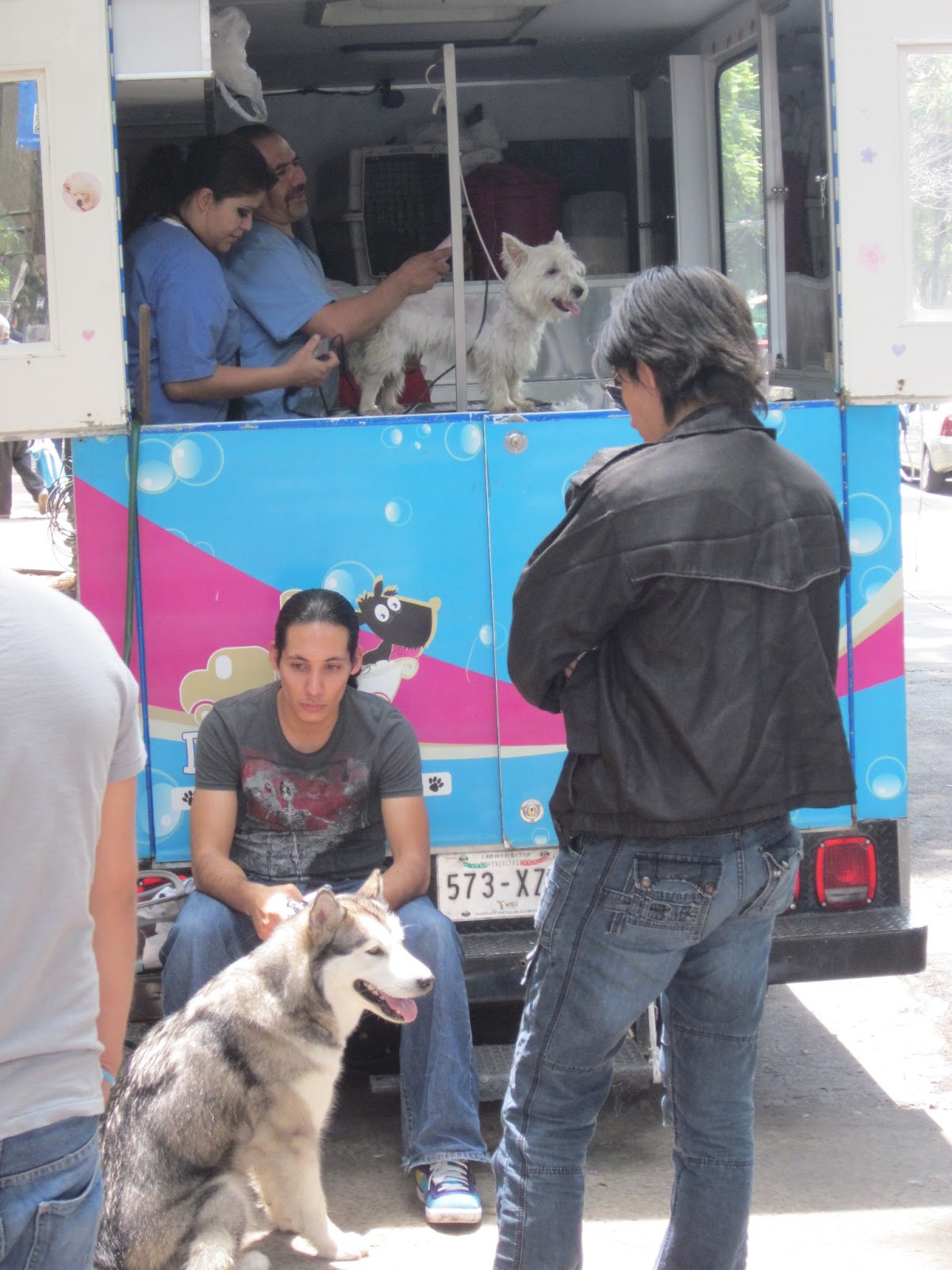
People unable to find a "formal job" try to make a living any way possible—from selling something in informal street markets to doing odd jobs. On Saturdays a street market of probably fifty puestos (stalls) is set up on America, a major street near our apartment in an upper middle-class neighborhood of Coyoacán.
Moreover, our days are punctuated with the arrival of peddlers hawking their wares—the knife-sharpener man with his pushcart blows a distinctive whistle. A steam whistle announces the arrival of the peddler selling roasted sweet potatoes. But our favorite is the young man who peddles a three-wheel bicycle cart loaded with steaming pots of tamales, all the while singing out, "
Tamales oaxaceños, tamales calientitos" (tamales Oaxaca-style, wrapped in banana leaves; '
calientitos'—'little' hot tamales).
Note:
-ito is the diminutive form widely, affectionately used in Mexico.
These street entrepreneurs are all part of the informal economy. Few Mexicans would say they are "unemployed", and official "unemployment" statistics are low. But as the report points out, these "facts" are deceptive.
There's more....
For many generations, the only things many Mexicans have had any control over was their personal pride and dignity. Despite the diminished social and political status and never-ending poverty that accompanied arrival of the Spanish, ordinary Mexicans have maintained an extraordinary sense of pride exercised with a quiet dignity.
Mexico's poet-activist Javier Sicilia tellingly named the movement he founded in response to the drug cartel-directed murder of his son in Cuernavaca, the "Movement for Peace with Justice and Dignity". Recently, grassroots activist Gustavo Esteva titled
"Karama", or "The issue is
dignity", a column he wrote for the newspaper
La Jornada, in which he assessed the country's economic shortcomings.
Astute cultural observers take note in Mexico of a need to maintain face that is remarkably similar to the cultural trait usually associated with Asia. A Mexican friend whose grandfather is Japanese, once commented to me that Mexicans feel a strong affinity with Japan, which they enjoy visiting because they feel so comfortable with Japanese culture.
For those of us raised in the U.S. and in the Northern European tradition, dignity is perceived to be an internalized trait—something we maintain in the face of any kind or degree of humiliating or insulting behavior. In this sense, dignity is more our private 'take' on ourselves than anything based on or requiring respect from others.
It is different in Mexico. Here, dignity and respect not only go hand-in-hand, but they are both very public. In general, Mexicans tend to feel strongly the need to receive specific, positive respect from others.
We witnessed this when an architect visited our house in Pátzcuaro to assess some repairs. He addressed our handyman deferentially as 'Don' Ramón, which surprised us. [The Spanish honorific 'Don' is used to show respect.] We tend to treat everyone equally and with respect, so we were taken aback by this formal show of respect.
Even the lowest status workers expect to be accorded careful respect. Their pride in their work is expressed in the oft-heard phrase, "
Es mi trabajo" (It's my job). Hearing it, I am always struck by the 'quiet dignity' with which it is spoken, and the way the phrase seems to communicate—to my ears—a sense of personal mastery of the work that makes it worthy of respect.
Now it gets tricky....
A well-known U.S. business and cultural consultant writes about the challenges of giving feedback in Mexico. Timely, accurate feedback is an absolutely essential requirement, of course, for maintaining efficient production and quality control. He writes:
Unfortunately for U.S. businesses in Mexico, the hierarchical, authoritarian nature of Mexican society, going back centuries, has meant that presenting anyone with "negative feedback" of any kind—"from revealing mistakes, being the carrier of bad news, to criticizing or questioning a plan or project—[has generally been] considered disrespectful and [hence] taboo."
My reaction upon reading those words? Wow!
Meanwhile, Back in Jenny's Kitchen....
All of this has given me a richer understanding of the team of tradespeople working in our apartment. Their sense of ownership over their projects makes much more sense now.
But one challenge remains. Pulling the refrigerator out to lay down new tiles is a perfect opportunity to pull out and clean the vegetable drawers at the bottom. I can't usually open the door all the way, because the kitchen cabinets are in the way.
Speaking of cultural preferences, as the daughter of a Dutch mother, I prefer to use a solution of baking soda and water to wipe down the refrigerator. Given my heightened understanding about Sandra's work and her pride in how she performs it, how might I suggest the baking soda-water solution as the preferred cleaning agent?
After thinking it over, I've decided to explain that "in my country, we have the tradition of cleaning the refrigerator with a baking soda-water solution. I wonder whether we might use this solution today...."
It's a formal Spanish structure that gives Sandra control over the decision. Wish me luck!
Still Curious?
Here's Jenny's 2011 post on Mexico's informal economy:
Mexico Traditions: Vibrant Informal Economy.
Mexican bureaucracy developed in response to the same conditions. See Jenny's post
Bureaucracy: Encountering Labyrinths of Power.
On his
Mexico Voices blog, Reed posted these just-released reports on the vulnerable status of workers and of children (translations, with links to original articles in Spanish).
Sixty percent of Mexican workers are on subcontracts
Fifty-five percent of Mexican workers are in the "informal economy"
Half of Mexican workers earn less than $10 per day
Five out of six Mexican children are poor or vulnerable
Children living on the streets
Boye Lafayette De Mente's,
Mexican Etiquette and Ethics: Understanding Mexican Social and Business Behavior (1996) is a little dated now, sixteen years after publication; nonetheless, this little book has useful insights. Let me urge you to read it cautiously, skeptically, always asking,
"How well does this point jibe with my personal experiences? What impact might Mexico's entry into the 'global economy' be having on this point?"