Showing posts with label Diego Rivera. Show all posts

Tuesday, December 29, 2015

Mexico: Culture and Public Education

The article translated below calls for some historical and cultural context. My insightful Spanish teacher once commented, "First you have to learn how to read the Spanish, then how to read between the lines." These introductory remarks are intended to help you read between the lines of Hermann Bellinghausen's culture-rich article.
The headline itself—Culture and Education—refers to the quite recent passage of congressional legislation granting secretariat status to the National Council for Culture and Arts (Conaculta). Initially established in 1988 as a decentralized agency of the Secretariat of Public Education (SEP), Conaculta was put in charge of the nation's museums and monuments, promoting and protecting the arts (visual, plastic, theatrical, musical, dance, architectural, literary, televisual and cinematographic), and managing the national archives. The new Secretariat of Culture is the 'easy divorce' mentioned in the article.
The ongoing struggle between the government and the so-called "dissident wing of the teachers' union" alluded to in the article is yet one more example of a stubborn fracture between the country's political and cultural elite (los de arriba, those from above) and everyone else (los de abajo, those from below; most especially the rural underclass served by the 'dissident' teachers).
Next is the controversial 2013 Education Reform regarded by many observers as the government's attempt to regain control over the teaching ranks rather than as a reflection of official desire to implement a reform of teaching methods or a reform of the country's notoriously poor infrastructure in public schools, especially those in rural, often indigenous remote areas.  
The article's historical references aren't chronological, but thematic. Historical context, however, relies on chronology, so here's the short version starting from Mexico's Independence from Spain, confirmed September 16, 1821:
  • Reform Era 1855-1876: Attempting to recover from the more than a decade-long struggle (1810-1821) for independence, the fledgling country was nonetheless strongly divided between two broad groups: Liberals and Conservatives. 
Conservatives favored a strong centralized government, with many wanting a European-style monarchy. They also favored protecting many institutions inherited from the colonial period, including tax and legal exemptions for the Catholic Church and the military. 
Liberals favored establishment of a federalist republic based on ideas coming out of the European Enlightenment, with limits put on Church and military privileges. Until the end of the Reform period (1876, when Porfirio Díaz was elected President), Mexico’s history was dominated by these two factions vying for control and fighting against foreign incursions at the same time; i.e., Mexican-American War, 1846-47; French Intervention (aka Maximillian Affair), 1861-67.
  • Maximilian: Ferdinand Maximilian Joseph (born 1832, Vienna, Austria; died 1867, near Querétaro, Mexico), archduke of Austria and emperor of Mexico from 1864 to 1867, when he was executed. Maximilian's naive liberalism proved unequal to the international intrigues that had put him on the throne and to the brutal struggles within Mexico that led to his execution.
  • Benito Juárez (born 1806, in a Zapotec pueblo in Oaxaca; died 1872, Mexico City), national hero, President of Mexico (1861–72) and the country's only indigenous (Zapotec) President. For three years (1864–67), Juárez fought against foreign [French] occupation under the emperor Maximilian and sought constitutional reforms to create a democratic federal republic. Juárez's followers are known as Juaristas.
  • Porfirio Díaz (1830-1915), President of Mexico (1876-1911). The thirty-year period of Díaz's reign is known as the Porfiriato. A controversial figure in Mexican history, Díaz commands villain status among the revolutionaries who overthrew him, but he is something of a capitalist hero in the business community. The Porfiriato was marked by significant internal stability (known as the "paz porfiriana"), modernization and national economic growth—due in part to heavy investment in mining and railways by U.S. and British business. Porfiriano refers to features that resemble Porfirio.
Díaz's regime, however, grew unpopular due to civil repression and political stagnation. His economic policies helped a few wealthy estate-owners acquire huge areas of land, but they left rural campesinos (small, indigenous and mestizo farmers) unable to make a living. The resulting job shortage and depressingly low wages for the Mexican peasantry was a direct, precipitating cause of the Mexican Revolution.
  • Bola, (lit. ball) was a popular 19th century term used to evoke popular, unorganized uprisings; hence, 'la Bola de 1910' is an indirect reference to the rabble-rousing 1910 outbreak of the Mexican Revolution that would convulse Mexico until 1917, with scattered uprisings continuing into the 1930s.
  • Lázaro Cárdenas (born 1895; died 1970), general in the Mexican Revolution and an able statesman, President of Mexico 1934-1940, Cárdenas is perhaps best known for nationalizing the oil industry in 1938 and creating the government oil monopoly, Pemex. 
Early on, Cárdenas distanced himself from his presidential predecessor, establishing legitimacy and power in his own right. His administration overhauled the agrarian reform of the agricultural sector begun by the Mexican Revolution, created ejidos—lands owned and worked collectively by peasants; and strengthened the system of Public Education. Notably, Lázaro Cárdenas surrendered complete power to his successor at the end of his presidential term in 1940.
Two cultural references complete this introduction:
  • 'The' Mexican Epic Novel. Mariano Azuela, Los de Abajo (1915), The Underdogs  [available in transl.], is based on the author's experiences as an Army doctor during the Revolution. Los de Abajo is regarded by many as the quintessential Mexican epic novel or, as historian José Luis Martínez explains:
“The novel of the Revolution had its roots in the appearance at the end of the 19th and at the beginning of the 20th century of such works as: La bola (1887) by Emilio Rabasa; La parcela, The [Indigenous Farmer's Tiny] Plot (1898) by José López Portillo y Rojas, and Federico Gamboa's theater piece, The Serf's Revenge (transl.), La venganza de la gleba (1905)."
  • Silvestre Revueltas (born 1899, Durango; died 1940, Mexico City) was a Mexican composer of classical music, a violinist and a conductor.
La Jornada: Hermann Bellinghausen*

Invoking culture with your mouth full is an old nineteenth-century habit that, in a manner of speaking, always presents Conservative (realistic, imperial, Porfiriano[1]) and Liberal sides. From the beginning, the Liberal side encouraged the idea that the young Nation deserved to be instructed, enlightened, educated. Works of creation and thought were undertaken with that perspective in mind. Members of the nineteenth century Liberal or Juarista[2] generation took on the role of being the Nation's teachers in a broad and profound sense.

This Liberal generation sought to put knowledge into circulation through creation, chronicles and pedagogy. When Guillermo Prieto [poet, 1818-1897], Ignacio Manuel Altamirano [lawyer, teacher, journalist, essayist, politician, 1834-1893], Ignacio Ramírez [writer, poet, journalist, lawyer, atheist, and political libertarian, 1818-1879], even Vicente Riva Palacio [liberal politician and intellectual, 1832-1896], invoked knowledge—they were thinking not of the Athenians but of the Mexicans, for the benighted commoners that they were.

Battered by the disorder accompanying Independence from Spain [1810-1821], the neoclassical tradition recomposed itself in schools and private salons, directing their tastes and aspirations toward Europe, namely France, seeking acceptance in the longed for royal courts .... The Hapsburgs had settled in Austria, and good for them.

There were those who dreamed of "restoring them" here and brought Maximilian[3], the first neocolonial experiment in what the 21st century now seems to be achieving—even though petty tyrants and managers are deemed good enough for the current globalism. These "restorers"—for descriptive purposes, let's brand them Conservative (they always consider themselves "modernizers")—often have neither any clear idea of who "the pueblo" [refers both to the people and their village] are, nor do the people awaken in Conservatives any interest greater than as folkloric ornamentation.

The Liberals had a stereotyped and general, but nonetheless generous, idea. Inspired by the egalitarianism of the revolutions in France and the United States, they nurtured the ideal of making us all equal. Mid-nineteenth Mexico remained overwhelmingly indigenous. Where it wasn't, it was dominated by a mestizaje [mixed heritage, mestizo] that descended mainly from the indigenous side, either for being rural or for belonging to the nascent working class that for practical reasons Karl Marx began studying in England. It all had to do with one thing: Mexicans. Plurality, multiculturalism and diversity were not fashionable concepts.

With the positivists, "scientists" and generals influenced by the Porfiriato, education and culture were concentrated in the male minority that could choose to attend Preparatory [High] School. Although by the end of the 19th century, the Catholic Church was at a low point, what it or the State didn't teach wasn't taught by anyone. The ideals of the Reforma[4] became accustomed to academicism, modernist manners and decadent bohemianism.

La Bola de 1910[5] disrupted the prolonged siesta. Moreover, to the dismay of the (more rancid than ever) aristocracy, it brought to the forefront the ignorant, the uneducated, the rabble.

But they [the people] were noticed by a new generation of painters, writers, thinkers, lawyers, composers and educators who not only noticed them, they joined or led them. Guided by the steady, intelligent hand of José Vasconcelos [Secretary of Public Education, 1921-24], they threw out the culture in order to educate the nation. This time the people came: their history was The History. 

The murals of Diego Rivera [Mexican Muralists[6]] and the epic fiction[7] coincided with [post-Revolution] labor laws and land reform. Education and culture, together, became a crusade that during the Cárdenas[8] era would be heroic, with background music by Revueltas[9]. And what did the Right do with the teachers? It turned a deaf ear to them.

Independent of the progressive corruption, decadence and institutionalization that hollowed out and emptied this "popular" discourse of any meaning, government rhetoric was nonetheless nourished by this Mexico of the redeemable masses and, in fact, held on to it well into the 1970s.

Beyond the inertia, however, education was culture, and culture, didactic or not, was education—at least in the regulations. Free textbooks were an established fact. From the office [Secretary of Public Education] occupied by José Vasconcelos [1921-24] and, later, by Jaime Torres Bodet [1943-46], they continued administering not just bilingual elementary education and literacy, but the fine arts as well with publishing projects, historical and archaeological conservation, museums, ethnological research. The two faces of Janus that the country was not able to separate.

There followed a deviant period (today's so-called neoliberal cycle, still underway) where the elite cultural sphere obtained niches of power and well-being, guaranteed their creative freedoms and economic solvency, with passports necessary for the market of prestige. Meanwhile, education itself—in the minds of its administrators, public education—is thrown in the garbage heap. The education priority passed into private hands, extremely conservative and wealthy. (It is appropriate to recognize the role of public universities in resisting full dismantlement.)

The easy divorce that the neoliberal State has finally imposed between education and culture[9] rounds off the distance from high culture, corporatized by the soft path, with what relates to the eternally educable masses who [they say] are better off with a new TV [Mexico is currently switching to digital TV and the government is providing free TVs to those on welfare programs] and a bag of cookies than with a book.

When the bottom falls out of the long, but fragile dream of fairs, festivals, awards, scholarships, complete works and retrospective exhibits, the Culture will come around to bumping up once again against the stubborn people, those dark-skinned and bedraggled hicks.

What do they think? Sometimes the people think, believe, organize and educate themselves in autonomy. It comes from below, the same as their original roots. This is less likely to evaporate into the air. Spanish original

*Hermann Bellinghausen (born Mexico City, 1953) obtained his medical degree from the National Autonomous University of Mexico. He has been a contributor to the Mexican weekly magazines En Solidaridad [In Solidarity] and Mundo Médico [Medical World]. As editorialist and correspondent, he covers the state of Chiapas and the activities of the Zapatista Army of National Liberation (EZLN) for La Jornada.

Footnotes:
[1] Porfiriano: Reference to Porfirio Díaz (1830-1915), President of Mexico (1876-1911). The thirty-year period of Díaz's reign is known as the Porfiriato. A controversial figure in Mexican history, Díaz holds villain status among the revolutionaries who overthrew him, but he is something of a capitalist hero in the business community. The Porfiriato was marked by significant internal stability (known as the "paz porfiriana"), modernization and national economic growth—due in part to heavy investment in mining and railways by U.S. and British business.
The Díaz regime grew unpopular, however, due to civil repression and political stagnation. His economic policies helped a few wealthy estate-owning hacendados acquire huge areas of land, but they left rural campesinos (small, indigenous and mestizo farmers) unable to make a living. The resulting shortage of jobs and depressingly low wages for the Mexican peasantry was a direct, precipitating cause of the Mexican Revolution. 
[2] Juarista: Followers of Benito Juárez (born 1806, in a Zapotec pueblo in Oaxaca; died 1872, Mexico City), national hero, president of Mexico (1861–72) and the country's only indigenous (Zapotec) president. For three years (1864–67), Juárez fought against foreign occupation under the emperor Maximilian and sought constitutional reforms to create a democratic federal republic. 
[3] Maximilian: Ferdinand Maximilian Joseph (born 1832, Vienna, Austria; died 1867, near Querétaro), archduke of Austria and emperor of Mexico from 1864 to 1867, when he was executed. Maximilian's naive liberalism proved unequal to the international intrigues that had put him on the throne and to the brutal struggles within Mexico that led to his execution.  
[4] Reform Era 1855-1876: Attempting to recover from more than a decade (1810-1821) spent fighting for its Independence from Spain, the fledgling country was nonetheless strongly divided between two broad groups: Liberals and Conservatives. 
Conservatives favored a strong centralized government, with many wanting a European-style monarch. They also favored protecting many institutions inherited from the colonial period, including tax and legal exemptions for the Catholic Church and the military. 
Liberals favored establishment of a federalist republic based on ideas coming out of the European Enlightenment, with limits put on Church and military privileges. Until the end of the Reform period (1876; with Porfirio Díaz's election), Mexico’s history was dominated by these two factions vying for control and fighting against foreign incursions at the same time; i.e., Mexican-American War, 1846-47; French Intervention, 1861-67.
[5] Bola, (lit. ball) was a popular 19th century term used to evoke popular, unorganized uprisings; hence, 'la Bola de 1910' is an indirect reference to the rabble-rousing outbreak of the Mexican Revolution in 1910 that would convulse Mexico until 1917, with scattered uprisings continuing until 1920.
[6] Diego Rivera, José Clemente Orozco and David Alfaro Siqueiros are the three great Mexican Muralists.
[7] 'The' Mexican Epic Novel. Mariano Azuela's Los de Abajo (1915), The Underdogs  [available in transl.], is regarded by many Mexicans as the quintessential Mexican epic novel. It is based on the author's experiences as an Army physician during the Revolution. Historian José Luis Martínez explains:
“The novel of the Revolution had its roots in the appearance at the end of the 19th and beginning of the 20th century of such works as: La bola (1887) by Emilio Rabasa; La parcela, The [Indigenous Farmer's Tiny] Plot (1898) by José López Portillo y Rojas, and Federico Gamboa's theater piece, The Serf's Revenge (transl.), La venganza de la gleba (1905)." 
One other novel deserve mentions: Carlos Fuentes' The Death of Artemio Cruz (La muerte de Artemio Cruz, 1962), is today "widely regarded as a seminal work of modern Spanish American literature". The novel begins with the titular protagonist on his deathbed; the story of Cruz's life is then filled in by flashbacks. Cruz is a former soldier of the Mexican Revolution who has become wealthy and powerful through "violence, blackmail, bribery, and brutal exploitation of the workers". The novel explores the corrupting effects of power and criticizes the distortion of the revolutionaries' original aims through "class domination, Americanization, financial corruption, and failure of land reform".
[8] Lázaro Cárdenas (born 1895; died 1970), general in the Mexican Revolution and an able statesman. President of Mexico from 1934 to 1940, Cárdenas is perhaps best known for nationalizing the oil industry in 1938 and creating the government oil monopoly, Pemex. 
Early in his presidency, Cárdenas distanced himself from his predecessor (forcing him into exile) and establishing legitimacy and power in his own right. Overhauling the agrarian reform of the agricultural sector begun by the Mexican Revolution, the Cárdenas administration created ejidos—lands owned and worked collectively by peasants; and strengthened the Public Education system. Notably, Lázaro Cárdenas surrendered complete power to his successor at the end of his presidential term in 1940.
[9] Silvestre Revueltas (born 1899, Durango; died 1940, Mexico City) was a Mexican composer of classical music, a violinist and a conductor.

For more on Bellinghausen's last point—"Sometimes the people think, believe, organize and educate themselves in autonomy"—see Green Shoots.

Wednesday, July 25, 2012

Diego Rivera-Frida Kahlo: 'Twin Houses' Designed by Juan O'Gorman

Nothing Diego Rivera nor Frida Kahlo did was remotely conventional. So when Diego set out to build a house to be shared with his wife, Frida, in Colonia San Ángel, it is not surprising that he asked his friend and fellow muralist, the young architect Juan O'Gorman, to design it.

A recent graduate of the National Autonomous University of Mexico, O’Gorman began his architectural career designing spare, rectilinear houses and buildings in the style of the Functionalist architect Le Corbusier. The result: completion in 1932 of the Casas Gemelas, Twin Houses. Diego's is the white house; Frida's is the blue. A bridge famously connects the two houses. The building is distinguished for being one of the first constructed in the Functionalist style in Latin America.

'Twin Houses' of Diego Rivera (white) and Frida Kahlo (blue) famously connected by a  footbridge!
The cactus fence that separates the property from the street is traditional.  Photos: Reed
Functionalism sought to meet the basic needs of its users, but it was also a movement that was in rebellion against the excessive ornamentation of earlier periods—a stylistic change made abundantly clear to us during our recent visit to the Colonia of San Ángel, due west of Coyoacán. As in Coyoacán, the dominant architectural style in San Ángel is Spanish Colonial.

Ornate Spanish Colonial door—the very ornamentation the Functionalists rebelled against.
We were amused that the blue and Teotihuacan red are the same colors used at the Twin Houses.
As we approached the property, the contrast with Colonial Spanish architecture was dramatic.  Remarkably, the house is not particularly jarring aesthetically, perhaps because of the traditional Mexican cactus fence that separates the house and property from the street.

Historical Context

When the Mexican Revolution (1910-1920's) finally wound down, it was time not only to rebuild the country but to generate a new image of unity and change. An earlier post discussed Diego's time in Europe and his return (1921) to Mexico at the request of President Obregón and Secretary of Public Education Vasconcelos in order to develop a public art to foster national identity. Diego threw himself passionately into the work, which resulted in what is recognized today as the Mexican Mural Movement.

It makes sense that all the arts would be called upon to contribute to this national project. As a new architectural concept, Functionalism seemed to serve not only these interests, but the needs of a new generation as well. Not only did the Functionalists seek to use new construction materials (cement, glass and metal), but they tended toward an aesthetic that was industrial and modern—an aesthetic that could open the door to new construction methods and new styles of life for a new age.

Diego Rivera's Studio at Casas Gemelas

One enters the property facing Diego's House. When I saw the ascending spiral, I immediately thought of Frida's severe mobility issues and thought, "Oh, this is great—no stairs!"
Spiral Entryway to Diego Rivera House-Studio
But I was wrong! 
Spiral Staircase.
On both first and second floors, doors open from landings to give entry to the house. All I could think was, "How on earth did Frida Kahlo—with her serious mobility issues—ever manage these stairs?" The short answer is, "She didn't—or at least, she didn't for very long."

Walking into Diego's studio, I had an unexpected—and very positive—visceral reaction to the space. The studio is two stories tall, and the light is extraordinary. The east wall is glass, but light also enters the room from windows mounted in soffit-like structures next to the roof. The effect is nearly indescribable—diffuse yet remarkably full.

Diego Rivera's Studio—hardwood floors, floor to ceiling windows, and full of Diego's collected objects.
The hardwood floors are brilliantly waxed. I had the feeling the artist was expected to return at any moment.
Diego's Studio is upstairs; in the window are Judas figures (described below).
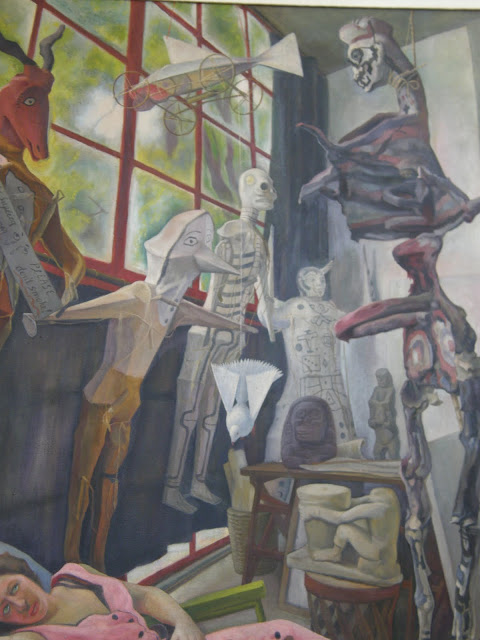
Diego had a vast collection of papier mache Judas figures (ritually burned the night of Easter Sunday) and calaveras (skeletons).
Judas figure, part of the collection in Diego's Studio
Calaveras, skeleton, figures in Diego's Studio

Lovers of everything 'Mexican', Diego and Frida collected prehispanic pieces (about 59,000!); folk art from all parts of Mexico; judas and calaveras figures; and many juguetes (toys, miniatures). 

Many prehispanic pieces are now in the garden of Frida Kahlo's Casa Azul, Blue House, in Coyoacán, but the majority of the pieces are housed in the Diego Rivera Anahuacalli Museum, also in Coyoacán.

One exception is this object exhibited in Diego's studio. It must have been in the studio when Rivera was alive because it appears in the painting he made of his own studio (below).


Cha'ac mool, prehispanic altar for sacrific

Diego's painting of the jumble in his studio, including the cha'ac mool (bottom right), calaveras, judas figures, and a beautiful, reclining woman—possibly Dolores Olmedo?

Rivera's painting of his studio
In this studio Diego Rivera painted over 3,000 portraits and portrayals of everyday Mexican life. Of Rivera's style, it has been noted:
Rivera defines his solid, somewhat stylized human figures by precise outlines rather than by internal modeling. The flattened, simplified figures are set in crowded, shallow spaces and are enlivened with bright, bold colours. The Indians, peasants, conquistadores, and factory workers depicted combine monumentality of form with a mood that is lyrical and at times elegiac.
Paintings by Diego Rivera: 
Indigenous Woman
Niña, little girl
Diego lived and worked in his house until his death in 1957.

Frida Kahlo at Casas Gemelas

When in 1934 Diego and Friday returned from a three-year stay in the United States, they moved into Diego's house. Frida lived and painted there for six years. I actually asked a guard how on earth Frida managed all the stairs. The guard smiled as she answered—clearly, it was not the first time she had answered the question!  She said that Diego had full-time help whose job it was to make it easier for Frida to move around the house.

Frida Kahlo at Casas Gemelas
But Frida did important work at the Casas Gemelas, including her paintings Lo que el agua me dio (What the water gave me), El ojo avizor (The Lookout), and El difunto Dimas (Dead Dimas). Only one of Frida's paintings remains in her house at Casas Gemelas:
Frida painted this surreal set of images from her point of view while sitting in the bathtub. Her feet are reflected in the water. The Empire State Building rises from an erupting volcano; diagonally to the left is one of her corseted dresses...she lies nude beside it. Her German father and Mexican mother are portrayed standing (lower right) slightly to one side of a couch where Frida reclines with a woman (Frida was bisexual). 

Days after her father's death in 1941, Frida moved back to the Casa Azul in Coyoacán, where she had grown up and where she died in 1954.

Still Curious?

Related Jenny's posts:
Interesting discussion of Diego Rivera's impact on public art in the United States.

Reed's annotated photo album of our visit to the Colonia San Ángel.

Thursday, March 22, 2012

Sunday in Xochimilco: Museo Dolores Olmedo

Every once in awhile, a visit to a new museum just plain knocks our socks off! It happened to us recently. The occasion was our daughter's visit from Chicago, but the museum had long been on our list of Places to Visit.

Similar to our experience at the Frida Kahlo Museum in Coyoacán, stepping through the gate took us into another world. The gardens are magnificent.

Driveway up to the house. The iron gates are usually open.
(Photo: Museo Dolores Olmedo) 
In 1962 the Mexican philanthropist, art collector and businesswoman, Dolores Olmedo, bought the rundown, sixteenth century, 8-acre property in Xochimilco known as Hacienda La Noria. She immediately set out to restore its buildings and gardens—an undertaking uniquely suited to Dolores' capabilities as businesswoman, art connoiseur and collector.

House from across the gardens
(Photo: Museo Dolores Olmedo) 

Upon her death in 2002, the estate of Dolores Olmedo was dedicated to making her collections available to the public:
  • Precolumbian art (600 pieces certified by the National Institute of Anthropology and History), 
  • Frida Kahlo paintings (25), 
  • Diego Rivera works (45), 
  • Popular art and 
  • Library (4,000 volumes). 

Approaching Chapel and Museum 
(Photo: Museo Dolores Olmedo)
The gardens feature more than twenty-five varieties of Mexican plants and trees. Ducks and turkeys roam large, attractive pens landscaped with plants and ponds. A flock of splendid peacocks parade through the gardens. When a male displays—or, as happened, when three males in a row simultaneously all decide to display—onlookers gasp with excitement and delight.

In a large, comfortable pen, about a dozen of the nearly extinct breed of Mexican hairless hunting dogs called xoloitzuintles make their home. They move across well-worn paths. When they catch sight of something, they stand stock still...at attention.

Xoloitzuintles (Mexican Hairless Hunting Dog).
Notice stance of dog in background...standing stock still.
(Photo: Kyla's iPhone)
A bronze statue of one proud male adorns their pen. Until one moved, I thought they were all statues. I doubt I'm the only one who has made this mistake! Their color is similar to the bronze statue, and when they stand still...not a magnificent muscle moves. Remarkable!

More Xoloitzuintles
The Museum also sponsors cultural events, including Sunday afternoon concerts held outside. We heard an excellent band of young people playing Mexican music. In addition to marimba and mandolin, the band also had four psalteries—a stringed instrument held on the lap.

Four Psalteries gave the music a sound that we in the U.S. might describe as 'mountain' music. The  result was absolutely delightful! The audience sang along with many songs.   

Dolores Olmedo (1908-2002)

Born two years before the onset of the Mexican Revolution (1910-1920), Dolores Olmedo was a real personaje (character)—businesswoman, philanthropist, art collector. Her mother, widowed by the untimely death of Dolores' father, supported her family as an elementary school teacher. Like many others, the family suffered through food shortages as the Revolution ground on and on—an experience that undoubtedly marked Dolores for life.

After the Revolution, the arts in Mexico enjoyed a renaissance with a distinctly foreign flavor  reflective of new ideas arriving from the United States and the capitals of Europe. These foreign influences also had a profound effect on Mexico's cultural and scientific mentality, giving rise to a new generation espousing new values focused on social injustice, strategies for building a society based on a nascent nationalism, and conceptualized in terms of progress and development.

Dolores studied art at the Academy of San Carlos—the same school attended by the 'Big Three' of Mexican Muralists: Diego Rivera, José Clemente Orozco and David Alfaro Siqueiros. She also studied music at the National Conservatory.

Mexico's Artistic Elite

About 1924, Dolores met Diego Rivera while he was working on his murals at the Secretaría de Educación Pública. It was primarily a friendship based on their shared artistic interests, but Rivera also asked Dolores' mother for permission to have Dolores pose for him. Permission granted, she posed more than a hundred times for the artist, whom she held in the highest esteem.

Portrait of Dolores Olmedo (Oil on canvas)
Diego Rivera (1955)
Collection, Museo Dolores Olmedo
Source:  http://www.diegorivera.com/gallery/dolores.html
As with most of Rivera's friendships, theirs was to have its highs and lows. At one point, Dolores distanced herself from Rivera for several years, but in 1955 she and Rivera renewed their ties and were practically inseparable until his death two years later. Aware that he would soon die, during this time the great muralist named Dolores trustee of his estate. 

During this time, Rivera, himself a renowned collector of precolombian art, guided Dolores through several important acquisitions. Her collection of 600 objects is on exhibition at the Dolores Olmedo Museum in Xochimilco. Rivera also guided Dolores in the purchase of several paintings both by Frida Kahlo and by himself. These paintings are important exhibits at her museum.

Meanwhile, in 1930 Dolores had met the Englishman Howard S. Phillips, founder and editor of Mexican Life, a magazine focused on the arts and  tourism. They were married in 1935. Although they eventually divorced amicably, during their marriage Howard and Dolores moved in Mexico's elite circles of the arts and culture.

Business Woman

In order to support her family, Dolores turned her talents to the business world. Her business instincts were superb. She identified and turned to her advantage the construction boom that accompanied the country's post-Revolution development agenda.

With great difficulty, she borrowed money to purchase a brick factory. In a canny move, she formed a partnership with the owner of the brick factory next-door to hers, the German Heriberto Pagelson. Together they purchased additional brick factories, which became enormously profitable.

Similarly, Dolores allied with an adobe maker, again capitalizing on the country's construction boom. Needless to say, her success was extraordinary at a time when few Mexican women participated in entrepreneurial activity, let alone achieve such success in the male-dominated construction industry!

Still Curious?

The Museum's web site is excellent, including a description in English.  For the best photos, go to the Spanish site where, below the GoogleMap, is a series of photos. Click to access, then Scroll Down one row—voilá!—superb photos of the Museum grounds. Here's the link:  Dolores Olmedo Museum.

Excellent description in English with link to Spanish: http://www.myhero.com/go/hero.asp?hero=Dolores_Olmedo_Patino

Link to Wikipedia entry (Spanish):  http://es.wikipedia.org/wiki/Dolores_Olmedo

Note to Readers: 
Jenny's Journal is beta testing the new Google+ Dynamic View template. We're already excited about the results. Daily visits have more than doubled! 
Click on Tips for Navigating in New Template for ideas on how to tailor your visit to your preferences. 
Use Comment feature located at bottom of post to tell us about your experience with the new template.   
BTW - The moving gears mean processing. Dynamic View can sometimes be slow to load. Use Send feedback in white box at bottom right corner to send technical issues directly to the Google+ Technical Support Team.

Saturday, February 4, 2012

Diego Rivera: European Apprenticeship & Mexican Homecoming

In 1907, at age 21, Diego's paintings caught the eye of the governor of the state of Veracruz, who awarded him a traveling scholarship. The award enabled him to travel to Europe. For the first two years, he studied with Eduardo Chicharro in Madrid, Spain. From Spain he moved on to Paris, to live and work with the great gathering of artists in Montparnasse, including Modigliani.

View of Toledo, Diego Rivera, 1912 -  Cubist elements are evident even before the artist moved to Paris.

Diego returned to Mexico only once for a brief visit in 1910, just before the outbreak of the Mexican Revolution that lasted for the next decade and whose violence devastated the country. Diego spent the years of the Mexican Revolution in Paris studying and working—and occasionally showing his work. 

Amedeo Modigliani's portrait of Diego Rivera (1914).
In those years, Paris was witnessing the beginning of cubism in the paintings of such eminent painters as Pablo Picasso and Georges Braque. From 1913 to 1917, Rivera enthusiastically embraced the Cubist school of art.

Paisaje zapatista. El guerrillero (Zapatista Country: Guerrilla Fighter), Diego Rivera, 1915.

But in 1917, Rivera shifted toward Post-Impressionism—inspired by Paul Cézanne's paintings and attracted by the simple forms and large patches of vivid colors. His paintings began to attract attention, and he was given even more opportunities to show his work.

Still Life, Diego Rivera, 1918. The style reflects the influence of Rousseau and Cezanne. 
The Outskirts of Paris, Diego Rivera, 1918 -- In the Post-Impressionist style of Rousseau and Cezanne. 
In 1920, at the urging of Alberto J. Pani, Mexican ambassador to France, Diego spent time in Italy studying the work of the Renaissance fresco masters, including Giotto, Uccello, Piero della Francesca, Mantegna and Michelangelo.  

Viewing their masterpieces first-hand had a profound impact on Rivera's artistic sensibility—leading him to integrate his two main passions: the Post-Impressionist use of simple shapes and vibrant colors to represent realist subjects, and the application of paint to walls to create textured frescoes. In Italy, Diego laid down the artistic foundation for what would become the Mexican Mural Renaissance (described below). 

Mesoamerican Influences

But Rivera didn't limit his study to the European tradition. To ground his art in Mexico's history, Rivera studied Mesoamerican painting and portraiture—very likely before he left for Europe at age 21. I haven't been able to find objective confirmation of my intuitive sense that Diego's friend and mentor, the engraver-illustrator-political cartoonist José Guadalupe Posada might have suggested this direction to Diego, but it is difficult to ignore Posada's probable role.

An earlier post on Jenny's Blog discusses José Posada's work and its influence on the young Diego. Meanwhile, the fact remains that over his lifetime Diego collected thousands of precolumbian artifacts now housed at his Anahuacalli Museum in Coyoacán, Mexico City. 

Rivera's murals have a specific and unmistakable Mesoamerican feel for geometric shapes and use of colors. From Maya stele (stone columns on which were sculpted glyphs that recorded a ruler's deeds), Rivera acquired the powerful, yet challenging idea that a mural should tell a story rather than simply present an image—a concept strongly reinforced by Posada's body of work. 

Mexico's Revolution Winds Down  

With the election in 1920 of Álvaro Obregón Salido as president of the Second Republic of Mexico, the violence associated with the Mexican Revolution finally came to an end.

President Obregón appointed José Vasconcelos as Secretary of Public Education. Trained as an attorney, Vasconcelos was also an educator, writer, philosopher and politician who was serving as president of the National Autonomous University of Mexico (UNAM) prior to his appointment as Secretary. Quite naturally, Vasconcelos promoted academic freedom and freedom of thought.

But Vasconcelos also championed an educated citizenry. In pursuit of this goal, he undertook a major public education effort that included construction of over 1,000 rural schools and almost 2,000 public libraries across the country. Above all, Vasconcelos reaffirmed traditional cultural, ethical and aesthetic values as constituting the essential foundation for the emergence of Latin America as a social and political reality.

Mexican Muralism, or Mexican Mural Renaissance

It was in this political and social context that Secretary Vasconcelos and President Obregón supported development of the art movement known today as Mexican Muralism, or the Mexican Mural Renaissance—a designation that recognizes the Mesoamerican roots of the movement.

Through Ambassador Pani, Diego was in contact with José Vasconcelos. In 1921 both men encouraged Diego to return to Mexico to apply his artistic skills in service to his country.

The Mural Movement was dominated by los tres grandes (the three great ones): Diego Rivera, David Alfaro Siqueiros, and José Clemente Orozco. These artists helped to forge a new national cultural consciousness, or mexicanidad (Mexican-ness). To support their work, the government established a program of commissions for a large number of murals.

The overriding idea was that art ought to be accessible to all, and that each artist must contribute to glorifying the people's strengths and building a more egalitarian future. To this end, the painter Siqueiros wrote, "We condemn so-called easel painting and all the art produced by ultra-intellectual circles on the grounds that it is aristocratic, and we glorify the expression of monumental Art because it is public property." 

Diego Rivera: First Murals in Mexico

When Diego Rivera returned to Mexico in 1921, he was thirty-five years old. For one of his numerous autobiographies, "My Art, My Life" (1960), co-written in English with Gladys March, Diego reminisced:  

"My homecoming produced an aesthetic exhilaration which it is impossible to describe. It was as if I were being born anew, born in a new world... I was in the very center of the plastic world, where forms and colors existed in absolute purity. In everything I saw a potential masterpiece—the crowds, the markets, the festivals, the marching battalions, the workingmen in the shop and in the fields—in every glowing face, in every luminous child....   My style was born as children are born, in a moment, except that this birth had come after a torturous pregnancy of thirty-five years.“ [Emphasis added]

In this ecstatic description, Diego's enormous ego is evident ("I was in the very center...."). Equally striking is the glimpse the artist gives us of his creative imagination ("In everything I saw a potential masterpiece...").

It is the last sentence, however, that may be most significant—illuminating, as it does, Diego Rivera's awareness of the lengthy and 'torturous' artistic training that laid the foundation for what might look to the outsider as an 'instantaneous' emergence of artistic style. Not so, says the artist. One might be excused for  sensing perhaps the slightest whiff of messianic purpose as Diego describes himself assuming the role he may well have believed himself destined to perform in his country's history.   

Rivera's first murals in Mexico, titled La Creación, were made in the Anfiteatro Bolivar (Bolivar Lecture Hall) of the Escuela Nacional Preparatoria. Critics suggest that these murals are not as advanced as work done during Rivera's Cubist period in Paris—likening the style of these murals to a version of what is recognized today as Art Deco. At this point, sniff these critics, Diego's political ideas were more radical than his artistic ones.

Creación [Artística y Scientífica], Diego Rivera, Escuela Nacional Preparatoria, 1921.

In 1922 Rivera was the leading figure in the formation of a Union of Technical Workers, Painters and Sculptors whose manifesto—borrowing language of the Russian Revolutionary Constructivists—proclaimed a collective repudiation of so-called easel-painting and all art of ultra-intellectual circles in favor of art works that were both physically and intellectually accessible to the mass public. The manifesto thus reflects Diego's artistic vision—that is, the influence of José Posada's art for the people and the story-telling concept implicit on Maya stele. 

The first murals in Rivera's fully mature style were done for the east patio of the Secretaria de Educación Pública (SEP) in Mexico City. Working up to eighteen hours a day, it took Rivera just over four years to complete this gigantic series of compositions—117 fresco panels covering almost 1600 square meters of wall. The intense mental and physical effort begun by Rivera in 1923 ended early in 1928 and established the artist as a leader of the new Mexican school.

Diego Rivera: (Detail) Día de muertos (Day of the Dead), fresco, 1923-1924,  Patio de las Fiestas, SEP. 
Is Diego's debt to Posada perhaps acknowledged in this mural?
Diego Rivera: Mecanización del campo (Mechanization of the Countryside), fresco, 1926, Patio de las Fiestas, SEP.
Diego Rivera: La liberación del peón (Liberation of a peasant), fresco, 1928, Patio de las Fiestas, SEP. 

The frescoes in the Auditorium of the National School of Agriculture in Chapingo (1927) are considered by many critics to be his masterworks. The general theme of the frescoes is human biological and social development. The overall unity of the work and the quality of each of the different parts, especially the female nudes, show Rivera at the height of his creative power.

In the old hacienda chapel—now the University Ceremonies Room—is a mural by Diego Rivera called Tierra Fecundada (Fertile Land). Begun in 1924 and completed in 1927, the work covers an area of over 700 sq m (7,500 sq ft) and is divided into three parts. The left panel depicts man’s struggle to acquire land; the center panel depicts the communion between Man and Earth (an element of the Mesoamerican worldview); the right panel shows the evolution of Mother Nature. 

Keen contradictions existed between Rivera's politics and his art. His political beliefs implied opposition to the United States, but his reputation was greatly helped by North American enthusiasm and patronage. One of his finest series of murals (1929-1930)—depicting the fight against the Spanish invaders—were commissioned for the Palacio de Cortés in Cuernavaca  by the influential American ambassador to Mexico, Dwight D. Morrow. 

From the cycle: “Historia de Cuernavaca y Morelos”. Construcción del Palacio de Cortés, 1930-1931.

Rivera's own political career was both public and stormy—at times with deleterious effects on his art. In light of the history of his mother's Jewish family, he felt himself to be a natural Communist. Reflecting back on his formative years, he wrote, "My Jewishness is the dominant element in my life. From this has come my sympathy with the downtrodden masses which motivates all my work."

However, Rivera was often on bad terms with both the Mexican Communist Party and with the official Communists in the Soviet Union—resigning from and rejoining both organizations several times. Attending a conference in Moscow, he was asked to leave by the Soviet government, which branded him a 'renegade'.  

Rivera's stormy relationship with Communism is relevant to his idea of Modernism. For much of his career, Diego tried to make art that would achieve objectives aligned with those of Soviet Socialist Realism. But inside Mexico, Rivera's overriding goal was to make art that would speak directly to the Mexican people—and in the 1920's illiteracy in Mexico was widespread.

Mexican Culture: Visual and Performance (Dance, Film) Arts First—Literature Last

But illiteracy is only a piece—arguably the least interesting piece—of the story. When we were tourists in San Miguel de Allende five years ago, our thirty-something expat innkeeper (who had lived in San Miguel for several years), remarked, "Reading is not part of Mexican culture."

As a lifelong reader, I confess I am just beginning to understand the implications of her remark. If literature is one side of the cultural coin, then the visual and performance arts may be considered the other. Certainly, the exceptional creativity of Mexico's graphic arts today is readily apparent even to a casual visitor.

The woman who helped me with our house in Pátzcuaro was not educated, but she engaged creatively and enthusiastically with the paintings and artesanía in Casa Mariposa. These art objects spoke to her, and she spoke to them—this dialogue, which she shared with me, was lively, delightful, revealing.

To state the obvious: Mexican culture is highly visual; moreover, as a people, Mexicans tend to be visual and auditory learners—cultural characteristics that Diego Rivera understood all too well!

In order to make art for Mexico's common people, then, Rivera had to abandon much that was typical of Modern art—most notably, fragmentation of imagery and the disguise of appearances. But above all, he had to discipline his work to the demands of narrative—a discipline most emphatically rejected by the early Modernists.

Fortunately, story-telling was a discipline that had been enthusiastically championed by the youthful Diego's friend and mentor, José Guadalupe Posada, who conveyed to his young disciple important techniques for using images to tell stories. Many of these techniques were also embraced by subsequent Mexican Muralists—most notably, by José Clemente Orozco, who had also come under the influence of the engraver when, as a student he passed by Posada's shop and stopped for brief chats. Over time, these muralists came to regard Posada as a revered ancestor figure.


Diego Rivera's enormous talent and keen intellect also found expression in work done in the United States, where—unleashed by cultural constraints, no matter how willingly embraced—his imagination was free to explore cutting-edge social-political themes and artistic techniques. But that is for another post!

Still curious?

MOMA in New York City is exhibiting Diego Rivera "Murals at the Museum of Modern Art", which runs until May 14. In its five-week run from December 22, 1931, to January 27, 1932, the exhibit shattered MOMA attendance records. MoMA brought Rivera to New York six weeks before the exhibition’s opening and gave him studio space within the Museum, a strategy intended to solve the problem of how to present the work of this famous muralist when murals were by definition made and fixed on site.

Working around the clock with two assistants, Rivera produced five “portable murals”—large blocks of frescoed plaster, slaked lime, and wood that feature bold images drawn from Mexican subject matter and address themes of revolution and class inequity. After the opening, Rivera made three more murals.  These eight murals are the core of the current exhibit.
Excellent chronology of Diego's life, with links to paintings (dates provided):  http://www.riveraexperts.com/chrono/chrono1886.html

Good biography, including artistic influences on Diego Rivera:  http://www.diego-rivera.org/article6-diego-rivera-influences.html

Interesting discussion of how Diego's politics affected his art:  http://www.leninimports.com/diego_rivera.html#partone

Good biography of Diego Rivera:  http://www.encyclopedia.com/topic/Diego_Rivera.aspx

Monday, January 30, 2012

Diego Rivera: Artist for Mexico's People

In the Western European tradition, artists are often prophets of the future—alerting us to emerging trends. But artists also perform other roles: they can, for example, integrate and reflect back to the people a fresh understanding of their history and culture.

Mexico's complex history is fraught with conflict. Confronted by their country's complexity and conflict, the best of Mexico's artists have risen to the challenge—creating works that are not only artistically important, but culturally meaningful and revealing.

Mexico: Major Historical Forces
  • Mesoamerican agrarian civilization, based on maís (corn), gave rise to a worldview focused on the annual solar cycle (birth-death-rebirth) and the critical need to maintain equilibrio (balance) between the world of humans and the forces of naturaleza (natural-spiritual world). This worldview was expressed in unique and powerful symbolic rituals and art. 
  • Spanish Colonial Culture was imposed by Spanish soldiers and forced conversions of the people to Spanish Catholicism. The Spanish brought their symbols of power (sword) and faith (cross). The crown imposed a caste system that kept people divided from one another and fostered isolated sub-cultures rather than a national identity. This also prevented the people from developing competence in self-governance. 
  • Struggle for Nationhood. The War of Independence (1810-1821) was followed by a century of civil strife. Caudillos, military strongmen, overthrew one-another for the presidency. The country was invaded three times. Conservatives (landed elites) attempted to establish a monarchy, while liberals sought a democracy. This led to civil war (1857-61). Porfirio Díaz seized control in 1876 and held the presidency for thirty-four years. He brought stability and industrial modernizaion at the cost of violent repression. These injustices triggered the Mexican Revolution.
  • Mexican Revolution (1910-1920's):  The Mexican Revolution was a civil war that once again pitted conservatives against liberals, and peasant populists against both. The victor, Venustiano Carranza, was an upper-class conservative, but he was forced to accept some liberal and populist reforms in order to create a government under the Constitution of 1917, which is still the legal basis of the Mexican Republic.
  • Mexico under PRI (1930 -2000):  After a series of struggles between rivals for the presidency—which included assassinations—President Plutarco Elías Calles successfully substituted party rule for the competition of regional caudillos. One-party rule by the Institutional Revolutionary Party (PRI) delivered stability without democracy to Mexico for 70 years.
Into this history, in the late nineteenth century, during the thirty-four year dictatorship of Porfirio Diaz, was born a Mexican with his own complex family history. He was to come into his artistic own after the Mexican Revolution, at a time when Mexico was trying to become a modern nation—struggling to define its identity in relation to its past and to articulate a vision of its future, including its relation to the larger world. His brilliant talent, original artistic vision and prolific productivity played a central role in furthering that process.

Diego Rivera: Self portrait
Diego Rivera (1886-1957)

In 1886, Diego María de la Concepción Juan Nepomuceno Estanislao de la Rivera y Barrientos Acosta y Rodríguez was born in Querétaro, Guanajuato. On his father's side, Diego was descended from Spanish nobility. His mother was a converso, a Jew whose ancestors—residing on the Iberian Peninsula during the 14th and 15the centuries—were forced to convert to Catholicism in order to survive.

Baptized Catholic, Diego was not raised as a Jew. As an adult he was a strident atheist. Also as an adult, he described how he identified with his mother's family as marranos—Jews living in the Iberian Peninsula forced to convert to Christianity, but continuing to observe rabbinic Judaism in secret.

Reflecting back later on his formative years, Diego wrote:
"My Jewishness is the dominant element in my life. From this has come my sympathy with the downtrodden masses that motivates all my work."
Diego began drawing when he was only three, just a year after his twin brother's death. Caught drawing on the walls of his family's house, his parents installed chalkboards and canvas for the youngster's use. In 1892 the family moved to Mexico City. By the time he was ten, Diego was studying art at the Academy of San Carlos in Mexico City.  

Later in his life, Diego said he learned about his country’s art from José Posada, graphic artist and teacher who worked as an illustrator and political cartoonist in a small shop located near the San Carlos Academy.

In keeping with his Posada's commitment to make art for the people, he worked in the window of his shop so the people could see what he was doing. The engraver's activities were to attract not only to Diego Rivera, but José Clemente Orozco—who would become, along with Rivera, another of 'the greats' of the Mexican Muralists. But I'm getting ahead of the story.

Posada's Own Photograph of his Taller (Shop)

José Guadalupe Posada (1852-1913) Influences a Young Diego

In light of his family history, it is not difficult to understand why Diego was attracted to Posada's illustrations, which focused on the inequities and social injustice of the Porfirio Díaz regime—including political caricatures that raised pointed questions about the morality of the regime's 'cult' of modernity-industrialization.

"Man in a Top Hat" holding aloft a dollar bill, exemplifies
Posada's humanity, humor and whimsy, even while criticizing the
wealthy elite. This cartoon figure reminds me of a Mexican saying,
"Pobricito, mi patrón piensa que el pobre soy yo"
("Poor little man, my boss thinks that I am the poverty-stricken one.") 

Most importantly for Diego's artistic and intellectual development, Posada's work was supremely original in its characterizations of the Mexican people across a wide range of issues. In his illustrations and caricatures, Posada addressed not only political issues, daily life, and the people's terror as the nineteenth century drew to a close (which carried, for the people, portents of the end of the world), but also their fear of natural disasters, their deeply-held religious beliefs and the omnipresent spirit world (superstition) rampant them and still widespread in everyday Mexican life.

Considered a popular artist because of his subject matter and his style (Posada was a master of political caricature), the graphic artist in fact sprang from the pueblo (ordinary people). The people inspired Posada's wildly popular Mexican imagery, and they were Posada's primary audience—thus providing  an important model for the impressionable young Diego of how an artist can relate his work to and for the people. It is fair to say it is a lesson Diego Rivera never forgot. 

Rivera Pays Homage to Posada's Influence in the mural: Sueño de una tarde dominical en la Alameda Central

Decades later, Rivera wrote that Posada was the prototypical artist of the people and their most astute defender. In his 1947 mural Sueño de una tarde dominical en la Alameda Central (Dream of a Sunday Afternoon in Alameda Park), Diego portrays himself as the offspring of Posada and la Catrina. Diego holds Catrina's right hand; José Posada stands to the left of la Catrina.

Diego Rivera, Sueño de la tarde dominical en la Alameda Central (1947)

In this mural, Rivera constructed a panoramic view of the four hundred years of Mexico's history set in Mexico City's historic Alameda park (Poplar Grove). Built in 1592 by order of the eighth Spanish Viceroy Luis de Velasco, the park was built on land that was once the site of an Aztec marketplace.

The mural's chronology proceeds left to right, but this monumental mural—15 m (50 ft) by 4.8 m (15 ft)—is not a history. Rather it is a collage of images such as those inspired by dreams (sueños). To convey social movement, Rivera arranges the trunks and branches of trees. Trees at the left stand motionless against a dark blue sky—representing the people's helplessness before Spanish sword and cross.

On the right side of the mural, trees bend and twist in winds...of change that Diego associated with the just-concluded Mexican Revolution—depicted by flames rising behind a mounted Zapatista (populist) fighter. 

It is important that Rivera had a second reason for setting his panorama in the Alameda Central. What is today the park's western section was first a plain plaza built during the Inquisition in Mexico. Known as El Quemadero (The Burning Place), witches and others convicted for heresy by Mexico's Inquisitors were publicly burned at the stake. In the mural, a detail recalls this history.

Mural Detail: The first victim of the Mexican Inquisition was a
granddaughter of Nezahualcóyotl, who was burned at the stake
for idolatry. Her grandfather Nezahualcóyotl was a 15th century
ruler of the city-state of Texcoco, now part of Mexico City.
Revered as a wise and just ruler,  Nezahualcóyotl's poetry and
philosophy reflected his exceptional intelligence. 

Diego's Autobiographical Comment

By far the best way to appreciate fully the originality of the 150 characters depicted on this mural is to view it in person—walking its length more than once and referring frequently to a diagram that identifies key personages. Intriguingly, this dream-collage includes autobiographical information about the artist himself.

In the center of the mural, Diego portrays himself at the turn of the century, wearing short pants and straw hat. In his pockets are a frog and snake—live toys! With his bulging eyes and corpulent physique, evident even at an early age, Diego throughout his life presented a somewhat crude physical appearance.

Mural Detail: Young Diego in short pants and straw hat, holds the right hand of
la Catrina (Mexico's elegant iconic image of Death); to the left of la Catrina
is the engraver-artist José Posada with a cane. Behind Diego stands Frida Kahlo,
his future wife, with her right hand resting protectively on Diego's right shoulder;
in her left hand, Frida holds the Chinese symbol for Yin and Yang. This essential
duality (equilibrio) is both an essential component of Mesoamerican and Mexican
culture and characterizes Diego's and Frida's volatile love-hate relationship.  

Diego Creates la Catrina 

Why la Catrina stands in the middle between Diego and his mentor José Posada is quite interesting. For a newspaper, José Posada drew a female skull that he titled, La Calavera Garbancera (The Chickpea Skull), which was a burlesque of indigenous people who, having become wealthy during the Porfiriato, embraced European styles and rejected their indigenous origins and customs.  

La Calavera Garbancera, José Posada

For the mural, Rivera painted a full-figured skeleton of Death, whom he named la Catrina. As part of her elegant costume, Rivera draped a plumed boa around her shoulders. The boa sports a serpent's head and a rattlesnake's tail that, in effect, represents the plumed serpent, Quetzalcóatl.

Mexico's art experts agree:  it was Diego Rivera who created the iconic Catrina—today an essential component of Mexico's annual Dia de los Muertos (Day of the Dead) commemorations. 

Imagine our surprise to take a closer look at Reed's cherished Catrina—only to discover that at opposite ends of the boa draped across her shoulders are a serpent head and rattlesnake tail!

No doubt about it—the boa on our la Catrina has a
serpent head! It is indeed a feathered serpent!

The People Provide the Action

Mural detail: Indigenous women in yellow dress being faced down by a
police officer to prevent her from mingling with the 'decent' people. 

Rivera depicts the 'decent' people in static poses—in itself a telling social comment. Now is probably a good time to point out a dozing Porfirio Díaz (Mexico's, thirty-four year 'efficient' dictator)—his pink complexion, white beard and blue tricorn hat is flush against the right margin.

But it is those de abajo (the common people) that Rivera chooses to provide the narrative action—a technique in keeping with his intent to make murals that tell the people's story. The face-off between the indigenous woman and the authorities is one example, but the mural provides several others.

For example, the hot air balloon at the right is taken from an actual balloonist, who was well-known to the Mexican public. Diego took advantage of the public's familiarity to write 'RM'—¡República Méxicana!—on the side of the balloon. Given Mexico's brief experiments with imperial rule, it was an important message— signaling resolution of a hundred-year political conflict in favor of populist, representative government.

Rivera's Artistic Debt to José Guadalupe Posada

We can surmise that the youthful Diego Rivera, who had internalized the persecution of his mother's Jewish family, embraced Posada's depictions of the Mexican pueblo—the common people. Diego's conversations with the brilliant, intense engraver undoubtedly influenced the young artist's thinking and gave him creative ideas about how art could be made to tell important stories of and about the people.   

In 1907, Diego received a government traveling scholarship that enabled him to study in Europe. He returned to Mexico only once for a brief visit in 1910, just before the outbreak of the Mexican Revolution.  Most likely Diego visited his old mentor, José Posada, during this visit. It would be the last time they saw each other. 

Diego spent the years of the Mexican Revolution (1910-1921) in Paris, where he studied, worked and was able occasionally to exhibit his work.

From the outbreak of the Mexican Revolution in 1910 until his death in 1913, José Guadalupe Posada worked tirelessly in newspapers directed to Mexico's workers. 

Diego Rivera returned to Mexico in 1921 at the urging of the Mexican Ambassador to France, Alberto J. Pani, and Mexico's new Secretary of Public Education, José Vasconcelos—who joined forces to appeal to Diego to put his prodigious talent to work for the good of his country.  

Coming Soon  

Posts on Diego's Mexican Mural Art and on the Studio-House designed and built in San Ángel by Diego's friend, Juan O'Gorman, whose Irish, painter father immigrated to Mexico.  

Still Curious?

An excellent description, abundant with examples of José Guadalupe Posada's political cartoons and caricatures, "Posada and the Popular [Mexican] Graphic Tradition."

Here's a well-known example of Posada's use of the Calavera (Skeleton):

Calavera Ciclista (Cycling Skeletons), Posada
Another of Posada's calavera political caricatures

Wikipedia entry for the Alameda Central.