We lived in New York City for twenty years, which is where we became aware that most cosmopolitan cities break down into neighborhoods. Walk-able and hence know-able, neighborhoods offer residents what almost amounts to a small-town feeling. It's pretty much the same here in Mexico City. We're enjoying the process of becoming familiar with some of Mexico City's neighborhoods. Of course, we started with where we live, which is in Coyoacán.
 |
Meridian walkway on street in La Condesa. The small wood structure with peaked roof and can of flowers is a shrine, most likely to the Virgin of Guadalupe. (Photo: Reed)
|
But this Sunday we decided to visit Parque México in
La Condesa, the Countess. Leaving the taxi, we walked several blocks then stopped to rest a moment at a fountain located in the center of a traffic circle situated on a moderately busy street. A broad meridian runs down the middle (see photo above). This is a design of many busy Mexico City streets, and people actually use the walkways.
Walking on one more block, we entered the park. Reed mentioned that the park was in the shape of an oval and herein lies a tale.
 |
Quiet paths wind through the park, whose gardens are lush and whose exotic plantings include bamboo and tall palm trees that give a tropical feel.
|
Although we've lived in Mexico for five years now, I confess I may never become fully accustomed to a country with a colonial history that extends back to 1521, when Hernán Cortés declared victory for the Spanish invasion, and a Mesoamerican history that reaches back three to five thousand years.
The contemporary history of La Condesa begins in the colonial period, when the Hacienda de Santa María del Arenal was established between the pueblo (village) of
Tacubaya and the pueblo of Romita. The hacienda changed hands several times until 1704, when it was acquired by the family of the Countess of Miravalle, Doña María Magdalena Dávalos de Bracamonte y Orozco, whose royal title gave the area its name,
La Condesa.
Early in the twentieth century, a section of the northern part of the hacienda was subdivided to provide housing for an expanding upper middle-class population. Development slowed during the chaotic years of the Mexican Revolution (1910-1920), but the Jockey Club of Mexico constructed a racetrack that operated until the 1920's. In 1926, architect José Luis Cuevas envisioned the Parque México as an integral part of the urban design of Colonia Hipódromo, which is one of the three neighborhoods that, taken together, make up the area known today as La Condesa.
Intriguingly, the new subdivision was designed to conform with Garden City guidelines pioneered in 1898 in the United Kingdom by Sir Ebenezer Howard.
Garden Cities was a method of urban planning for designing self-contained communities surrounded by "
greenbelts" that contain proportionate areas of residences, industry and agriculture. The legacy of that movement continues to bring pleasure to the neighbors.
Strolling Through Parque México
Entrepreneurial Mexico
Reed has a saying,
"Wherever people gather together in Mexico, vendors will be there selling something to meet their needs."
The truth is that sixty percent of the Mexican economy is "informal", without the most basic benefits, such as health and pension. The informal sector is made up of people who hold temporary positions in large businesses (just like in the U.S.); day workers, which include the ubiquitous street vendors, domestic workers and agricultural workers; and small private businesses, like the
albañiles (tradespeople) who do household repairs like plumbing, electrical, laying tile, painting, etc.
So we weren't surprised to come upon a vendor's cart doing a brisk business selling ... squeaky dog toys!
 |
| Vendor selling doggie toys! |
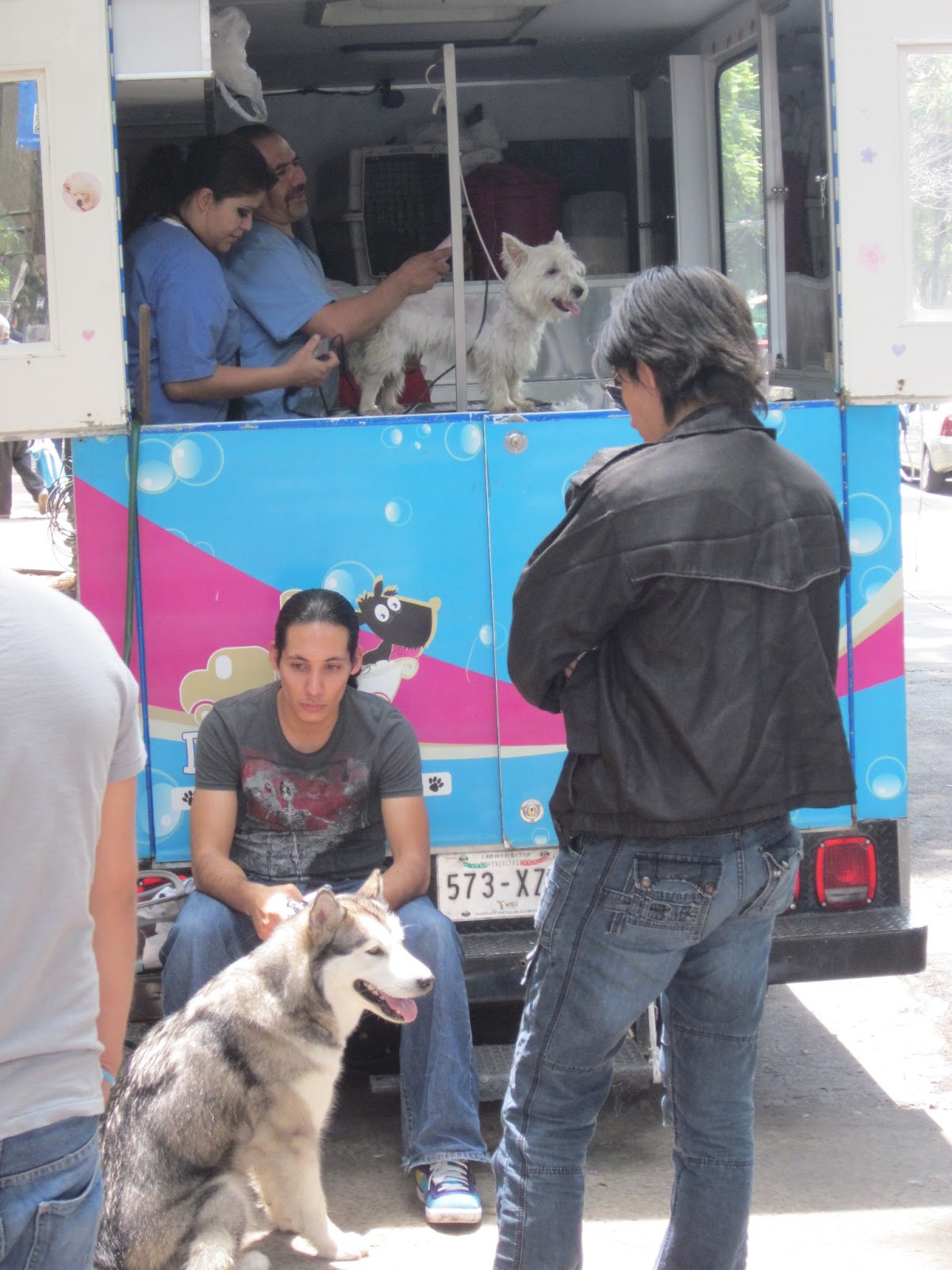
Strolling on, we chuckled to come upon a mobile dog-grooming wagon. Clearly popular, customers were lined up waiting for service.
 |
| Mobile Dog-Groomer |
I hope you're getting the message. Parque México is clearly
'the' destination for dog owners and their pets. But that's not all it is!
Paseo is a Spanish word that means promenade, especially in a public space like a park or plaza. During the colonial era, the
paseo was highly ritualized: young men walked in one direction around the plaza or park; young women, accompanied by their chaperons, walked in the opposite direction.
In Pátzcuaro, Michoacán, when a young woman agreed to walk with a young man, it was to one of the vendors of
nieve (ice cream) located at each corner of the Plaza Grande.
Nieve in hand, the young couple and her chaperon would find a park bench to sit and eat their
nieves, which gave the young couple an opportunity to chat privately...well, relatively privately.
It's not like that today. Today's activity in Parque México rivaled that of a Sunday afternoon in New York's Central Park. For starters, we were surprised to see some kind of New Age practitioner speaking intently to a woman lying back, eyes closed, in a canvas reclining chair. Above her, a sign proclaimed all kinds of practices ranging from a group listed as 'Prehispanic' to another group labeled 'New Age'.
A little farther along, we came upon a Reiki practitioner for dogs! But that's not all. Looking across the park, it was hard to see exactly what was going on, so Reed walked over and took a picture.
 |
Young man walking on a strap about three inches wide anchored around two trees. There were three or four straps at varying heights off the ground.
|
The most amazing stunt we saw was a young man bounce, then sit down on the strap before bouncing back up to a standing position. All kinds of people were engaged in trying to improve their skills.
Next to the tight-walking straps was a fitness area with several different types of heavy-duty workout apparatuses.
 |
| This girl's father was helping her on the heavy metal fitness equipment |
I don't want to give the impression that the park was nothing more than dogs (on and off leashes) and walkers. There were also cyclists of all shapes and sizes:
 |
| Cyclist's two dogs are harnessed together |
 |
| A somewhat hesitant, if determined, cyclist |
 |
Father carrying young son in a rebozo. From the expert way the rebozo has been tied, I assume mom had a hand in it.
|
 |
| Dad rests while his youngster rides his tricycle |
 |
| Another youngster enjoys a family outing on a rented pedal-cart! |
Then we came upon a very wet pooch. What on earth?
 |
| One thoroughly soaked puppy! |
 |
| A waterway runs through part of the park. |
We were fascinated by a large group of people on the bridge. What could they be gawking at? When we got closer, it became clear that dogs were swimming in the pool at one end of the waterway. Mystery solved.
 |
| This is the back end of the pool we saw from a distance. |
Residential Surroundings
At about this time, Reed's appetite alarm went off, so we headed out of the park in search of a cafe. It was easy to find one, because the streets that border the park are lined with cafes. As we strolled, we enjoyed the houses that front the park. A typical description of the
Condesa neighborhood reads,
"Fashionable and popular with younger business people, artists, students and intellectuals, it features a large number of international restaurants and nightclubs, despite the fact that it is mostly residential" (Wikipedia).
The architecture is a mixture of late nineteenth century houses and modern apartment buildings. In the nineteenth century, the Mexican elites were attracted to France and French culture. Mexico's Emperor Maximiliano (1864-1867), imposed by France's Napoleon III, introduced many architectural ideas drawn from the mid-century Parisian development plan of Baron Haussmann. During the years of dictatorship under Porfirio Díaz (1876-1910), these ideas were developed further in Mexico City, including in the La Condesa area.
 |
The design of this house derives from French nineteenth century architecture.
|
One of Mexico City's many charms is the juxtaposition of seemingly discordant elements that nonetheless seem to 'work'. Side by side with the traditional house is a modern house painted an intense, cerulean blue (photo below):
 |
Modern house with second floor atrium (green window frames) adjacent to traditional house on corner.
|
We finally made our way out of the park and chose a sidewalk cafe. Reed kept saying that La Condesa feels like Paris. I pushed back, arguing that it is far too lush to be Paris, but Reed persisted.
At the end of our meal, he smiled wryly and asked if I'd seen the mural behind me. I twisted around enough to see ... Toulouse-Lautrec:
 |
The object between the couple is a lamp shade actually inserted onto the mural.
|
When will I learn that Mexico is not only all it seems to be ... but much, much more?